

A sense of home and a sense of place
Louisiana leaders have not only been voicing the anger and frustration of their constituents over the oil spill in the Gulf of Mexico, but late last week they began to mourn the place they call home.
read more
Deepwater drilling going ahead despite eco disaster
The desperate ongoing operation to contain the Gulf of Mexico oil disaster is not deterring the Canadian government from “soliciting bids” for offshore drilling, according to press reports.
read more
The BP Deepwater Oil Spill - Why Top Kill May Have Failed and Monday Open Thread
Note: this is the same prose from last night’s post of 6p or so, just with a new comment thread this morning. Enjoy.
The Top Kill attempts have failed, and the Government has given its response.
He (President Obama) said US Energy Secretary Steven Chu was leading a team of “the world’s top scientists, engineers and experts” in devising a contingency plan should the “top kill” attempt fail.
But while waiting for that, and for the Lower Marine Riser Package (LMRP), I thought I would spend a few paragraphs discussing why Top Kill may have failed as a substitute for my tech talk tonight; you can find that under the fold by clicking “there’s more.”
(The last post has a very technical discussion of LMRP, check that out there and in the comments.)
In a couple of earlier posts I wrote about how it was necessary to fill the gaps that ran through the Blow-Out Preventer (BOP) either with spheres and triangles or with wire (string would act similarly). To refresh your memory, in the initial simpler analysis, I had put up a simple sketch of the BOP and well, to show how the blocking particles were injected.
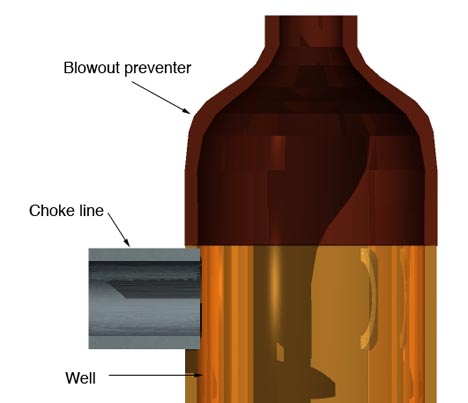
Simple approximation of the situation
Now, unfortunately that diagram left a significant part out, and that is that there are three sets of pipes leading down into the well. These are the well outer casing, which, surrounded by a layer of cement, holds the BOP in place. Then there is the production casing, which had just been set to the full depth of the well. And then there is the drill pipe that, at the time of the incident, extended down 8,367 ft from the platform, or roughly 3,367 ft below the BOP. That drill pipe (DP) had previously been used to locate the production casing at the bottom of the well, and itself now rode inside that production casing. In most normal operations it is closed at the bottom by a drill bit, but (and I’ll come back to this later), it had just finished the cementing of the production casing into position, and once it detached from that and was being pulled from the well, it was an open pipe all the way up to the rig floor. And in that condition, it could be used for other things. By pulling mud out of the DP and transferring it to the mud pits (or standoff vessel), the level in the riser would fall and be replaced by seawater flowing in at the top. Unfortunately this also lowered the weight of mud in the well, and that is what caused the oil and gas to flow into the well.
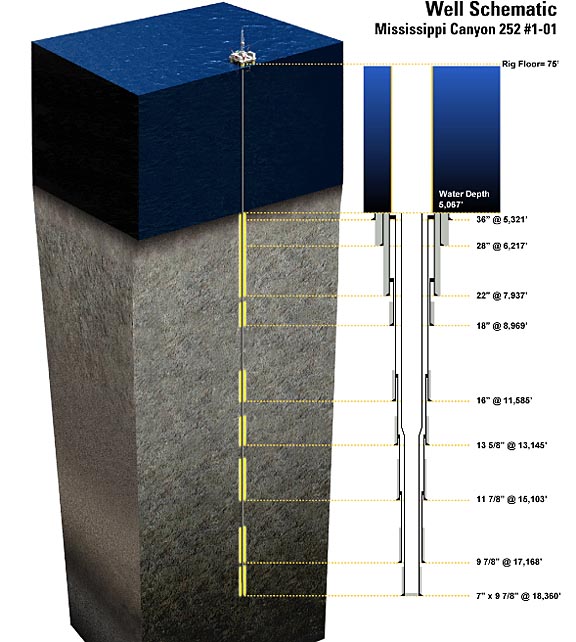
Outside of the DP is the casing and cement segments that make up the outer lining of the well. The diagram presented in Congressional testimony, shows these various pipes, except for the central drill pipe.
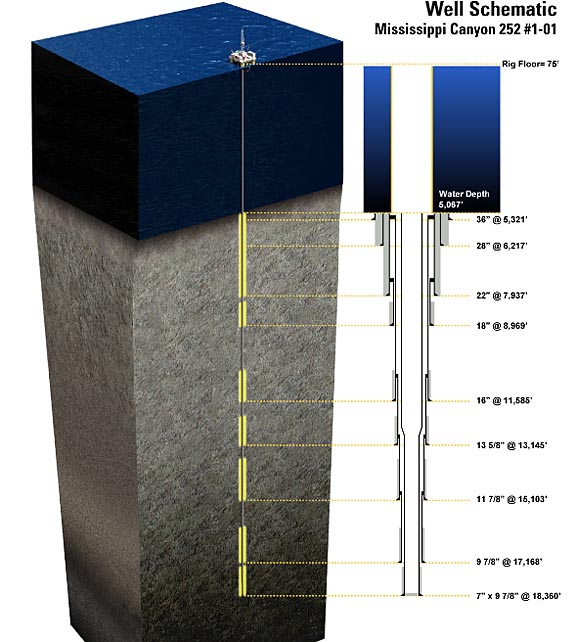
Casing and cement down the Deepwater well
BP do not know, but believe that the oil is getting into the well through the cement wall at the bottom of the well, and probably rising up the well through the empty space (annulus) between the production casing and the outer lining of the well. However the oil and gas may have broken through the bottom of the cement plug and be rising up within the production casing, in which it is also rising through the DP once the oil reaches its lower end. It could also reach the bottom of the DP by flowing up the annulus then go down the production casing to the bottom of the DP and then back up into the BOP.
Most normal blowouts occur when the well is being drilled, and mud is flowing down, through the drill bit, and then back up the space (the annulus) between the DP and the rock wall. Thus, when there is a blowout, the oil and gas that flow into the well normally flow up this outer passage to the rig, and give the spectacular fountain of oil. The BOP was invented (by Harry Cameron and Jim Abercrombie) to stop that flow and to protect the crew at the surface. Because the flow is normally up the outside of the drill pipe, the initial BOP designs were rams that pushed seals across the flow path through the BOP, and sealed against the side of the DP.
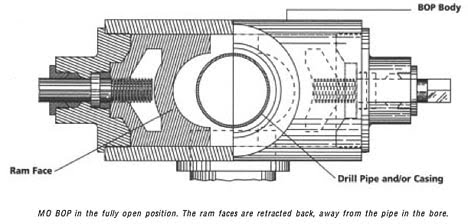
BOP open allowing flow through the annulus (ASME )
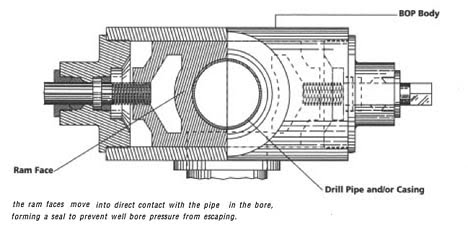
BOP closed against the pipe, sealing the annulus (ASME )
A BOP could have two of these mounted so that one sealed to the production casing in the well, and one to the drill pipe, but if underwater then the production casing is tied back to the Wellhead Collet Connector, and then the only tube running through the BOP will be the DP, to which they will seal.
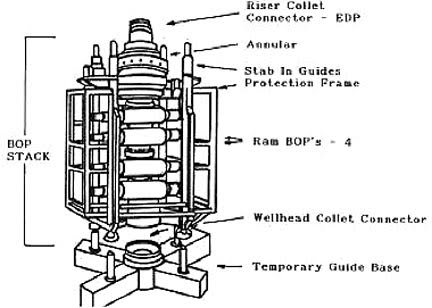
BOP connection to casing at the seabed (PCCI report for MMS)
The problem that this leaves, in the current situation, is that the pipe that runs through these two seals is open at the bottom to the oil flow. So how can the flow through this be stopped?
The answer is to mount a top ram set that has a set of shear cutting blades on it, that will cut through the pipe and seal the full face of the well.
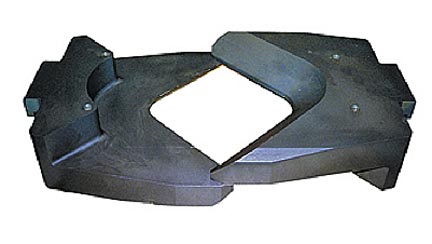
Shear blades to cut through the DP and seal the well (Varco )
The DP should shear, but would be held in place by the grip of the annular sealing rams below.
In this case it seems to be recognized that for some reason this shear event did not totally succeed. Thus the pipe was not totally severed and the two shear plates did not fully move over one another to complete the seal.
Now this is where the problem arises, because, in part, that pipe is still open at its lower end. If the leak is around the outside of the pipe, through a gap that has generated between the pipe and the annular seals, then the use of the junk shot to fill the cracks and gaps could conventionally have worked. But the configuration of the rams on the Deepwater Horizon had changed from the initial simpler configuration to add seals for occasions where the drill pipe was not in place.
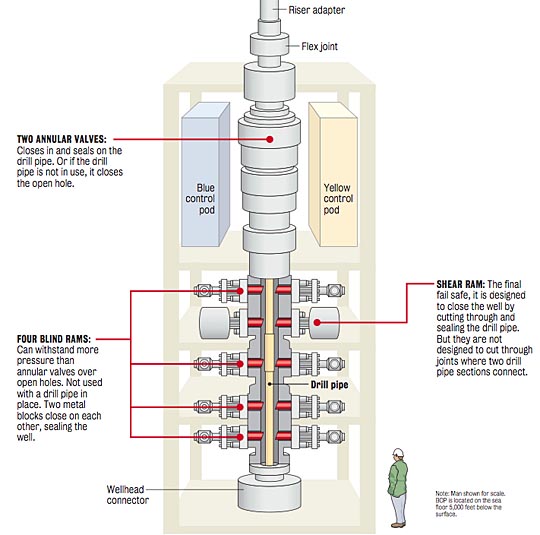
Ram layout on the BOP (Times Picayune)
And the “junk” is being injected at the bottom of this stack.
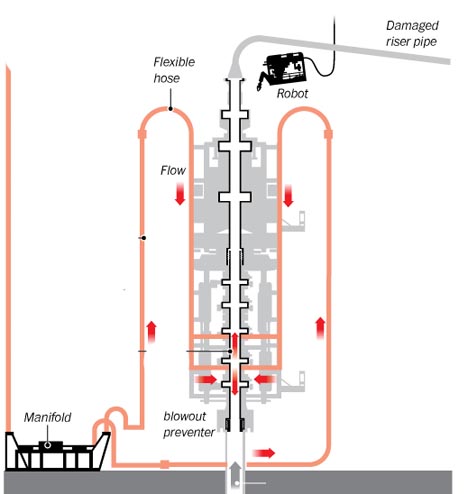
Section through the BOP, showing the anticipated mud flow path (initially from BP)
If the leak is coming up through the remnants of the drill pipe then life is complicated. It can’t all be coming up through an undamaged pipe alone, since it was the far open end of that which was successfully closed at the beginning of the remedial steps, but if it is coming through the pipe and leaking out at the shear rams into the annulus that feeds into the riser, and out to the sea, then putting sealing particles into the bottom of the BOP to seal the cracks could have sealed some of the leakage around the DP trapped in the shears, but not that flowing through the shears in the remaining pipe section.
The reason that it can’t is that the access to that flow is occurring 3,367 ft below the riser, and there is no easy way to get the sealing particles down that far. If they are mixed with mud and pushed down the well to that level and then released they have a different problem. The hope when they were released into the well was that the flow of the current would be enough to carry them up to the cracks that they could seal. But if they have to be carried down to the zone where the oil remains, then their density may be sufficiently high that they get into the flow without enough speed to lift them up into the BOP, instead it will cause them to sink to the bottom of the well.
The materials that BP tried included materials that might float on the surface, and might not be dense enough.
Those materials, including fibrous pieces of rope and chunks of rubber, were supposed to force more of the mud down the wellbore, but ultimately it did not work.
Rubber has a specific gravity of 0.91 and rope varies from 0.9 to 1.4. But remember that at that depth any buoyancy from air entrainment would be lost.
In other circumstances it might have worked, If they could have dropped the DP out of the shears perhaps, but they couldn’t and it didn’t. So on to the LMRP.
UPDATE: Thinking about this a little more, I had two more thoughts. The first is that once the LMRP preparation cuts off the riser and the bent drill pipe, then the full weight of the pipe below the shears may come onto the section in the shear jaws at the moment, pulling them further out of alignment and increasing the flows. It could also cause the pipe to drop out of the jaws, pulled out by the underlying weight, and hopefully not distorting them too much so that in the best of worlds they could then be cranked shut.
One could also, once the bent riser and pipe had been cut, go in down the pipe bit that extends up, go down past the annular seals with an abrasive jet lance (most of the flow is around the DP as we have established above) and cut it off, right above the shears. Then partially open the shears, drop the pipe out, and close them again. If they move all the way closed, without the obstruction, then the well may be sealed.

Drumbeat: May 31, 2023
BP Shifts Gears in Gulf Oil Fight as ‘Top Kill’ Fails
In such a scenario, “there could be oil coming up until August when the relief wells…are finished,” Carol Browner, special assistant to the president for energy and climate change, told NBC’s “Meet The Press.”
Appearing on CBS’s “Face the Nation,” Ms. Browner added that government experts believe BP’s containment operation could result in a temporary 20% increase in the volume of oil spilling from the well. That’s because the company will cut off a kink in the pipe that currently seems to be holding back some of the gusher, Ms. Browner said. She added that government experts believe the increase could last four to seven days.
“Once the cap is on, the question is how snug is that fit?” Ms. Browner said. “If it’s a snug fit, then there could be very, very little oil. If they’re not able to get as snug a fit, then there could be more.”
Factbox: Gulf oil spill impacts fisheries, wildlife, tourism
Tourism operators in Louisiana, Mississippi and Alabama — from hotel owners to restaurateurs and boat charterers — have reported cancellations as a result of the oil spill, although some are picking up other business from journalists, officials and cleanup workers who have flocked to the Gulf Coast.
Amidst a scare involving tar balls found on Florida Keys beaches — later declared not to have come from the BP oil spill, Florida’s $60-billion-a-year tourism industry is also losing millions as a result of the incident, a top state tourism marketing official said earlier this month.
Regulators let oil industry write rules
Our economy went in the ditch while traders got rich peddling CDOs and DSs. Even many bankers — much less average Americans who lost their shirts — were gobsmacked by the acronyms, and scrambled to figure out how collateralized debt obligations and credit default swaps worked.
And now a gazillion gallons of oil have poisoned the Gulf of Mexico, thanks in part to unethical employees at a once-obscure agency known as MMS — the Interior Department’s Minerals Management Service. MMS is charged with collecting royalties from Big Oil even as it regulates it — an absurd conflict right there. So MMS has had the same sort of conflicts of interest as ratings agencies like Moody’s and Standard & Poor’s had with Wall Street.
Salazar: Oil Moratorium In Gulf Won’t Affect Oil Production Wells
Interior Department Secretary Ken Salazar said Thursday a moratorium in place for 33 rigs in the Gulf only applies to exploratory, deepwater wells in 500 feet of water or more, not those that currently are producing oil.
After fix fail, a dispiriting summer of oil, anger
BOOTHVILLE, La. (AP) — There is still a hole in the Earth, crude oil is still spewing from it and there is still, excruciatingly, no end in sight. After trying and trying again, one of the world’s largest corporations, backed and pushed by the world’s most powerful government, can’t stop the runaway gusher.
As desperation grows and ecological misery spreads, the operative word on the ground now is, incredibly, August - the earliest moment that a real resolution could be at hand. And even then, there’s no guarantee of success. For the United States and the people of its beleaguered Gulf Coast, a dispiriting summer of oil and anger lies dead ahead.
Oh … and the Atlantic hurricane season begins Tuesday.
Fury and despair as BP admits oil could leak for months
An uncontrollable fountain of oil could gush into the Gulf of Mexico until August, the Obama administration warned today, as BP conceded it was moving to a containment strategy after failing to plug the well at the centre of the most environmentally disastrous spill in US history.
As anger and despair grew in the coastal communities of Louisiana, BP began preparations to cut a leaking drill pipe on the ocean floor and attach a containment cap intended to capture at least some of the 12,000 to 19,000 barrels of crude spewing from its Macondo well every day.
BP facing multimillion-dollar legal claim from British pension fund
The Gulf of Mexico oil spill, which could see BP face hundreds of lawsuits, is giving new impetus to a highly damaging legal case stemming from a previous environmental disaster in Alaska.
A UK pension fund alleges that it lost money because of falls in the BP share price after a pipeline leak in the Prudhoe Bay field four years ago. Lawyers for the fund say the latest spill is providing further ammunition for its case.
“It is too soon to tell exactly what went wrong in the gulf, but what is clear is that they [the accidents] both reflect a corporate culture and series of operating procedures that need to be reformed,” said Thomas Dubbs, a partner at New York law firm Labaton Sucharow, which is handling the case against BP for the Lothian pension fund, claiming tens of millions of dollars. The fund, an investor in BP, looks after the retirement benefits of 67,000 workers employed by councils in Edinburgh and the Midlothian area, and also by the local bus company.
BP CEO disputes claims of underwater oil plumes
During a tour of a BP PLC staging area for cleanup workers, CEO Tony Hayward said the company’s sampling showed “no evidence” that oil was suspended in large masses beneath the surface. He didn’t elaborate on how the testing was done.
Hayward said that oil’s natural tendency is to rise to the surface, and any oil found underwater was in the process of working its way up.
“The oil is on the surface,” Hayward said. “There aren’t any plumes.”
BP’s behavior in the Gulf is appalling. But our thirst for oil is the real issue
Casting BP executives as cardboard cut-out villains does not get us very far though. Whatever the courts may find about BP’s culpability the real cause is our demand for oil and our refusal to pay its true price. Right now, everyone in America wants to do something to fight the spill. However, if you suggest that perhaps we should double the price of fuel and use the revenue to rebuild our transportation network, the general response is suspicious silence.
BP unsure how much oil in reservoir in Gulf spill
COVINGTON, La. (AP) — BP spokesman John Curry says the company does not know how much oil is contained the vast reservoir nearly three miles beneath the seafloor.
Curry said Sunday that the company didn’t have time to properly analyze how much was in the discovery well. He says if the oil rig had not exploded, BP PLC ultimately would have drilled another well to complete that analysis.
Reforms slow to arrive at drilling agency
Mr. Obama, shortly after taking office, had assigned Interior Secretary Ken Salazar to clean up the agency, the Minerals Management Service. The office’s history of corruption and coziness with the industry it was supposed to regulate had been the subject of years of scathing reports by government auditors, lurid headlines and a score of Congressional hearings.
But the promised reforms of the agency were slow to arrive, and the subject of the minerals service never came up at the meetings leading to the new drilling policy, according to a senior administration official involved in the discussions.
Political expediency may have played a role. In pushing offshore drilling, Mr. Obama was hoping to placate the oil industry and its supporters in Congress, who were demanding increased access to the outer continental shelf in exchange for their possible support for broader climate change and energy legislation that Mr. Obama wants.
That focus apparently eclipsed any concerns about the minerals agency, especially since at the time no oil rig had exploded and sent hundreds of thousands of barrels of oil into the gulf.
Oil prices steadied after upwards drive
Oil prices steadied on Friday after an upwards drive was reversed by renewed concerns about the health of Europe’s economy.
Most metals prices fell as the US dollar gained strength against other currencies.
Radioactive fish near Vt. nuke plant deemed common
MONTPELIER, Vt. — When a fish taken from the Connecticut River recently tested positive for radioactive strontium-90, suspicion focused on the nearby Vermont Yankee nuclear plant as the likely source.
Operators of the troubled 38-year-old nuclear plant on the banks of the river, where work is under way to clean up leaking radioactive tritium, revealed this month that it also found soil contaminated with strontium-90, an isotope linked to bone cancer and leukemia.
Three days later, officials said a fish caught four miles upstream from the reactor in February had tested positive for strontium-90 in its bones. State officials say they don’t believe the contamination came from Vermont Yankee.
Tritium was reported leaking from the plant in January, and since then has turned up in monitoring wells at levels 100 times the federal Environmental Protection Agency’s safety limit for that substance in drinking water. Other radioactive isotopes have been found as well, including cesium-137, zinc-65 and cobalt-60.
Presence of world leaders ‘paralysed’ climate summit, UN letter claims
A leaked letter from the United Nations’ climate chief suggests the Copenhagen climate summit failed because the presence of 130 world leaders paralysed decision-making and the Danish presidency backed the US and other western nations over the interests of the poor.
Pedal or throttle? The lure of the electric bike
We might not have been fast but we’ve made it – over the past couple of weeks myself and two colleagues have been testing out three examples of that curious half-way point between the bicycle and the moped. You can hear more about the experience in the next Bike Podcast, out on Tuesday.
Below are some details about the three models, but firstly an observation as someone who had never previously tried out an electric bike: they really are great fun.
Why Wal-Mart wants to take the driver’s seat
The retailer aims to take over U.S. transportation services from suppliers in an effort to reduce the cost of hauling goods. Wal-Mart is contacting all manufacturers that provide products to its more than 4,000 U.S. stores and Sam’s Club membership warehouse clubs, says Kelly Abney, Wal-Mart’s vice-president of corporate transportation.
Manufacturers would compensate Wal-Mart by giving the retailer lower wholesale prices for the goods it transports. Wal-Mart isn’t saying how much it hopes to save. However, in a slim-margin business such as retailing, even small efficiencies can help the bottom line; in 2009, Wal-Mart trimmed expenses by almost $200 million by packing and scheduling its U.S. truck fleet more efficiently, according to spokesman Lorenzo Lopez.
The new Nissan Leaf electric car sold out
Automaker Nissan reports that more than 19,000 of the new Leaf electric cars have been ordered in the U.S. and Japan. The car is not scheduled to arrive at dealerships until January 2011, and that model year is already sold out. CEO Carlos Ghosn has not yet decided if the automaker will continue to take preorders for the electric auto. The advance orders include 13,000 in the U.S. and 6,000 buyers in Japan. Most of the U.S. orders are in California, where charging stations are being installed.
After speaking to the Detroit Economic Club, CEO Ghosn said that the company is very happy with the level of advance orders. The cars are priced at $32,780 with buyers receiving a federal tax credit of $7,500.
California: ruined by the supermajority
You don’t need to know anything about electricity to understand what’s wrong with Proposition 16, the initiative sponsored by the parent company of the Northern California utility PG&E, on the June 8 ballot. You only need to know California’s tortured history with supermajorities.
Proposition 16 would establish a new supermajority requirement in the state Constitution by mandating that local governments get approval from two-thirds of their voters before starting or expanding a public power agency.
Vermont family farms face a grim future
The Vermont Agency of Agriculture last month delivered a worst-case scenario that envisioned 200 farms — 20 percent of the state’s total — closing down this year, primarily because of volatile milk prices and debts accrued during a devastating 2009.
Last year, prices fell from $18 a hundredweight to $12 a hundredweight for conventional milk, forcing farmers to sell milk at a loss. A hundredweight, the unit by which milk most commonly is measured, is 11.6 gallons. The cost of production for a Vermont dairy farm regularly is estimated at $17 to $18 per hundredweight.
Rail transit ideas await their fate in Milwaukee
After years of study and debate, the state has landed an $810 million federal grant to build a high-speed train line from Milwaukee to Madison. At the same time, Milwaukee-area authorities are seeking federal permission to start preliminary engineering on a $283.5 million commuter rail line from Milwaukee to Kenosha and a $95.8 million modern streetcar line in downtown Milwaukee, two other long-discussed ideas.
Mile by mile, landmark Bay Area Ridge Trail comes together
The plan is ambitious: a 550-mile-long trail for hikers, horse riders and bicyclists, complete with campsites, scenic vistas, mountain ranges and forests.
It’s still unknown to many of the Bay Area’s 7 million residents.
But the Bay Area Ridge Trail, begun as a far-off dream by a few parks lovers more than 20 years ago, is slowly taking shape.
We Are Oil Responsible; Can We Get Serious About Kicking the Habit?
Make no mistake:BP stinks. Their Gulf accident and safety violation record, their lack of transparency, their short-term profit focus are all sickening. But ultimately, BP is only truly responsible for this spill if you believe that drilling for oil in a mile of water can ever be done safely. BP is part of a system that has made us all dependent on oil and petroleum-based products, and with our consumption spurring demand, we must all shoulder some of the blame for the calamity in the Gulf of Mexico and beyond.
It’s not just about the gas for driving cars. Oil is everywhere, trickling throughout our consumer-driven society. Denture adhesives, electric blankets, bras and bubble gum…they all contain oil. Cameras, carpets, umbrellas, vitamin capsules…ditto. Perhaps we are finally waking up to realize that what once seemed so cheap and plentiful is actually very, very expensive-and becoming more so.
U.S. natural gas production reaches highest level in 30 years
U.S. natural gas production in March rose to the highest level in at least 30 years, led by gains in Texas and Alaska, the Energy Department reported Friday.
Production increased 1.3 percent to an average 74.64 billion cubic feet a day, according to the report. Texas, the nation’s largest gas producer, was up 2 percent to 20.71 billion cubic feet a day, while Alaskan gas production rose 1.2 percent to 9.97 billion cubic feet a day.
“We’ve had production and rig numbers increasing all while prices are decreasing, and that makes no sense,” said Michael Rose, director of trading at Angus Jackson Inc. in Fort Lauderdale, Fla. “I think they have to reduce the rig count and production.”
Natural gas for July delivery advanced 4.7 cents, or 1.1 percent, to settle at $4.341 per million British thermal units. Prices have fallen 22 percent this year.
Shale’s a curse and blessing for natural gas
A supply surplus has made natural gas a cheap source of energy, and its growing production from so-called “unconventional” sources such as shale may be destined to keep it that way.
“Natural gas is at a historically cheap price, assuming we’re just looking at the last ten years, but one major issue not affecting other energy markets is driving the price lower and lower,” said Neal Ryan, managing partner at Ryan Oil & Gas Partners LLC.
Driven by the nation’s growing need for energy and high natural-gas prices in recent years, interest in gas derived from shale, a geologic formation, has increased despite the high costs involved with developing the sources.
The BP Deepwater Oil Spill - Why Top Kill May Have Failed and Tonight’s Open Thread
The Top Kill attempts have failed, and the Government has given its response.
He (President Obama) said US Energy Secretary Steven Chu was leading a team of “the world’s top scientists, engineers and experts” in devising a contingency plan should the “top kill” attempt fail.
But while waiting for that, and for the Lower Marine Riser Package (LMRP), I thought I would spend a few paragraphs discussing why Top Kill may have failed as a substitute for my tech talk tonight; you can find that under the fold by clicking “there’s more.”
(The last post has a very technical discussion of LMRP, check that out there and in the comments.)
In a couple of earlier posts I wrote about how it was necessary to fill the gaps that ran through the Blow-Out Preventer (BOP) either with spheres and triangles or with wire (string would act similarly). To refresh your memory, in the initial simpler analysis, I had put up a simple sketch of the BOP and well, to show how the blocking particles were injected.
Simple approximation of the situation
Now, unfortunately that diagram left a significant part out, and that is that there are three sets of pipes leading down into the well. These are the well outer casing, which, surrounded by a layer of cement, holds the BOP in place. Then there is the production casing, which had just been set to the full depth of the well. And then there is the drill pipe that, at the time of the incident, extended down 8,367 ft from the platform, or roughly 3,367 ft below the BOP. That drill pipe (DP) had previously been used to locate the production casing at the bottom of the well, and itself now rode inside that production casing. In most normal operations it is closed at the bottom by a drill bit, but (and I’ll come back to this later), it had just finished the cementing of the production casing into position, and once it detached from that and was being pulled from the well, it was an open pipe all the way up to the rig floor. And in that condition, it could be used for other things. By pulling mud out of the DP and transferring it to the mud pits (or standoff vessel), the level in the riser would fall and be replaced by seawater flowing in at the top. Unfortunately this also lowered the weight of mud in the well, and that is what caused the oil and gas to flow into the well.
Outside of the DP is the casing and cement segments that make up the outer lining of the well. The diagram presented in Congressional testimony, shows these various pipes, except for the central drill pipe.
Casing and cement down the Deepwater well
BP do not know, but believe that the oil is getting into the well through the cement wall at the bottom of the well, and probably rising up the well through the empty space (annulus) between the production casing and the outer lining of the well. However the oil and gas may have broken through the bottom of the cement plug and be rising up within the production casing, in which it is also rising through the DP once the oil reaches its lower end. It could also reach the bottom of the DP by flowing up the annulus then go down the production casing to the bottom of the DP and then back up into the BOP.
Most normal blowouts occur when the well is being drilled, and mud is flowing down, through the drill bit, and then back up the space (the annulus) between the DP and the rock wall. Thus, when there is a blowout, the oil and gas that flow into the well normally flow up this outer passage to the rig, and give the spectacular fountain of oil. The BOP was invented (by Harry Cameron and Jim Abercrombie) to stop that flow and to protect the crew at the surface. Because the flow is normally up the outside of the drill pipe, the initial BOP designs were rams that pushed seals across the flow path through the BOP, and sealed against the side of the DP.
BOP open allowing flow through the annulus (ASME )
BOP closed against the pipe, sealing the annulus (ASME )
A BOP could have two of these mounted so that one sealed to the production casing in the well, and one to the drill pipe, but if underwater then the production casing is tied back to the Wellhead Collet Connector, and then the only tube running through the BOP will be the DP, to which they will seal.
BOP connection to casing at the seabed (PCCI report for MMS)
The problem that this leaves, in the current situation, is that the pipe that runs through these two seals is open at the bottom to the oil flow. So how can the flow through this be stopped?
The answer is to mount a top ram set that has a set of shear cutting blades on it, that will cut through the pipe and seal the full face of the well.
Shear blades to cut through the DP and seal the well (Varco )
The DP should shear, but would be held in place by the grip of the annular sealing rams below.
In this case it seems to be recognized that for some reason this shear event did not totally succeed. Thus the pipe was not totally severed and the two shear plates did not fully move over one another to complete the seal.
Now this is where the problem arises, because, in part, that pipe is still open at its lower end. If the leak is around the outside of the pipe, through a gap that has generated between the pipe and the annular seals, then the use of the junk shot to fill the cracks and gaps could conventionally have worked. But the configuration of the rams on the Deepwater Horizon had changed from the initial simpler configuration to add seals for occasions where the drill pipe was not in place.
Ram layout on the BOP (Times Picayune)
And the “junk” is being injected at the bottom of this stack.
Section through the BOP, showing the anticipated mud flow path (initially from BP)
If the leak is coming up through the remnants of the drill pipe then life is complicated. It can’t all be coming up through an undamaged pipe alone, since it was the far open end of that which was successfully closed at the beginning of the remedial steps, but if it is coming through the pipe and leaking out at the shear rams into the annulus that feeds into the riser, and out to the sea, then putting sealing particles into the bottom of the BOP to seal the cracks could have sealed some of the leakage around the DP trapped in the shears, but not that flowing through the shears in the remaining pipe section.
The reason that it can’t is that the access to that flow is occurring 3,367 ft below the riser, and there is no easy way to get the sealing particles down that far. If they are mixed with mud and pushed down the well to that level and then released they have a different problem. The hope when they were released into the well was that the flow of the current would be enough to carry them up to the cracks that they could seal. But if they have to be carried down to the zone where the oil remains, then their density may be sufficiently high that they get into the flow without enough speed to lift them up into the BOP, instead it will cause them to sink to the bottom of the well.
The materials that BP tried included materials that might float on the surface, and might not be dense enough.
Those materials, including fibrous pieces of rope and chunks of rubber, were supposed to force more of the mud down the wellbore, but ultimately it did not work.
Rubber has a specific gravity of 0.91 and rope varies from 0.9 to 1.4. But remember that at that depth any buoyancy from air entrainment would be lost.
In other circumstances it might have worked, If they could have dropped the DP out of the shears perhaps, but they couldn’t and it didn’t. So on to the LMRP.
UPDATE: Thinking about this a little more, I had two more thoughts. The first is that once the LMRP preparation cuts off the riser and the bent drill pipe, then the full weight of the pipe below the shears may come onto the section in the shear jaws at the moment, pulling them further out of alignment and increasing the flows. It could also cause the pipe to drop out of the jaws, pulled out by the underlying weight, and hopefully not distorting them too much so that in the best of worlds they could then be cranked shut.
One could also, once the bent riser and pipe had been cut, go in down the pipe bit that extends up, go down past the annular seals with an abrasive jet lance (most of the flow is around the DP as we have established above) and cut it off, right above the shears. Then partially open the shears, drop the pipe out, and close them again. If they move all the way closed, without the obstruction, then the well may be sealed.
Stocks: New month, same malaise
May 31, 2023 by admin
Filed under Stock Market
Investors return from a long holiday weekend having bid adieu to the Dow’s worst May since 1940. But the issues that caused the collapse haven’t gone anywhere.
Oil Prices Look Well-Capped
May 30, 2023 by admin
Filed under Commodities News
Europe’s woes and surplus supply threaten.
Oil Prices Look Well-Capped
May 30, 2023 by admin
Filed under Commodities News
Europe’s woes and surplus supply threaten.
Three Chinese curses
I’m writing a book about the dire nature of our predicaments and I mention the high likelihood of a global economic collapse within a decade or so. The naturalist doesn’t bat an eye before responding: “I hope I’m around to see it. I don’t want my son to have all the fun.”
read more
Three Chinese curses
I’m writing a book about the dire nature of our predicaments and I mention the high likelihood of a global economic collapse within a decade or so. The naturalist doesn’t bat an eye before responding: “I hope I’m around to see it. I don’t want my son to have all the fun.”
read more