

Fewer Beans to Count
November 30, 2022 by admin
Filed under Commodities News
Dwindling coffee supply will someday lift prices.
Prices & supplies - Nov 29
The return of high oil
Roubini sees oil falling further 20%, hurting Russia
UK’s Michael Meacher: Crude mathematics
The truth behind low oil prices
read more
Low Temperature Geothermal Power
The ABC recently had a report on plans to power north-west Queensland with low temperature geothermal power using hot water from the Great Artesian Basin.
A Brisbane-based company says it could supply geothermal power to all of north-west Queensland. Clean Energy Australasia wants to build a $50 million geothermal power station near Longreach. But it has now also revealed plans to build a pilot geothermal project near BHP’s Cannington mine at McKinlay, south of Cloncurry. The company’s Joe Reichman says the Mount Isa region needs about 500 megawatts of power a year and geothermal resources could easily provide that. “It’ll change the region into a powerhouse,” he said. Mr Reichman says the company has applied for federal and state government grants and has support from the major mining companies in the region. If the projects proceed they would be the first geothermal power plants in Australia.
Low temperature geothermal power is a relatively new (and very low profile) form of extracting energy from geothermal sources that provides yet another option for meeting our energy needs cleanly and sustainably.
[break]
Low Temperature Geothermal Power
When geothermal power is mentioned, people usually think of traditional high temperature geothermal power stations using water from volcanic areas, such as those found in Iceland, New Zealand, the US and elsewhere around the ring of fire.
More recently, interest in enhanced / engineered geothermal systems (EGS) - also known as hot dry rock (HDR) or hot fractured rock (HFR) geothermal power - has been high, with a number of experimental projects underway in Australia and Europe.
Low temperature geothermal power is also starting to attract significant interest, as lower temperature water resources are common in many countries (for example, waste hot water produced by oil and gas wells - in Texas alone, more than 12 billon barrels are produced, with oil companies usually re-injecting the waste water into the earth) and new technologies are beginning to appear that allow these resources to be developed commercially.
UTC Power has developed a low-cost Rankine cycle system that can convert temperatures as low as 195 °F (91 °C) into electricity. The technology is similar to a steam engine, with steam or hot water vaporizes a hydrofluorocarbon refrigerant that drives the turbine (it has been compared to a “refrigerator compressor running backwards”).
Geothermal Power In The Great Artesian Basin
The Great Artesian Basin provides the only reliable source of water through much of inland Australia. The basin is the largest and deepest artesian basin in the world, covering a total of 1,711,000 square km. It underlies 23% of the continent, including most of Queensland, the south-east corner of the Northern Territory, the north-east part of South Australia, and northern New South Wales. The basin is 3000 metres (10,000 ft) deep in places and is estimated to contain 64,900 cubic kilometres of groundwater.
Most recharge water enters the rock formations from relatively high ground near the eastern edge of the basin (in Queensland and New South Wales) and very gradually flows towards the south and west. Because the sandstones are permeable, water gradually makes its way through the pores between the sand grains, flowing at a rate of one to five metres per year. Discharge water eventually exits through a number of springs and seeps, mostly in the southern part of the basin. It takes up to two million years for water to travel to the springs in the Lake Eyre area.
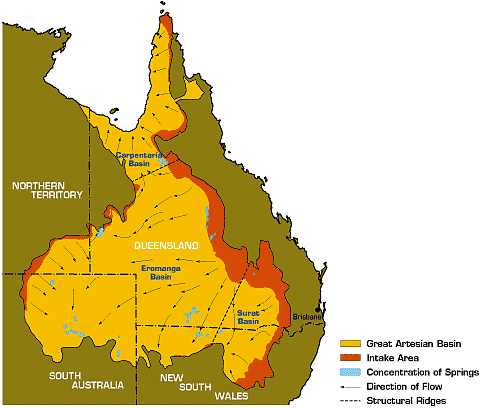
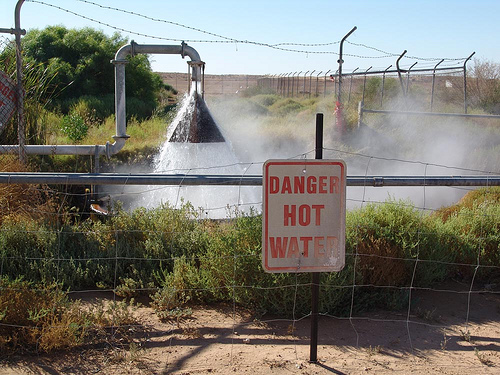
Temperatures of the artesian groundwater (which is generally of a very good quality) range from 30o to 100o C at the well heads. As the groundwater is too hot for town water supply and for stock to drink, it needs to be cooled down before consumption. That is why cooling towers can be seen throughout the region.
The ABC report’s claim that the Longreach plant would be Australia’s first geothermal power plant is incorrect.
A small (120 kW) power station (pdf) has been in operation at Birdsville in western Queensland since the early 1990′s - one of the few low-temperature geothermal power stations in the world. The plant derives its energy from the near-boiling (98 degrees C) water taken from the Great Artesian Basin (at a depth of 1230m) that provides a water supply for the town. Operation of this geothermal power station reduced the town’s diesel consumption by about 160,000 litres per year.
The Victorian town of Portland (in the Otway Basin) also operated a district heating scheme using water from geothermal sources for about 20 years, though this did not generate power.
Geothermal Power In The United States
The UTC plant has been trialled at the Chena Hot Springs in Alaska, with the first plant going online in July 2006. A second unit began operating later that year. Together, the two power units are contributing to the resort owner’s goal of making Chena the first totally renewably powered and fueled community in the United States. The Chena experience is motivating other cities in Alaska, including Anchorage to investigate setting up larger scale geothermal plants.
UTC installed more production systems at another location in New Mexico in August this year.
Utah company Raser Technologies is looking to build a range of geothermal power plants throughout the western United States using Rankine cycle systems, with their first plant going live in Utah earlier this month.
Some oil fields also produce hot water which can be used to drive Rankine cycle power plants, with trials being performed in Wyoming.
Geothermal Power In Germany
Germany is interested in deriving significant amounts of energy from both EGS / HFR and low temperature geothermal sources. There are already four small geothermal power plants successfully operating in Germany, albeit supplying only a tiny amount of electricity.
The first geothermal plant to start operating in Germany is situated in Neustadt-Glewe in the north-eastern part of the country. The 230-kW combined electricity and heat power plant started up in 2003 and extracts water with a temperature of 97 °C from a well 2250 meters under the ground. It supplies 1,300 households with heat and a further 500 households with electricity.
Other plants now operating are the 3.5-MW plant at Unterhaching close to Munich, in Bavaria which is the first geothermal plant in Germany to use Kalina cycle technology. At that plant water is extracted at a temperature of 122 °C from a well 3,500 meters deep. Another 2.5-MW plant in Landau taps water of 150°C that is located 3,000 meters beneath the ground. Another 550-kW plant is due to go into operation in Bruchsal shortly, extracting water at temperatures of 128°C from a well 2500 meters deep.
More plants (as big as 8-10 MW) are due to go into operation in 2009-2010 in Sauerlach, Dürrnhaar, Riedstadt, Speyer, Gross Schoenebeck and Mauerstetten. By 2015 there could be more than a hundred plants operating - around 150 geothermal power plant projects are in the pipeline according to the German government. One major constraint on expanding the program has been shortages of drilling equipment.
Geothermal Power In New Zealand
While New Zealand already generates a significant portion of its power using traditional geothermal sources, the country is also conducting a NZ$2.6 million research program into low temperature geothermal power.
Conclusion
Low temperature geothermal power has the advantage of being clean, continuously available energy that can be generated in a wide variety of locations.
Plants will likely to continue to be relatively small-scale, making it a classic distributed energy generation alternative (like biogas and solar PV), with growth probably remaining low profile for some time.
In the long run, I expect we’ll see a useful and significant amount of our energy needs being produced using this technology.
Cross posted from Our Clean Energy Future.






DrumBeat: November 29, 2022
OPEC freezes crude output quota
CAIRO (AFP) – OPEC decided on Saturday to leave its oil output quota unchanged and vowed to take any action necessary to balance the market next month, the cartel’s president said after a consultative meet in Cairo.
“Ministers agreed to take any additional action on December 17th (in Oran, Algeria) to balance oil supply and demand and achieve market stability,” said Chakib Khelil, who is also Algeria’s energy minister.
The widely expected decision comes as oil prices are trading at lows not seen in nearly four years, sparking alarm among the cartel’s members about plunging revenues.
[break]
OPEC warns stocks could hit 59 days without action
CAIRO (Reuters) - Commercial oil inventories held among industrialised nations of the OECD could hit 59 days by the end of 2009 if OPEC doesn’t take further action on supply, OPEC President Chakib Khelil said on Saturday.
Days of forward OECD inventory cover is a key measure for OPEC in assessing the oil market’s supply and demand balance.
Steve LeVine: The Return of High Oil
So, with prices having gone strongly down, as Morse forecast, I made a phone call to the report’s lead author – Jan-Hein Jesse, whom I met last year at an OPEC meeting in Vienna – and asked whether he thinks his thesis still holds. I.E., is another price spike coming down the road?
The answer, Jesse replied, is probably yes. The ‘probably’ covers the event that we are headed into a long, deep depression, in which case all such previously composed economic analyses are off the table, and one must reassess the facts afresh.
But if in the next two or three years we come out of recession in fair economic shape, look for another steep rise in oil and gasoline prices.
Qatar says oil price too low for investments
(AFP)
CAIRO - Qatar Energy Minister Abdullah al-Attiyah said on Saturday that current crude prices were too low to sustain investments in the oil industry to meet a future rise in demand.
“We can all live with 70 dollars,” Attiyah said. “With this price, we can invest in upstream projects, but below that it will be very difficult” to boost output capacity.
“Projects could be postponed and maybe we will see a shortage in production” when demand picks up, he added ahead of a meeting of OPEC ministers in Cairo on Saturday to review a sharp drop in the price of oil.
Minister: Iran proposes gas transfer to Kuwait
TEHRAN (Xinhua) — Iran’s Oil Minister Gholam-Hossein Nozari said his country had proposed to transfer 500,000 cubic feet of gas per day to Kuwait, the semi-official Fars news agency reported Saturday.
Survivalism: For peak oilers and ecotopians too?
As a peak oiler myself since 2002, I have often wondered why most of the prominent peak oil authors and activists dismiss the survivalist movement.
It seems that many of the peak oil heavyweights, including Richard Heinberg and Dmitry Orlov, in particular, despite their own ingenious contributions to analyzing our current predicament, seem to blithely dismiss survivalism. They apparently do not understand the basic technical constructs of survivalism, such as the military skill sets, weapons, and organization that go into survivalism. They also do not seem to understand the technical aspects of long-term food storage (i.e. oxygen absorbers, desiccants, dry ice, etc.), or the emphasis that survivalism also places on organic gardening and food preservation.
ZIMBABWE: Soldiers riot over cash shortage
HARARE (IRIN) - Uniformed Zimbabwean soldiers raided one of the capital’s money-changing haunts after becoming frustrated with queuing to withdraw cash at a Harare bank, according to an IRIN correspondent who witnessed the event.
The soldiers descended on foreign currency dealers in “Roadport” in central Harare on 27 November, where they assaulted money dealers and robbed them, an indication of the low morale among Zimbabwe’s rank and file soldiers.
…The cash shortages join other shortages such as food - the UN estimates that in the first quarter of 2009 nearly half the 12 million population will require food aid - medicines, electricity, fuel, potable water and agricultural implements.
A World of a Different Color
Once upon a time, America derived most of its power from a natural, renewable resource that was roughly as efficient as an automobile engine but did not pollute the air with nitrogen dioxide or suspended particulate matter or carcinogenic hydrocarbons. This power source was versatile. Hooked up to the right devices, it could thresh wheat or saw wood. It was also highly portable — in fact, it propelled itself — and could move either along railroad tracks or independently of them. Each unit came with a useful, nonthreatening amount of programmable memory preinstalled, including software that prompted forgetful users once it had learned a routine, and each possessed a character so distinctive that most users gave theirs a name. As a bonus feature, the power source neighed.
Bear Grylls: How are we going to face up to energy crisis?
Beneath the surface of world instability bubbles a much more fundamental issue. How are we going to face up to the earth’s energy crisis? And at what cost do we ignore that question?
When we are fighting for basic economic survival it is hard to look beyond our front door, but we must. If we are to have a world worth handing on to our children, we must have the courage to look beyond oil and conventional fossil fuelled power solutions. We must also fight against the cynicism that questions global warming and we must fight against a lethargy that says it is too late or that isn’t our problem. It is not someone else’s problem.
Iran again warns of Persian Gulf blockade if attacked
Tehran - Iran has once again warned that it would blockade the oil export route in the Persian Gulf if its nuclear sites were attacked, Iranian media reported Saturday.
‘We are capable of blockading the Strait of Hormuz in the Persian Gulf and whoever does not believe this should … see what happens in reality,’ Navy Commander Admiral Habibollah Sayari told IRNA news agency.
U.S. infrastructure shaky, official says
If you thought the $700 billion bailout of banks and financial institutions was big, you haven’t looked at the bill for repairing the country’s aging infrastructure.
To repair and then increase the capacity of the country’s infrastructure would cost from $87 billion to $225 billion more a year than we are spending for decades to come, said Jack Schenendorf, vice chairman of the National Surface Transportation Policy and Revenue Study Commission.
Cameco to suspend Port Hope UF6 output
TORONTO (Reuters) - Cameco Corp said on Friday it will suspend production of uranium hexafluoride (UF6) at its Port Hope plant in Ontario due to a contract dispute with its supplier of hydrofluoric acid.
Output of UF6 will be halted until the second half of 2009, by which time Cameco expects to either resolve the dispute or secure acid from other sources. Because of the dispute, the company, the world’s largest uranium producer, has been buying acid on the spot market at a much higher cost.
Oil Prices as a Force Majeure?
It might be possible to fashion new language for the typical force majeure clause that could cover high fuel prices as a new kind of force majeure event. For example, you could add as a force majeure event a phrase such as “fuel shortages or a 50 percent or more increase in the price of oil, gasoline, or standard airfare during the period from the execution of the contract to the date of the event.” Of course, the trick would be selling such a clause to the hotel’s conference manager. At the current time with demand for hotel space still fairly robust, it might be a hard sell. But if oil prices resume their climb and groups begin to drastically reduce the number of their meetings, it may very well be possible to sell such a clause to a hotel, especially if the alternative to rejecting the clause is that you refuse to book any conference at all, and the hotel ends up empty-handed.
Oil demand falls first time in a generation
LONDON/NEW YORK (Reuters) - Global oil demand is expected to decline slightly in 2008 and 2009, the first drop in a generation, as the most severe economic crisis since the 1930s slashes consumption across the developed world.
Worldwide demand will decline by 20,000 barrels per day (bpd) in both 2008 and 2009 to 86.03 and 86.01 million bpd respectively, according to a Reuters poll of 11 analysts, banks and industry groups.
The slight fall is a large shift from a Reuters poll of experts in August, which forecast demand would increase by nearly 1 million bpd next year. Demand has not declined since the early 1980s, following the 1979 oil crisis and a severe recession in the United States.
“Global GDP growth is the main driver of oil demand, and with the economic slowdown we see global GDP rising by just 1.2 percent next year,” Michael Lewis, head of commodities research at Deutsche Bank, said.
Oil firms set to keep pumping, but not investing
LONDON (Reuters) - Oil prices have a long way to fall before producers start to lose money and shut in fields but even prices around $50 can choke investment and lead to a supply crunch before the global economy recovers from recession.
Arab oil exporters approve Egypt’s anti-crisis proposals
CAIRO (RIA Novosti) - The Organization of Arab Petroleum Exporting Countries approved ahead of an OPEC emergency session on Saturday Egypt’s proposal to outline a set of measures to overcome the consequences of the global financial crisis.
Oil ministers of the regional organization’s member countries convened in Cairo on Saturday to deal with a plunge in prices caused by falling crude demand amid the global economic meltdown.
Saudi Arabia wants oil price at $75 a barrel
CAIRO, Egypt (AP) — Saudi Arabia said Saturday that it hoped to raise oil prices to $75 a barrel, but indicated that no measures would probably be taken until an OPEC meeting next month in Algeria.
Saudi Oil Minister Ali Naimi said that OPEC will “do what needs to be done” to shore up falling oil prices when the cartel meets next month in Algeria, even as his king told a Kuwaiti newspaper that $75 a barrel was a fair price for oil.
Protesters in Guiana block roads over fuel prices
CAYENNE, French Guiana, Nov 29 (Reuters) - Protesters calling for lower fuel prices have blocked roads for a fifth day in French Guiana where shops and petrol stations remained shut despite moves by France to cut fuel costs by 30 centimes.
Consumer groups and truckers have since Monday erected blockades across the overseas departement which belongs to France, paralysing many roads.
U.S. Moves Ahead on Oil, Gas Leases on Public Land: Decision Could Pose Problem for Obama
A decision by federal officials this week to press ahead with a controversial sale of oil and gas leases in eastern Utah is stoking the debate over how to balance the nation’s needs for fossil fuels against concerns over the environmental impact on iconic national parks and other sensitive areas.
Farmer Focus: Andrew Charlton is looking beyond peak oil flow
The completion of winter ploughing gives me a brief chance to lift my head from the grindstone and look at what is going on in the wider world. I’ve become involved, albeit on the fringes, of the local Transition Town Group for Downham Market.
The Transition movement is simple to understand if you accept that the world has probably already passed the point of peak oil flow. By 2050 we’re all going to have to accept great changes to our lifestyles.
Poverty spreading in suburbs: study
WASHINGTON (Reuters) - Poverty in the United States is spreading from rural and inner-city areas to the suburbs, according to a study, a situation that can worsen as the economy confronts what may be a protracted recession.
…”Poverty is spreading and may be re-clustering in suburbs, where a majority of America’s metropolitan poor now live.”
Do the Math
Sterilizing women is the key to depopulation, and that may mean it is the key to humanity’s harmonious survival. Incentives to depopulate in the form of cash, education, jobs, tax relief, free tubal ligation, and easy adoption should be targeted at women. Casting women who sacrifice having their own children in a heroic light should be an essential of advertising world over. Sex education must provide free contraception and impress the importance of women waiting to have children and having only one child and no more than two if they are determined to have their own. Incentives can be scaled to decrease with one and two children, with tax social penalties for women that have three or more. Social services must reward depopulation and cease to support overpopulation.
Pickens: Renewable energy sources a must for US
OKLAHOMA CITY — As he prepares to address a wind-power conference in Oklahoma, billionaire energy magnate T. Boone Pickens said it shouldn’t seem strange that he is interested in wind and other alternative energy sources.
“It’s not totally unrelated to the oil business,” Pickens told The Associated Press. “It’s an energy business. It’s easy for me to make the transition to wind. If we hadn’t had such a tough year in the market, we were looking seriously at a couple of solar ideas.”
EU near green energy deal despite biofuel deadlock
BRUSSELS, Nov 28 (Reuters) - The European Union has agreed rough deals on promoting renewable energy, but talks remain deadlocked over the controversial issue of biofuels, the European Parliament’s lead negotiator said.
“Nearly 100 pages of the report are done and three pages are not done, but those three pages are the most politically difficult,” Luxembourg Green group member Claude Turmes told Reuters late on Thursday.
Brazil Amazon destruction rises after 3-year fall
BRASILIA (Reuters) - Destruction of the Amazon forest in Brazil accelerated for the first time in four years, the government said on Friday, as high commodity prices tempted farmers and ranchers to slash more trees.
Satellite images showed nearly 4,633 square miles (12,000 sq km), or an area nearly the size of the U.S. state of Connecticut, were chopped down in the 12 months through July, the National Institute for Space Studies said.
Turn veggie to save planet, says Sir Paul
Sir Paul McCartney has teamed up with a Nobel Prize-winning scientist to urge people to become vegetarian to save the planet from the greenhouse gases created by rearing livestock.
U.N. urges climate cash boost for poorest
LONDON (Reuters) - The United Nations and aid groups are pushing for an urgent increase in international funding to help the world’s poorest countries cope with climate change, even as the global credit crunch strains rich nations’ budgets.
Aid experts say tens of billions of dollars are needed to prepare for more extreme weather and other effects of global warming like rising seas. The issue will be on the agenda at 190-nation climate talks starting on Monday in Poznan, Poland.
Global Warming Is Changing Organic Matter In Soil: Atmosphere Could Change As A Result
ScienceDaily — New research shows that we should be looking to the ground, not the sky, to see where climate change could have its most perilous impact on life on Earth.
Scientists at the University of Toronto Scarborough have published research findings in the journal Nature Geoscience that show global warming actually changes the molecular structure of organic matter in soil.
New rifts form on Antarctic ice shelf
(CNN) — Scientists have identified new rifts on an Antarctic ice shelf that could lead to it breaking away from the Antarctic Peninsula, the European Space Agency said.
The Wilkins Ice Shelf, a large sheet of floating ice south of South America, is connected to two Antarctic islands by a strip of ice. That ice “bridge” has lost around 2,000 square kilometers (about 772 square miles) so far this year, the ESA said.
A satellite image captured November 26 shows new rifts on the ice shelf that make it dangerously close to breaking away from the strip of ice — and the islands to which it’s connected, the ESA said.




General Jones and the Chamber of Commerce Energy Plan
Well they say that “the Times they are a changin’ ” and with the impending change in the Administration and its approach to energy , and the change in the leadership of the Energy and Commerce Committee in the House, I suspect that change is what we are going to get. One indicator of a possible path forward comes from the U. S. Chamber of Commerce, where General James Jones, anticipated to be the next National Security Advisor, has been heading a panel that has just issued A Transition Plan for Securing America’s Energy Future. So I thought we might take a quick look at what it says. To quote the preamble
Global demand (for energy) will increase by more than 50% between now and 2030 – and perhaps by as much as 30% here in the United States. We must develop new, affordable, diverse, and clean sources of energy that will underpin our nation’s economy and keep us strong both at home and abroad. Our energy future must address growing shortfalls in infrastructure capacity and emerging environmental issues. . . . .And looking ahead, even the most optimistic among us must conclude that we are not well positioned to anticipate nor prepared to meet tomorrow’s energy needs.
[break]
Based upon an initial list of 13 pillars that had been submitted as an open letter earlier this year, the Chamber has presented a detailed plan to move forward. The thirteen pillars are:
1. Aggressively Promote Energy Efficiency
2. Reduce the Environmental Impact of Energy Consumption and Production
3. Invest in Climate Science to Guide Energy, Economic and Environmental Policy
4. Significantly Increase Research, Development Demonstration and Deployment of Advanced Clean Energy Technologies
5. Significantly Expand Domestic Oil and Gas Exploration and Production
6. Commit to and Expand Nuclear Energy Use
7. Commit to the Use of Clean Coal
8. Increase Renewable Sources of Energy
9. Transform our Transportation Sector
10. Modernize and Protect U.S. Energy Infrastructure
11. Address Critical Shortages of Qualified Energy Professionals
12. Reduce Overly Burdensome Regulations and Opportunities for Frivolous Legislation
13. Demonstrate Global Leadership on Energy Security and Climate Change.
To ensure that the program is given the importance it deserves, the plan recommends the creation of a new office within the Executive Office of the President, to coordinate energy policy. Further that the holder of this post should sit on the National Economic and National Security Councils.
The plan then goes ahead to list 88 recommendations as a roadmap to meeting the above imperatives. In the interests of space, and time, I am not going into all of these – they are broken down into initiatives from the President and Administration, those that involve the Administration and Congress, those that relate mainly to Congress, and the Individual States. They are divided by the thirteen themes listed above, so let me briefly glance at each sector and give you my abbreviated thoughts on the recommendations for that theme.
In the area of Energy Efficiency, part of the recommendations relate to tax incentives for items such as more energy efficient buildings and the installation of more efficient appliances, windows, furnaces etc, but carry those on into the electric grid and smart grid devices. Since the document is from the Chamber it is more oriented toward business, but Alan wrote to me earlier this week about the Energy Savings that can come from retrofitting homes, citing the Austin Energy initiative, and the significant energy savings it has accomplished by the sort of Aggressive approach that the Chamber seems to be advocating. This pro-active sort of program is claimed to have saved the energy of a 500 MW power plant already, and at that level would also seem to deserve inclusion in the agenda, but does not appear.
Moving on to Environmental Impacts (separated from Climate Science) it seeks Congressional activity to give tax credits for retrofitting existing coal-fired power plants to reduce criteria pollutants and carbon dioxide emissions. It also seeks clarification that greenhouse gas emissions should not be regulated under the Clean Air Act or the Endangered Species Act.
There is an interesting paragraph in the section on Climate Science, which largely calls for a greater investment in Climate Science, and the integration of data. It reads:
To maintain the public’s trust and support and to ensure transparency, researchers who receive federal support should be required to disclose their data, models, and other relevant material, subject to protections for confidential business information, so that results can be assessed and reproduced.
Perhaps, having read of some of the issues that Steve McIntyre has had with the hockey stick plot of global temperature rise, I will quietly tiptoe away from this one. It is difficult to dispute, however, the need for the integrated surface, ocean and space-based observation network that the plan calls for.
In the field of Clean Energy Technologies the plan calls for venture capital firms and businesses to work within the national laboratories to commercialize technologies being developed there. It calls for a new ARPA-E program or its equivalent to fund high-risk, exploratory research on innovative concepts and enabling technologies, and also notes the need for an Electrical Energy Storage Initiative to develop cost-effective technologies that can store 50 to 100 MW of power, for use with intermittent technologies (I presume that means wind and solar). It calls for doubling federal spending on Energy Technology R&D, a long-term tax credit for companies in that area, and a Clean Energy Bank that will be able to accelerate the market penetration of advanced clean energy technologies.
Under the section dealing with the expansion of Domestic Oil and Gas Production it seeks to open the Outer Continental Shelf, encourage the Alaska natural gas pipeline and the expansion of the leasing program for access to fuel sources on non-park federal lands. It recommends repeal of the rule that prevents the federal government from using non-traditional transportation fuel sources.
Seems that Leanan had noted that the Bush Administration was doing something about the access to federal lands earlier last week, we’ll just have to see how that one plays out. As to the fuel source issue, seems to me there was a Congressman . . .
And speaking of Congressmen, it should be noted that if Leanan’s catch on the new head of the Energy and Commerce Committee not liking hydrofracing holds up then it is possible that the techniques that are currently producing gas from the shales of the East and Mid-West might be in trouble. He seems a sort of determined type of guy, so again, we’ll just have to see how that plays out.
Under the section dealing with the Expansion of Nuclear Energy, the plan calls for a resolution of the storage issue for spent fuel, and growth in the strategic stockpile of uranium.
Under Clean Coal technology it suggests partnering with other governments in advancing CCS technology, it recommends $500 million toward the IGCC program and related carbon capture technology research, and $500 million for an IGCC demonstration plant, with creation of an industry-funded research program to support further R&D in this area. It suggests that tax credits be used to encourage the first five or six advanced coal-fired plants.
When discussing Renewable Sources of Energy, the plan does not single out different potential programs, but rather (within the framework of doubling overall federal R&D spending) recommends more research and more tax credits to encourage investment. Maybe they think that all the current commercials for the technology, and the support of T. Boone will be all that it takes.
The recommendations for the Transportation Sector include encouragement for the military to find alternate sources of fuels for military use. Interestingly it is here that the possible conflict between biofuels and food is addressed, with the suggestion of a multi-agency review, though the problem gets tossed to the National Academies for recommendations. Sadly there is no encouragement of urban transportation systems, such as those that Alan, inter alia, advocates.
Infrastructure recommendations include the implementation of a smart grid, the inclusion of refined products in the Strategic Petroleum Reserve, which should be grown to 1 billion barrels, and the problems that water availability is going to bring to the production and availability of energy.
Hmm, and the section on the Critical Shortage of Energy Professionals – apart from the nice sounding “providing adequate financial and institutional support for researchers”, I don’t see a lot of recognition of a real program that will help get us where we need to be, though it contains the appropriate phraseology. Motivation, motivation, motivation . . . (so-when are we all retiring ??)
Under the heading of Reducing Frivolous Litigation, it suggests streamlining the permitting of refineries, a federal siting authority and a review of the Clean Air Act to allow routine maintenance. (This one goes right by me – I have no clue!!)
And that brings us to the final recommendations on Leadership in Energy Security and Climate Change. This includes the safety of international shipping routes, and the raising of energy as a critical part of the U.S. trade agenda. In light of our other ongoing discussions on the IEA it does recommend a strengthening of support for that Agency, and for the expansion of its membership to include India and China. It also calls for the creation of an International Clean Energy Fund, and as something close to Matt Simmon’s heart
Nations should improve transparency, reliability, and availability of oil and gas market data as well as their analysis of long- and short-term supply and demand trends to help make the world energy market less volatile.
Well, this has been a bit longer than usual, and yet has only skimmed the highlights of the recommendations, so I would encourage you to visit the site, and then add comments to perhaps explain some of the issues that I have glossed over. We will see if it has any future.




FTSE 100 records best-ever week
The FTSE 100 enjoyed its best week on record after notching up further gains today.
The blue-chip index rose by more than 500 points over the week, a 13.4% increase that surpassed the previous record, set just four weeks ago.
Most of the gain was attributable to Monday’s record-breaking 9.8% rally, the day US bank Citigroup was bailed out and the UK government unveiled a £20bn stimulus package to revive the economy.
Today the index gained 66.91 points to close at 4288.01, ending November’s trading only 89.33 points down on last month, even though just a week ago it touched its lowest level since April 2003.
Among the gainers today was satellite group BSkyB, after it applied for permission to appeal against the Competition Appeal Tribunal’s judgment that it should sell down its 17.9% stake in ITV. Sky shares rose 25.25p to 439.5p.
Vodafone shares ticked up 1.2p to 127.2p as the company said it was spending €250m buying up spectrum to run 3G services in Turkey.
The company was massively outbid for the largest licence in the country by market leader Turkcell, but even with the second-best licence, Vodafone has a chance to upgrade its Turkish network, which is so poor that it has been hampering the company’s turnaround.
Shares in Royal Bank of Scotland edged up 0.3p to 55.3p after the bank confirmed the government now holds a 57.9% stake in the business.
Lloyds TSB, which will also end up partially owned by the government after it takes over HBOS, also gained, up 4p to 168p. However, HBOS lost 1.7p to close at 91.3p.
Asia-focused bank Standard Chartered, which launched a £1.8bn cash call earlier in the week, was the FTSE 100′s top gainer, up more than 10% or 77.5p to 843.5p.
Platinum miner Lonmin led the FTSE 100 fallers after the South African union Solidarity said it had learned of 4,000 job losses.
Lonmin warned last week that with platinum sales projected to be flat in 2009, it would close uneconomic mines. Shares in the group were down 61p at 852p, while other mining stocks also fell amid profit-taking by investors.
Supermarket group Tesco slipped 6.3p to 295.3p ahead of a trading update next week that is expected to show a slowdown in sales growth. Analysts at RBS cut their target price to 525p from 574p.
Down in the FTSE 250, media-buying group Aegis rose another 4p to 63p amid hopes that the unexpected departure of chief executive Robert Lerwill could lead to a takeover by French group Havas.
Lerwill had blocked repeated attempts by Havas’s chairman and Aegis’s leading shareholder, the French financier Vincent Bolloré, to get two seats on the Aegis board.
Alex De Groote, a media analyst at Panmure Gordon, said the development suggested “corporate action is on the cards”.
guardian.co.uk © Guardian News & Media Limited 2008 | Use of this content is subject to our Terms & Conditions | More Feeds
Lonmin leads the losers
Mining group Lonmin is leading the FTSE 100 fallers this afternoon after reports that it is to cut 4,000 jobs in South Africa.
The South Africa union Solidarity said it had been notified about the job cuts at two platinum mines in the country.
South Africa’s biggest mine workers union, the National Union of Mineworkers (NUM), held a protest at the planned cuts yesterday.
Last week Lonmin warned that it would close uneconomic mines as it predicted flat platinum sales in 2009.
Lonmin shares were down more than 8% at 837.5p. It’s a far cry from the £33 a share that Xstrata offered back in August.
Xstrata, which has a 25% stake in Lonmin, was down more than 5% to 907p today.
Overall the FTSE 100 has been close to flat for much of the day. It is currently up 7.41 points at 4233.51.
guardian.co.uk © Guardian News & Media Limited 2008 | Use of this content is subject to our Terms & Conditions | More Feeds
FTSE 100 records best-ever week
November 30, 2022 by admin
Filed under Stock Market
The FTSE 100 enjoyed its best week on record after notching up further gains today.
The blue-chip index rose by more than 500 points over the week, a 13.4% increase that surpassed the previous record, set just four weeks ago.
Most of the gain was attributable to Monday’s record-breaking 9.8% rally, the day US bank Citigroup was bailed out and the UK government unveiled a £20bn stimulus package to revive the economy.
Today the index gained 66.91 points to close at 4288.01, ending November’s trading only 89.33 points down on last month, even though just a week ago it touched its lowest level since April 2003.
Among the gainers today was satellite group BSkyB, after it applied for permission to appeal against the Competition Appeal Tribunal’s judgment that it should sell down its 17.9% stake in ITV. Sky shares rose 25.25p to 439.5p.
Vodafone shares ticked up 1.2p to 127.2p as the company said it was spending €250m buying up spectrum to run 3G services in Turkey.
The company was massively outbid for the largest licence in the country by market leader Turkcell, but even with the second-best licence, Vodafone has a chance to upgrade its Turkish network, which is so poor that it has been hampering the company’s turnaround.
Shares in Royal Bank of Scotland edged up 0.3p to 55.3p after the bank confirmed the government now holds a 57.9% stake in the business.
Lloyds TSB, which will also end up partially owned by the government after it takes over HBOS, also gained, up 4p to 168p. However, HBOS lost 1.7p to close at 91.3p.
Asia-focused bank Standard Chartered, which launched a £1.8bn cash call earlier in the week, was the FTSE 100′s top gainer, up more than 10% or 77.5p to 843.5p.
Platinum miner Lonmin led the FTSE 100 fallers after the South African union Solidarity said it had learned of 4,000 job losses.
Lonmin warned last week that with platinum sales projected to be flat in 2009, it would close uneconomic mines. Shares in the group were down 61p at 852p, while other mining stocks also fell amid profit-taking by investors.
Supermarket group Tesco slipped 6.3p to 295.3p ahead of a trading update next week that is expected to show a slowdown in sales growth. Analysts at RBS cut their target price to 525p from 574p.
Down in the FTSE 250, media-buying group Aegis rose another 4p to 63p amid hopes that the unexpected departure of chief executive Robert Lerwill could lead to a takeover by French group Havas.
Lerwill had blocked repeated attempts by Havas’s chairman and Aegis’s leading shareholder, the French financier Vincent Bolloré, to get two seats on the Aegis board.
Alex De Groote, a media analyst at Panmure Gordon, said the development suggested “corporate action is on the cards”.
guardian.co.uk © Guardian News & Media Limited 2008 | Use of this content is subject to our Terms & Conditions | More Feeds
Lonmin leads the losers
November 30, 2022 by admin
Filed under Stock Market
Mining group Lonmin is leading the FTSE 100 fallers this afternoon after reports that it is to cut 4,000 jobs in South Africa.
The South Africa union Solidarity said it had been notified about the job cuts at two platinum mines in the country.
South Africa’s biggest mine workers union, the National Union of Mineworkers (NUM), held a protest at the planned cuts yesterday.
Last week Lonmin warned that it would close uneconomic mines as it predicted flat platinum sales in 2009.
Lonmin shares were down more than 8% at 837.5p. It’s a far cry from the £33 a share that Xstrata offered back in August.
Xstrata, which has a 25% stake in Lonmin, was down more than 5% to 907p today.
Overall the FTSE 100 has been close to flat for much of the day. It is currently up 7.41 points at 4233.51.
guardian.co.uk © Guardian News & Media Limited 2008 | Use of this content is subject to our Terms & Conditions | More Feeds
Dow, S&P 500 in 5-day win streak
November 30, 2022 by admin
Filed under Stock Market
Stocks rallied in a shortened holiday session Friday, with the Dow and the S&P 500 ending higher for the fifth session in a row, capping one of Wall Street’s best weeks in months.