

The Risk of Misjudging Peak Oil: A Real Physical Crisis
321energy
Click to Launch Slide Show
This is an interactive slide show. Click the link above to launch the slides in a popup window.
Comments on $37 oil
Just as the world does not work too well at $147 oil, the energy industry does not work well with oil at $37. If $147 oil was a problem, then $37 oil is actually NOT the solution. Cheap oil might even be worse for the world over the long term.
read more
Will the US Electric Grid Be Our Undoing?
Back in May 2008, I wrote a post on the US Electric Grid. With the Obama administration taking over shortly, I expect there will be more discussion about upgrading the US electric grid, so below the fold is a re-post of the earlier essay.
One obstacle to upgrading the grid not discussed in my earlier post is the issue of the differing costs of electricity around the country, depending on the fuel used to produce the electricity (natural gas tends to produce high-cost electricity; coal and nuclear produce lower cost electricity). As the grid currently operates, the limitations of the grid tend to discourage huge long-distance redistribution of electric power. If the impact of a new electric grid back-bone is to start evening-out electric rates across the country, customers currently in low-cost areas will tend to oppose the change, because their rates may be higher. This could create a significant obstacle to passing legislation to upgrade the grid.
I am not sure whether this will be an issue in practice. With the grid upgrade, areas currently with inadequate local electrical production will more easily be able to import electricity from elsewhere, so their costs may be lower, not considering the cost of the grid upgrade. Rates in areas which are currently low-cost will increase to the extent that customers are charged for the new grid upgrades, but it is not clear that they will increase otherwise. If low-cost utilities are able to sell some base-production that might otherwise go to waste, the grid could theoretically lower costs to even currently low-cost customers.
The real issue at this time might be that with the world’s current financial problems, it will be difficult for any organization (US government or local utility) to borrow money to support such a large upgrade. This will leave only a couple of options. One possibility is that the US government could raise taxes to finance such an upgrade. Such an option is likely to be unpopular. Another option would be for utilities to raise rates sufficiently to pay for the upgrade as it is constructed. This also is likely to be unpopular, especially for those customers receiving relatively little benefit from the grid upgrade.
May 2008 Post
Quite a few people believe that if there is a decline in oil production, we can make up much of the difference by increasing our use of electricity-more nuclear, wind, solar voltaic, geothermal or even coal. The problem with this model is that it assumes that our electric grid will be working well enough for this to happen. It seems to me that there is substantial doubt that this will be the case.
From what I have learned in researching this topic, I expect that in the years ahead, we in the United States will have more and more problems with our electric grid. This is likely to result in electrical outages of greater and greater durations.
The primary reason for the likely problems is the fact that in the last few decades, the electric power industry has moved from being a regulated monopoly to an industry following more of a free market, competitive model. With this financing model, electricity is transported over long distances, as electricity is bought and sold by different providers. Furthermore, some of the electricity that is bought and sold is variable in supply, like wind and solar voltaic. A substantial upgrade to the electrical grid is needed to support all of these activities, but our existing financing models make it very difficult to fund such an upgrade.
If frequent electrical outages become common, these problems are likely to spill over into the oil and natural gas sectors. One reason this may happen is because electricity is used to move oil and natural gas through the pipelines. In addition, gas stations use electricity when pumping gasoline, and homeowners often have natural gas water heaters and furnaces with electric ignition. These too are likely to be disrupted by electrical power outages.
Introduction
The whole discussion of electric grids may be a foreign topic for some readers. Because of this, let me start off with a couple of analogies:
1. Sometimes the analogy of water in pipelines is used as being similar to electricity and the electric grid. Transmission lines are like pipes. Voltage is like water pressure that forces electricity over long distances. Amperage is the amount of water flowing through the pipe. Our big challenge is that what we want the pipes to do is constantly changing, because of regional load shifting, peak demand, and intermittent generation. Sometimes we are slamming the system with a large slug of water. At other times, we have a trickle, but we still want an even flow out of the faucet. With these stresses, it is easy for the electrical system to get the equivalent of banging pipes and chattering faucets.
2. When I rented my first apartment in graduate school, I soon discovered it had exactly two 15 amp circuits. If I wanted a window air conditioner, it needed to be a small one, and it needed to be on the opposite circuit from the refrigerator. If I wanted to use an electric iron, I needed to think carefully regarding where I could plug it in, without blowing a fuse. I always needed to be aware of what was running on which circuit, if I wanted to keep the lights on.
The US electric grid is clearly not as bad as the wiring on my first apartment, but there are some similarities. The grid dates from a period not too much after the wiring in my apartment.
The US Electrical Grid in the 1960s
The current electric grid has its origins in the 1960s. One article noted that our current grid dates from the time when Frank Sinatra was in his prime, before a man walked on the moon, and before cell phones were invented.
At that time, electric utilities were pretty much local operations. Each utility was vertically integrated-that is, handled the entire supply chain of electricity production and distribution. The transmission system was set up so as to optimally serve its local area. There were some transmission lines to nearby utilities for use in emergencies, but the transmission grid was mostly set up to serve local customers.
Utilities were generally regulated as monopolies, and allowed to pass costs on to customers. One of the utility’s costs was the upkeep of transmission lines. Since these were necessary for operation, these were kept in good repair.
This model seemed to work for the electric system of the day. The most important law at that time was the Public Utility Holding Company Act (PUHCA), passed in 1935. Under PUCHA, electricity was a regulated industry, covering both generation and transmission.
Partial Deregulation of the Electric Industry
Starting in the late 1970s, deregulation became the fashion for many industries, including trucking, airlines, natural gas, telecommunications, banking, and health care. The law that opened the door to partial electricity deregulation was the Public Utilities Regulatory Policy Act of 1980 (PURPA), passed when Jimmy Carter was president. The law was intended to encourage efficiency in electricity production and to help the “little guy”.
Under PURPA, a utility was forced to purchase electricity from any “qualified” producer. To qualify, a system either had to produce electricity using an alternative source such as wind or solar, or had to meet a very modest efficiency standard. Natural gas production could qualify under the efficiency standard.
In the years after 1980, there was a move toward free market economics and capitalism. Under the new model, the purpose of a utility was to make money for its stockholders. Growth was an important objective. In some states utilities were forced to divest of their assets, with the idea that the smaller pieces would encourage competition. Power plants were bought and sold, and the new buyers were not necessarily in the utility business. Some buyers were hedge funds.
Electricity became a commodity like any other commodity, with widespread trading in electricity contracts, futures, and other derivatives. The financing model even included securitization, using bonds backed by future revenues related to planned recovery of stranded costs. At one point, marketing of electrical energy became a huge source of revenue, apart from the actual generation of the revenue.
After a few years of trying to the new system, some of the problems of the new approach became clear. In 2001, Enron’s manipulations of market prices became apparent, and in December 2001, it filed for bankruptcy. There were also a number of other new entrants into the electricity business that also failed, including Mirrant Corporation and Allegheny Energy.
Since 2001, there has been some back-pedaling at the state level on deregulation, with a number of states suspending deregulation. At the federal level, the push has been in the direction of competition, but with more federal oversight. The Energy Policy Act of 2005 repealed PUHCA (the 1935 act which enabled local monopolies), but gave the Federal Energy Regulatory Commission (FERC) a bigger role in the oversight of power transmission. The Energy Policy Act of 2005 also gives FERC oversight of an industry self-regulatory organization called North American Electric Reliability Council (NERC).
Energy Independence and Security Act of 2007 (EISA) makes yet another stab at helping the grid. Title XIII of ESIA establishes a national policy for grid modernization, creates new federal committees, defines their roles and responsibilities, addresses accountability and provides incentives for stakeholders to invest. The act only “authorizes” these activities, but does not actually provide funding. As far as I know, the funding has not yet happened.
With these changes, the industry continues to be much more fragmented than it was prior to deregulation. There is some state regulation, but the model of financial profitability and growth continues to play a big role. There is still widespread trading of electricity across long distances and use of derivatives and other financial instruments. The federal government has taken some steps toward more direct involvement, but it is difficult to do very much very quickly in such a fragmented industry.
What happens to transmission under deregulation?
When a utility’s primary role is taking care of its own customers, there is a strong incentive to carefully maintain its transmission and distribution system. Once the system is divided into many competing entities, many of whom do not have financial ownership of the transmission system, the situation changes significantly. Some of the impacts include:
1. Declining investment. There is less incentive to maintain transmission lines, since under a fractured system, no one has real responsibility for the lines. Also, profits are higher if equipment is allowed to run until it fails, rather than replacing parts as they approach the ends of their useful lives.
2. Overuse of lines between systems. Prior to deregulation, transmission lines between utilities were designed for use primarily in emergencies. Once widespread trading of electricity began, lines between utilities are put into much heavier use than they had been designed to handle.
3. More rapid deterioration. After deregulation, there is much more cycling on and off of power plants and the structures involved in transmission, to maximize profits by selling electrical power from the plant that can produce it most cheaply. This results in metal parts being heated and cooled repeatedly, causing the metal parts to deteriorate more quickly than they normally would.
4. Unplanned additions to grid. Wind and solar are added to the grid, with the expectation that the grid will accommodate them. “Merchant” (investor owned) natural gas power plants are also added to the grid, sometimes without adequate consideration as to whether sufficient grid capacity exists to accommodate the additional production.
5. Difficulty in assigning costs back. Since the industry is more fragmented, if any transmission lines are added, the cost must somehow be allocated back to the many participants who will benefit. Ultimately, the cost must be paid by a consumer. These consumer rates may in fact be regulated, so it may be difficult to recover the additional cost.
6. Increased line congestion. There is a need for more long distance transmission lines, because of all of the energy trading. There is a great deal of NIMBYism, so approval for placement of new lines is very difficult to obtain. The result is fewer transmission lines than would be preferred, resulting in more and more line congestion.
7. No overall plan. There is a need for an overall plan for an improved system, but with so many players, and so much difficulty in assigning costs to players, very little happens.
8. Little incentive to add generating capacity. As long as there is a possibility of purchasing power elsewhere, there is little incentive to add productive capacity. Profits will be maximized by keeping the system running at as close to capacity as possible, whether or not this causes occasional blackouts.
What do industry leaders say about the U. S. Electric Grid?
It is hard to find anyone who has anything very complimentary to say about the US grid. When Bill Richardson was energy secretary during the Clinton administration, he called the grid a third-world grid.
The Report Card for America’s Infrastructure, prepared by the American Society of Civil Engineers, gives the US Electric Grid a rating of D. Its summary says the following:
The U.S. power transmission system is in urgent need of modernization. Growth in electricity demand and investment in new power plants has not been matched by investment in new transmission facilities. Maintenance expenditures have decreased 1% per year since 1992. Existing transmission facilities were not designed for the current level of demand, resulting in an increased number of “bottlenecks,” which increase costs to consumers and elevate the risk of blackouts.
An article from EnergyBiz by Edwin D. Hill, president of the International Brotherhood of Electrical Workers, says:
The average age of power transformers in service is 40 years, which also happens to be the average lifespan of this equipment. Combine the crying need for maintenance with a shrinking workforce, and we may find that the 2005 blackout that affected parts of Canada and the northeastern United States might have been a dress rehearsal for what’s to come. Deregulation and restructuring of the industry created downward pressure on recruitment, training and maintenance, and the bill is now coming due.
Federal Energy Regulatory Commission (FERC) chairman Joseph Kelliher is quoted as saying:
The U.S. transmission system has suffered from underinvestment for a sustained period. In 2005, the expansion of the interstate transmission grid in terms of circuit miles was only 0.5 percent. At the same time, congestion has been rising steadily since 1998.
Transmission underinvestment is a national problem. We need a national solution. Pricing reform is an important part of the solution to this problem.
Summary of Where We Are Now
A this point, we have a grid that was designed many years ago. Many of the grid’s components are near the end of their normal life spans. There is a process for getting new segments added to the grid, but it doesn’t work very well. As a result, growth in transmission infrastructure tends to lag behind new additions to generating power.
One of the problems is getting permits for the siting of a new segment, when it has been approved. This can take years if local residents are opposed to additional lines in the area. One estimate is that actually getting a new transmission line installed can take up to 10 years.
Another issue is dividing up the costs among the various entities that would benefit. In some cases, there will be losers as well as winners-for example, a new line may be detrimental to a power plant that would be the low cost producer in the area, but because of the new line, a different plant from a distance can better compete. There may be several entities that benefit. There may be differences in the abilities of these organizations to charge their costs back to the ultimate customers.
There is of course the issue of obtaining funding for a new project, especially one with a very uncertain time frame. Costs relating to grid construction are increasing quite rapidly, for several reasons: Grid construction uses a lot of metals whose cost has been rising recently; China is rapidly building its grid, competing for available transformers and other components; and many of the materials are imported, and are affected by the declining dollar. In addition to the higher cost, there can also be delays in getting equipment, because of the competition from China and other buyers for available equipment.
The grid is now being used extensively for long distance transportation of electricity and for switching among providers so as to obtain electricity at the lowest cost. The grid was never designed for these uses, so it is stressed by them. One of the results is increasing congestion. One particular area of concern is the “Eastern Interconnection”.
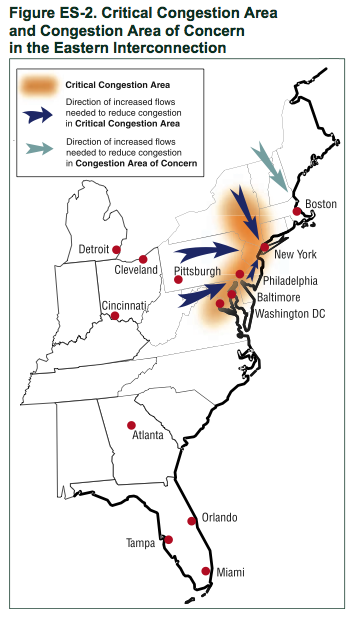
Figure 1. Figure from Department of Energy 2006 Electricity Congestion Study.
The extent to which congestion has been rising in the Eastern Interconnection is shown in Figure 2.
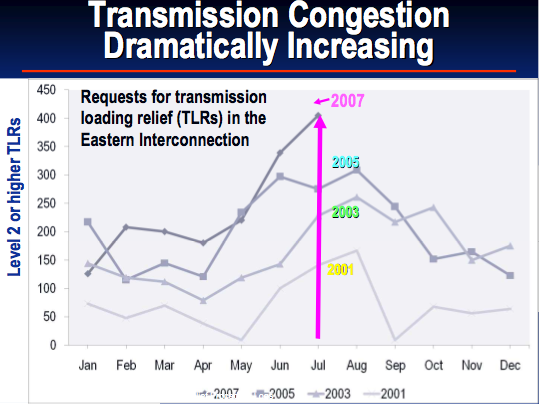
Figure 2. Slide from presentation by David Owens a 2008 EIA Conference.
While I have not shown a graph, another area with excessive congestion is Southern California. Changes to the grid structure are needed to relieve stress in this area as well.
One factor that affects line congestion is the relative cost of producing electricity for different types of fuels. The greater the differential in costs (usually natural gas higher than coal and nuclear), the more the financial incentive there is to import lower cost electricity from a distance. Natural gas prices have recently been rising. If this continues, this will put further pressure on utilities to import electricity from a distance created using coal or nuclear, rather than using locally produced electricity from natural gas.
Until now, additional wind capacity has simply piggy-backed on the general capacity of the grid. According to Stow Walker of Cambridge Energy Research Associates, spare capacity is now depleted, and new transmission capacity will need to be added to accommodate more wind energy. Even with the existing amount of wind energy (only about 9,339/405,582 = 2% of Texas’s total electricity, based on EIA production data for 2007), there have been reports of near rolling-blackouts in Texas, when the amount of wind energy suddenly dropped.
In Figure 3, I list states that are importers and exporters of electricity in 2006, based on EIA data. California and many of the Eastern states are big importers. Big exporters include coal producing states like Wyoming and West Virginia, and several states with large nuclear facilities. The percentages of imports and exports shown on Figure 3 are for the full year. It is likely that during peak periods, imports and exports will be much higher percentages than the amounts shown.
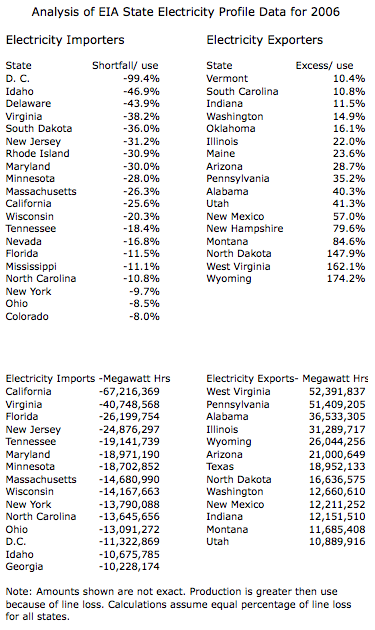
Figure 3. Based on EIA Data.
Federal legislation was passed in 2005 and 2007 which should help the grid situation a little, but it still leaves the many individual operating entities to share responsibilities and costs. The basic model is still one of competition, with governmental and industry organizations trying to get the various entities to work together for the common good.
What Changes Are Needed to the Grid?
We would have a very large task if we simply wanted to fix the grid to do what it was originally planned to do, since many of the grid’s elements are close to the ends of their useful lives. Unfortunately, nearly everyone who looks at the situation believes that a major upgrade to the grid is needed, rather than just patching the current system. From my reading, I have identified three basic changes that people believe to be necessary, over and above just getting the old system into better operating order. These are
1. Extra High Voltage Backbone. FERC commissioner Suedeen Kelly has been quoted as saying:
In order to truly capture not only the benefits of competition in generation but also to facilitate increased use of renewable resources, I am convinced that we will need not just to upgrade our electric grid but also to reconfigure it. We need a true nationwide transmission version of our interstate highway system; a grid of extra-high voltage backbone transmission lines reaching out to remote resources and overlaying, reinforcing, and tying together the existing grid in each interconnection to an extent never before seen. To get to that end state, we must have cost allocation provisions in place that can accommodate such wide ranging benefits.
2. Analog to Digital Grid. If we are going to enable energy efficiency, many believe we need to move from an analog to a digital grid. James Rogers, CEO of Duke Energy, says :
If you’re going to enable energy efficiency, you have to move from an analog to a digital grid with new transformers and new meters capable of two-way communication.
The Smart grid concept is very closely related to the digital grid. At the Green Intelligent Buildings Conference, keynote speaker Paul Ehrlich said:
We need to find ways to make the grid smarter, to make buildings smarter, and to have these smarts communicate with each other.
3. Real-time Transmission Monitoring System. With such a system, it would be possible to react more quickly to sudden shifts in power needs or power availability, and prevent cascading blackouts. Adopting such a system would not be simple. A 2006 study by FERC lists these steps:
• Define What a Real-Time Monitoring System is, What it Should Accomplish, and How
to Accomplish it
• Evaluate Existing Real-Time Monitoring Technologies and their Limitations
• Identify Required Communications and Related Security and Operating Issues
• Define Data Requirements
• Identify Promising Emerging Technologies
• Decide what Data Should be Shared, with Whom, and When
• Decide Who Should Operate, Use, and Maintain the System
• Identify Potential Participants Involved in Establishing a Real-Time Monitoring System
• Consider Cost and Funding Issues
How do we get from where we are now, to where we need to be, in a reasonable amount of time?
I am having a very difficult time seeing how this can be done. There are just too many entities and too many funding issues to make a transition from a neglected old system to a much-improved new system in a reasonable length of time. Our current economic model seeks growth and the maximization of profits. This economic model does not facilitate large groups of entities working together for the common good.
The transformation seems unlikely to succeed, if for no other reason than the fact that the cost of the new system is likely to be very high. Electric rates will already be increasing because of higher natural gas prices and the cost of building additional nuclear power. Adding the costs for a substantial upgrade to the transmission system at the same time would be very significant burden for the consumer. If we are dealing with peak oil at the same time, this will add an additional stress. It is difficult to believe that politicians and state regulators will allow such large costs to be passed back to consumers.
If anything would work to produce the desired result, it would seem to be something that approaches nationalization of the electric supply industry. If this were done, the problem of conflicting objectives could be greatly reduced. I have a hard time envisioning current leaders accepting such a radical approach, however.
What will happen if we just continue business as usual?
It seems to me that as more and more of transmission infrastructure exceeds its normal life expectancy, there will be more and more blackouts. Areas where there is high congestion, such as the Eastern Interconnection and Southern California, would seem to be particularly at risk. It seems like some of these blackouts could be very long (two weeks?).
With the current system, it takes longer to get new transmission lines in place than to build new natural gas or wind generating capacity. Because of this, we are gradually increasing the amount of constriction in the grid. We may have to forgo adding new generating capacity, particularly of wind, until sufficient additional transmission lines can be added.
Nuclear plants are big enough that they often can supply power to a fairly large area. If new nuclear plants are added, it may be difficult to add enough transmission lines to use the power they generate optimally. We may find ourselves able to use only part of the power the new plants are capable of generating because of transmission difficulties.
How about the longer-term outcome?
Longer term, if we cannot get the problem fixed, it seems likely that we will revert back to something closer to what we had in the 1960s, with local electric utilities serving an immediate area. There may still be some long-distance sale of electricity, but less than today, if the grid cannot support it. If some areas do not have enough locally-generated power, they may be forced to have planned blackouts, perhaps for several hours a day.
There would almost certainly be indirect impacts, if some areas of the country are subject to periodic electric outages. As mentioned at the beginning of this article, there may be impacts on oil and natural gas use, either because of problems with pipelines, or because of problems with people’s equipment that uses natural gas, but has electric ignition.
It is hard to know where the impact of intermittent electricity would end. For example, electric power plants currently get their fuel from very long distances. Georgia imports coal from Wyoming to run its power plants. Most uranium is imported from overseas. It is possible that some of these supply lines could be interrupted as an indirect result of the electricity disruptions, further disrupting electric power. The interconnections of electricity with petroleum, natural gas, and other operations could be the topic of another post.
If we cannot get the electrical grid upgraded, it seems like we will need to downgrade our expectations for applications such as electrified rail and plug-in electric hybrid cars. These will work much less well if there are frequent electric outages in much of the country. We may also need to downgrade our expectation for newer renewables because of the intermittent nature of their output, and the inability of local grids to handle this type of input. Efforts at higher efficiency may also be hindered, if we are unable to make the grid “smart”.
References
I link to a number of studies and presentations in the post. In addition, I should also mention:
Electricity: 30 Years of Industry Change Presentation by David K. Owens, Executive Vice President, Edison Electric Institute, April 7, 2008.
Light’s Out: The Electricity Crisis, the Global Economy, and What It Means to You by Jason Makanski, published by John Wiley in 2007.
Lines Lacking to Transmit Wind Energy USA Today, February 26, 2008.
State Almost Saw Rolling Blackouts Dallas Morning News, February 28, 2008.
2007 Long-term Reliability Assessment North American Electric Reliability Corporation.
Previous Electricity Article
US Electricity Supply Vulnerabilities






DrumBeat: December 31, 2022
The Peak Oil Crisis: Civil Unrest
Before grappling with 2009, it might be useful to remind ourselves that there is a dark side to what lies ahead.
There was a little flurry in the news last week when it was discovered that the Army War College had released a report talking about preparing for civil unrest in the U.S. When you read the report, it turns out to be yet another warning about generals preparing for the last war. It devotes only three pages to the idea that the Army might soon find itself so embroiled in helping local authorities cope with civil unrest that international commitments, such as the war on terrorism, could become secondary concerns.
Since the close of the Civil War, America has enjoyed nearly 150 years of domestic tranquility. There were, of course the Indian wars, some labor disputes and a handful of urban riots in recent decades, but these were isolated and did not last for long. Even during the great depression of the 1930′s America’s social fabric stayed largely intact. Signs that these idyllic decades may be coming to close are starting to arise. In the last few weeks the deteriorating economic situation has seen serious disturbances in Greece and Thailand. We are beginning to read of disturbances in Russia and China.
Oil prices surge $5 a barrel in pre-holiday trading amid concern about Russia-Ukraine natural gas dispute
COLUMBUS, Ohio – Oil prices jumped above $44 per barrel on the last day of 2008, wrapping up what has been the most turbulent year ever for crude markets in which crude gave up four years of gains in just five months.
It may be a temporary spike.
An unprecedented collapse in energy prices that began in July came as the world’s leading economies sank into recession.
Gazprom Will Cut Off Gas Supply to Ukraine Tomorrow, Miller Says
(Bloomberg) — OAO Gazprom will cut off gas supplies to Ukraine from 10 a.m. tomorrow, Chief Executive Alexei Miller said.
Reports: Ukraine, Russia at impasse in gas dispute
MOSCOW (AP) — The chance of a deal to avert a New Year’s Day shutoff of Russian gas to Ukraine is waning with talks showing no sign of progress as the midnight deadline approaches.
All three Russian news agencies are reporting that the delegation from Ukrainian gas company Naftogaz has been called back to Kiev. The reports cite an unnamed member of the delegation and could not immediately be confirmed.
Venezuela Halves Travelers Dollar Allowance to $2,500
(Bloomberg) — Venezuela pared in half the amount of dollars it will let people buy at the official exchange rate when traveling abroad to $2,500 as part of a push by President Hugo Chavez to curb outflows as oil, the country’s biggest export, plunges.
Review: Ditching car OK with Net transit planners
SEATTLE - As a New Yorker, I don’t own a car, and I really hate driving.
So I challenged myself to avoid the driver’s seat as much as possible during a recent West Coast trip, something made practical with all the online transit planners that have cropped up in recent years.
More Gulf industrial projects at risk after Dow
DUBAI (Reuters) - More Gulf projects may go the way of Kuwait’s aborted $17.4 billion deal with Dow Chemical or be renegotiated as states take a hard look at spending amid the global financial crisis and an oil price slump.
Gulf Arab states — which form the Gulf Cooperation Council (GCC), a loose economic bloc — have enjoyed a six-year boom on the back of soaring oil prices. But oil export revenues have shrunk as crude fell from a record above $147 in July to $38 at the year end.
Coupled with the financial crisis, this has led to a big push among Gulf states to revisit contracts as prices in general fall.
Tough choice for Gulf leaders
As GCC leaders gather in Muscat today, the deepening global economic crisis may force them to choose between multibillion-dollar projects proposed during more optimistic times.
Cancellations or delays of government-backed deals worth tens of billions of dollars have already been announced in industries from petrochemicals to aluminium production and oilfield expansion. On Sunday, the Kuwaiti government issued an 11th-hour reversal and cancelled a US$17.4 billion (Dh63.9bn) deal to create a petrochemical joint venture with the US company Dow Chemical.
Russia says slim chance of avoiding gas cut-off
MOSCOW/KIEV (Reuters) - Russia said on Wednesday the chances were receding that a gas deal will be clinched with Ukraine to avoid a threatened January 1 gas cut-off that could disrupt supplies to customers in Europe.
Ukraine PM cancels trip to Russia - source
KIEV (Reuters) - Ukrainian Prime Minister Yulia Tymoshenko will not fly to Moscow on Wednesday for a last ditch attempt to resolve a gas dispute with Russia, a source close to the Ukrainian government told Reuters.
Somali pirates to release Saudi tanker
Somali pirates have reportedly agreed to release the Saudi super-tanker, Sirius Star, withdrawing a 25 million dollar ransom demand.
“We decided to respect the request of Saudi Foreign Affairs Minister Saud Al-Faysal who asked us to release the ship…” Press TV correspondent quoted pirate’s spokesman Mohammed Said as saying.
2008 was the year forecasters got it all wrong
Oil to soar to $200 US a barrel.
This is a good time to buy stocks.
A lot of things economic took a battering in 2008 — from stock markets to autos to consumer confidence — but the list wouldn’t be complete without adding the pride of professional economic forecasters.
With commodities soaring in the first half of the year and plunging in the second, Wall Street financial giants collapsing, the Detroit Three teetering and the world heading into recession — all surprises — 2008 may be remembered as the year nobody got right.
Byron W. King: Comments on $37 oil
Today oil is trading in the range of $37 per barrel, or about $110 less than its price back in July. That’s a dramatic, 75% change downwards. Back when oil was selling at $147, I said that the world does not run very well at such lofty energy prices. A lot of things just stop working at $147 for a barrel of oil, particularly things with a large energy component. The airlines come to mind. So something had to give. The world economy could crash (no jokes about airlines here…), or the price of oil could come down.
As it turned out, we had both events. The world economy hit the wall, and the price of oil came down in almost a straight line over five months. I believe that the high oil prices of late spring and early summer – with gasoline prices well over $4 per gallon (and over $5 in some parts of the country) – had a lot to do with triggering the financial crash that we saw in the fall.
The Impact Of Asian National Oil Companies In Nigeria
There is no shortage of literature on the renewed interest in Africa by Asian countries seeking oil and other minerals to fuel their rapid industrialisation. Most attention has been focussed on China, and on India and others to a lesser extent. But there are few case studies.
This paper tries to fill that gap. It addresses the experience and impact of Asian National Oil Companies (ANOCs) in Nigeria, Africa’s premier oil producer. The study suggests that many of the general assumptions about the enhanced Asian presence in Africa need to be re-visited. However, Nigeria may be a special case.
Refinery fire’s Interior impact unknown
FAIRBANKS — Petro Star officials say it could be three weeks before they know the extent of the damage to a Valdez refinery following a major blaze Sunday night.
Until then, officials also say it’s unclear how the Interior will be affected by stalled production at one of the state’s four refineries.
Australia: Fuel shortage fears
FUEL shortages are likely to continue at service stations after another fault discovered at the Caltex refinery on the weekend pushed the re-start time back a week.
Students in Nepal cut electricity to protest power cuts
KATMANDU, Nepal – Students stormed an electricity transmission office and shut down power in western Nepal affecting hundreds of thousands of residents in a protest against government imposed power outages.
Will Mexico Fail in 2009 or 2010?
The Mexican government needs $70-per-barrel oil prices to balance its budget. For now, government spending is covered. But by the end of 2009, its fixed-rate contracts to sell oil at $70 will have expired.
If oil prices are still low by the end of next year, the government could be in real trouble. If oil had to be sold at today’s prices, almost 20 percent of the government’s budget would disappear.
Economic crisis has small car sales making a U-turn
No other vehicle segment saw such sales volatility in 2008. First, it was falling gas prices that slowed small-car sales. Now, it’s the inability of recent college graduates and other price-conscious drivers to qualify for loans.
RWE advances plan for new nuclear plant on Anglesey
RWE has unveiled plans for massive new nuclear capacity in Wales by obtaining grid connections for 3.6 gigawatts of electricity and buying up land for up to three new atomic power stations.
The British arm of the German-owned business, RWE nPower, said it was intending to make a “multibillion-pound investment” that could provide light and heat for 5m homes from 2017.
Ford Exec Admits Hybrid Battery Shortage
The new 2010 Ford Fusion Hybrid—the first mid-size sedan to break the 40-mpg mark in city driving—could become the hit that Ford so desperately needs. Unfortunately, Ford is already claiming that it can’t get enough hybrid batteries to meet potential demand.
Stern hope over US climate deal
Economist Lord Stern has said he is optimistic a global deal to reduce carbon dioxide emissions will be struck under Barack Obama’s US presidency.
Is oil cheap only because of the recession?
Several commenters on Tierney’s blog seem to acknowledge that he’s likely to win. (Oil is below $40.) But they say he lucked out with the severe global recession, which has depressed the demand for energy. The oil-price plunge, these commenters suggest, says nothing about long-term resource sustainability and long-term resource prices.
Not true. Granted, the recession does force energy prices lower, and the recession won’t last forever. But recessions and limits to growth are a crucial factor in favor of anybody who’s betting against long-term resource inflation. Until recently world GDP was growing close to an annual rate of 5 percent — an astonishingly fast pace. The idea that it couldn’t keep up was crucial to anybody betting against higher oil prices. Unsustainable demand was a key factor in the oil bubble.
But the business cycle is only one way economies adjust to seemingly scarce resources. When resources become expensive, we buy fewer of them. When resources become expensive, people switch to alternatives. When resources become expensive, entrepreneurs seek new sources or invent technology to better exploit old ones. All of these things have been going on with oil in the last two years. They are real but unmeasurable factors in its price decline. It’s not just the recession. Tierney didn’t luck out. He knew the odds favor the resource optimists for many reasons.
Crude Oil Falls a Second Day, Heading for Record Annual Decline
(Bloomberg) — Crude oil fell for a second day, heading for a record annual drop, on speculation that U.S. fuel stockpiles are increasing as the recession cuts demand.
…Crude oil for February delivery dropped as much as $2.09, or 5.4 percent, to $36.94 a barrel on the New York Mercantile Exchange and traded at $37.07 as of 11:50 a.m. London time. Prices are down 61 percent this year, the first annual decline since 2001 when oil fell 26 percent, and the biggest slide since trading began in 1983.
Iran May Scrap Subsidies on Fuel as Oil Income Drops
(Bloomberg) — Iran’s parliament may vote to scrap energy subsidies after a motion presented by President Mahmoud Ahmadinejad was approved by a majority of lawmakers yesterday, Iran’s Press TV reported.
Domestic fuel and utility prices will rise if an economic reform bill is passed, with some funds redistributed to low-income families, the state-run satellite news channel said, citing Ahmadinejad. A further vote is required.
Iran, holder of the world’s second-largest oil and gas reserves, relies on oil revenue for at least half of the government’s budget. The slide in oil prices — the biggest annual decline since futures trading began in 1983 — has prompted the government motion and could lead to social unrest, observers said.
“It shows that they’re running out of dough,” said Dalton Garis, associate professor of economics at The Petroleum Institute of Abu Dhabi in the United Arab Emirates. “It is extremely dangerous for the regime as it may precipitate some grass-roots action that could get out of hand, and the ultimate result might be quite chaotic in the short run.”
Iraq opens oil fields
BAGHDAD (Reuters) — Iraq on Wednesday opened up some of its most prized oil and gas fields to international firms that have been excluded for decades, part of new deals that could more than double its output within a few years.
PetroChina Parent’s Crude Oil Output Rises to Record
(Bloomberg) — China National Petroleum Corp., the country’s biggest oil company, boosted crude-oil output to a record in 2008 as the nation stepped up production to meet increased demand and build fuel reserves.
This is the seventh straight year in which the company’s crude output has grown “steadily,” China National said in a statement on its Web site today without giving details. The company’s crude production rose 2.2 percent to 137.6 million metric tons in 2007. Natural-gas output expanded “rapidly” this year, the statement said.
Gazprom accuses Ukraine of ‘blackmail’ on gas transit: Gazprom
MOSCOW (AFP) – Russian state gas monopoly Gazprom accused Ukraine on Wednesday of “blackmail,” saying it had threatened to confiscate Russian gas en route to delivery to customers in Europe.
“We are in a situation when transit volumes to western Europe are in danger,” Gazprom’s deputy chief executive, Alexander Medvedev, said at a news conference. “This position cannot be called anything but blackmail.”
Oil price collapse wreaks havoc on forecasts and budgeting
The global economic slowdown which unfolded in the second half of 2008, hit Russia hardest through the collapse in oil prices. They have fallen more than 70% in 6 months, making a mockery of predictions earlier in 2008 and undermining the entire Russian economy.
Sfakianakis Says Oil’s Decline Threatens Sovereign Funds: Video
(Bloomberg) — John Sfakianakis, chief economist at Saudi British Bank, talks with Bloomberg’s Erik Schatzker about the impact of lower oil prices on sovereign wealth funds in the Persian Gulf.
Crude oil’s biggest decline since 1983 may push the biggest oil producers in the region into budget deficit, limiting the nations’ ability to invest in foreign companies stung by the global credit crisis.
The Last Road Trip
It is the frightening rule du jour: the cheaper gas gets right now, the more completely screwed you know we are. At the same time, a cheap tank of gas is one of the few strokes of fiscal relief we have right now, a tiny reprieve from the brutal economic turmoil. What a thing.
But on the whole, it is not good news. Normally, the price of a barrel of crude drops a couple hundred percent in less than a year and we’d be out celebrating, joyous in the knowledge that ExxonMobileShellScrewYou must’ve just shoved an enormous drill bit the size of Sarah Palin’s vacuity deep into Russia or Venezuela or a precious Alaskan wildlife preserve and come up with enough pure, sweet crude to last us until you’re very, very dead and your grandkids are using the burned-out hull of your Chevy Tahoe XLT as a bomb shelter against the global warming food riots.
Gold was the best, oil the worst
Ironical, isn’t it, that gold should be the best performing commodity in a year when crude oil turned out to be the worst? After all, gold prices have historically marched in-step with crude oil. Remember that gold attained its previous record of $850 an ounce during the oil crisis of the eighties. In 2008, gold prices (in dollar terms) have gained 6 per cent while crude oil has lost 62 per cent.
The Gold to Oil Ratio Does Matter
Producing gold is essentially converting energy into bullion. How many calories go into producing a one ounce gold coin? In some cases to produce a single ounce hundreds of tons of rock are moved. Ultimately, money is about energy. To make it personal, how much value should you put on that nice steak dinner, bottle of water from Fiji or 3,000 mile Ceaser salad? Well, think through the supply chain and how much energy the good or service represents.
UK: The future for renewable energy
Renewable energy will be a highly dynamic part of the cleantech spectrum for several decades to come. The drivers for the sector are aligned and strengthening all the time. And remember these go beyond just climate change. Energy security too is a key plank of policy, especially in countries like the UK and the US whose domestic oil and gas supplies are a dwindling part of the energy mix.
Russia’s RTS Ends Worst Year Since 1998; Gazprom Tumbles
(Bloomberg) — A 72 percent drop in the RTS Index made Russia the worst index among the world’s 20 biggest equity markets this year and gave investors in the country their biggest losses since Russia defaulted on its debt 10 years ago.
OAO Gazprom dropped from being the world’s third-biggest company to 47th, and other stocks slumped amid falling oil prices, capital flight following the August war with Georgia and forced selling by investors and billionaires who faced margin calls from banks and brokers.
Ukraine govt delegation due to fly to Russia-source
KIEV (Reuters) - Ukrainian Prime Minister Yulia Tymoshenko is to fly to Moscow shortly to try to resolve a gas dispute with Russia before a deadline to cut Ukraine from supplies, a source close to the negotiations said.
Feds approve gas drilling plan for Montana
BILLINGS, Mont. – The Bush administration has approved a plan that could allow more than 18,000 natural gas wells to be drilled in southeastern Montana over the next two decades.
The decision by C. Stephen Allred, assistant secretary for land and minerals management at the Department of Interior, would allow companies to proceed with plans to drill on more than 1.5 million acres of federal land in Montana’s remote Powder River Basin.
China Datang to Build Wind Farm as Government Speeds Approvals
(Bloomberg) — China Datang Corp., the nation’s second-biggest power producer, received state permission to build a 4.5 billion-yuan ($659 million) wind farm as the government expedites project approvals to spur economic growth.
Winds of change come to country plagued by power blackouts
The forest of white windmills that make up Asia’s largest wind farm can be seen from miles away. Dotted across 2,000 square kilometres of hills and villages on a basalt plateau in western India sit more than 800 turbines - generating more than 1,000 megawatts of electricity.
The towering machines, which stand 80 metres tall, cast shadows across fields tilled by man and buffalo - a stark juxtaposition of ancient and modern India. For one man, however, the windmill farm in Dhule is a fitting riposte to the critics who derided his dream to build a global green energy business from a country plagued by crippling power cuts.
Ethanol sales top gasoline sales in a first in Brazil
SAO PAULO (AFP) – Ethanol sales for 2008 for the first time are outpacing those of gasoline in Brazil, a top ethanol producer, the National Petroleum Agency reported Tuesday.
Geothermal energy a booming business
PROVO, Utah - Within six months of discovering a massive geothermal field, a small Utah company had erected and fired up a power plant — just one example of the speed with which companies are capitalizing on state mandates for alternative energy.
Anticipation of new energy policies has sparked a rush on land leases as companies like Raser Technologies Inc., based in Provo, lock up property that hold geothermal fields and potentially huge profits.
Global warming may spread tick-borne disease
The brown dog tick (Rhipicephalus sanguineus) rarely bites people, far preferring the taste of dog. But global warming could be changing that, exposing people to dangerous diseases as a result.
2009 to be one of warmest years on record: researchers
LONDON (Reuters) - Next year is set to be one of the top-five warmest on record, British climate scientists said on Tuesday.
The average global temperature for 2009 is expected to be more than 0.4 degrees celsius above the long-term average, despite the continued cooling of huge areas of the Pacific Ocean, a phenomenon known as La Nina.




In this house, we obey the laws of thermodynamics!
When you use energy, the
rules are very well defined. The first and second laws of
thermodynamics have been well understood for well over a century, and the
third for just over a century, but the subject is still viewed by
most as being pretty arcane. This is a pity, both because these
laws are of such importance, and because almost everyone has a fair
understanding of the first and second laws, even if they think they
don’t. Understanding the implications of the laws is another
matter.
[break]
There are many facetious versions of the laws. The set I like
best
goes:
(zeroth law) You must play the game.
(first law) You can’t win.
(second law) You can only break even on a very cold day.
(third law) It doesn’t get that cold.
These are surprisingly
accurate.
The actual laws are, it should be remembered, experimental in
origin. The world has been found to work this way.
Zeroth Law
The zeroth law actually states that if two systems A and B are in
equilibrium with each other, and systems B and C are also in equlibrium
with each other, then systems A and C are also in equilibrium with each
other. Another way of putting it is that situations like Escher’s
“Waterfall” don’t occur in real life.
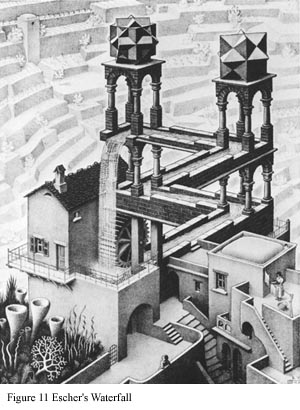
You must play the game.
First Law
The first law is the law of conservation of energy. It includes
the equivalence of heat and work, but is more general than that, in that there
are many forms of energy that are interconvertible, but with the total
for an isolated system remaining constant over time. One point
that is often misunderstood is the role of the equation E = mc2.
This is usually taken to refer to a conversion of matter into energy, but
the reality is simpler. Energy has mass, and the equation tells
you how much. No matter what conversions take place
in a isolated system, its total energy (and hence mass) remains constant.
You can’t win.
Second Law
The second law is the one that results from the observation that hot
things lose heat to colder ones. It’s a one-way process.
Mechanical work can be turned into heat. Heat can be turned into
mechanical work, but there are limitations. The implications of
this are far-reaching, and a surprising amount can be deduced (and
defined) from just this and a thought experiment.
If we have two reservoirs of heat (both conveniently infinite in
capacity) at different temperatures, then devices can be constructed
that take heat from the hotter reservoir, turn some of it into
mechanical work
and reject the rest to the colder reservoir. The rejection of
part of the heat has been found to be unavoidable, but the amount of
rejected heat becomes less as the temperature of the heat source is
raised. Without at
this
stage defining
what we mean by the numerical value of a temperature, let us suppose
that the maximum possible
efficiency of conversion is a definite function of the two
temperatures. Engine efficiencies are usually defined as [work
out/heat in], but in this case, I’ll look at [heat out/heat in] or [1 -
efficiency]. If the temperatures of the two reservoirs
are T1 and T2 and the heat taken from the hotter is q1, and the heat
released to the colder is q2, then we will say that:
q2/q1 = F(T2,T1) F is some as yet
unknown function (an algebraic expression) of the two temperatures.
Maximum efficiency implies reversibility of the process. An
example
of this is that heat transfer from the hotter reservoir to the engine
must be achieved without any temperature difference between the
reservoir and the part of the engine that absorbs the heat. If
there
were any difference, the heat engine would operate at a lower
efficiency (smaller temperature difference between hot and cold), and
it would not be possible to run the process backwards (heat won’t flow
“uphill”). There can’t be any friction either. The engine
with maximum efficiency
is thus reversible and can be used as a heat pump, pumping heat from
the cooler reservoir
to the hotter, and requiring mechanical work to do it. The values
of q1 and q2
are the same as in the case of the engine, but the direction of flow
is reversed and work is put into the system rather than being taken
out. The absence of temperature differences between the
engine/heat pump and its heat reservoirs also means
that the processes will be infinitely slow, but that is the case for
all
these ideal machines.
Let’s now suppose that we have a third heat reservoir at a still
lower temperature, T3, and that a second engine operates between the
second and third reservoirs. If the heat taken from the second
reservoir is q2 (same as rejected by the first engine), and that
rejected to the third is q3, then:
q3/q2 = F(T3,T2)
But we could instead have used one engine directly between the first
and third reservoirs. This engine must have the same overall
efficiency as the combination of the other two, because if it didn’t,
then heat could be run continuously around the cycle of three engines,
using the power from one or two engines to drive the other(s)
backwards, leaving a net work output with heat being taken from one
reservoir only. This would not be consistent with the way things work. So:
q3/q1 = F(T3,T1)
But: q3/q1 = (q3/q2)/(q2/q1)
So: F(T3,T1) = F(T3,T2)/F(T2/T1)
If you didn’t switch off at the beginning of the algebra, it should be
evident that this places a very severe restriction on the nature of the
function F. In the last equation, T2 disappears from the right
hand side, simply as a result of the division. This means that
F(T1,T2) must be of the form f(T1)/f(T2), where f is some other
function.
So: q2/q1 = f(T2)/f(T1)
You may remember that I started this argument without defining what
exactly was meant by a temperature. This equation gives us an
opportunity to define a
temperature scale, by choosing the function f. This is what William Thomson (later Lord Kelvin) did in 1848. He chose f(T) to
be as simple as possible:
f(T) = T
So: F(T2,T1) = T2/T1 and q2/q1 = T2/T1
In other words, an absolute temperature scale can be defined in
terms
of the behaviour of heat engines, independent of the properties of any
particular substance. If an ideal heat engine has a conversion
efficiency of 50% (half the input heat is turned into work and half to
rejected heat), then the ratio of the heat source temperature to the
heat sink temperature is 2 - by definition.
To complete the definition of such an absolute temperature scale, we
need to set the size of a degree. If we set the degree size
such that the difference between the freezing and boiling points of
water is 100 degrees, we have a scale that can match the Celsius scale,
but with an offset corresponding to the freezing point of water on the
absolute scale. That offset turns out to be 273.15 degrees and we now have the Kelvin scale.
Entropy
The idea of entropy is associated in most people’s minds with the
ideas of order and disorder (higher entropy = more disorder).
This is correct, but the origin of the idea comes from the movement of
heat. If an amount of heat q enters a system at (absolute) temperature T,
then the entropy of the system increases by q/T. This is the
definition of entropy. If we look at the first heat engine above, the
entropy of the hotter reservoir decreases by q1/T1, and that of the cooler increases by q2/T2. If the engine is reversible, q2/q1 = T2/T1,
so the overall change in entropy is zero. This is a
characteristic of reversible processes. In real processes, the
change in total entropy is always positive. One example is the
flow of heat from a hot body to a cooler one - the hot body loses
entropy, but the cooler one gains more than the hotter one lost, since
the T in the q/T expression is smaller and the q is the same.
Available work, or Exergy
The maximum amount of work that could possibly be extracted as a
process proceeds (i.e., if it proceeds reversibly) can
readily be calculated from energy and entropy changes between the
starting and finishing states of the process. This is sometimes referred to as the exergy
available at the start. Just how it may be derived may be the
subject for another
posting. Exergy, unlike energy, may be destroyed. The ideal
amount of work is never realised of course,
but it is reasonably straightforward to show that the exergy
irretrievably lost when
an irreversible change takes place is equal to the entropy
increase associated with the irreversible change multiplied by the
temperature of the environment in which the process takes place.
That is the lowest temperature at which heat can be rejected by the process. It
follows that if the temperature of the environment is absolute zero,
there is no loss in exergy or available work, whatever happens.
You can only break even on a very cold day.
Third Law
There are two ways of stating the third law:
The entropy of every pure substance at absolute zero is zero.
It impossible to reach absolute zero in a finite number of steps.
The reason the second follows from the first is that any process that
reduces the temperature of a substance must entail a step in which the
entropy changes. If the entropy of everything is zero, then no
changes of entropy are possible and there is no means of doing any cooling.
In fact, the observed law is that the change
in entropy is always zero. It is then convenient to declare all
entropies zero at absolute zero and this matches the statistical
interpretation of entropy. One can get very close (in degrees) to
absolute zero - the current record is about 10-10K, but the closer one gets, the more difficult it
becomes to cool further.
It doesn’t get that cold.




FTSE 100 edges up on last trading day of year
The FTSE 100 index lost 31.3% in 2008, its worst annual decline since it was created in 1984, and following a 3.8% gain in 2007.
It edged up 0.94% to 4434.17 on the last trading day of the year today, a gain of 41.49 points.
Banks, at the centre of the financial storm, were among the biggest losers of 2008 ranging from HBOS, Royal Bank of Scotland and Lloyds TSB to Barclays. Mining companies Kazakhmys, Xstrata and Rio Tinto also fared badly as the economy worsened.
Drugmakers AstraZeneca and GlaxoSmithKline were among the best-performing stocks on the FTSE. British Energy was another big gainer, up more than 40% in a year in which the government secured the sale of its stake in the nuclear power firm to French energy giant EDF.
David Buik at BGC Partners talked of an “annus horribilis by any standards”.
- Market turmoil
guardian.co.uk © Guardian News & Media Limited 2008 | Use of this content is subject to our Terms & Conditions | More Feeds
FTSE 100 hits best level for seven weeks
The FTSE 100 index closed tonight at its highest level for more than seven weeks. The blue-chip index gained 73.33, taking it to 4392.68, its best closing position since November 10.
Nevertheless, it remains on course to record its worst ever year by the time the markets close at lunchtime tomorrow, with leading shares down 32% over the course of 2008.
Commodity groups were among the day’s top gainers, with Eurasian Natural Resources Corporation (ENRC) up 5% or 16p at 339.25p and Anglo American 49p better at £15.55.
Amec, the consultancy and engineering group that specialises in the energy industry, lifted 14.25p to 484.25p.
Rolls-Royce gained 8p to 332.25p after announcing a deal with Russian gas giant Gazprom to supply eight turbines for the new Nord Stream pipeline from Russia to Europe.
In the red column, HBOS slipped 1.6p to 69p following a report in the Financial Times that the bank’s pension trustees are considering legal action to delay its merger with Lloyds TSB until it receives guarantees over the funding of the scheme.
Lloyds TSB also lost ground, down 1.5p at 126.5p, as did other financial stocks.
Shares in the Russia-focused Imperial Energy soared as shareholders appeared to have backed a £1.3bn bid from India’s ONGC.
The shares jumped 17% or 175p to £12.05, just 45p adrift of the price that ONGC has offered.
Shareholders had until 1pm today to vote on the offer, which had received backing from both the Indian government and Russian regulators.
There were fears that if less than 90% of them backed the deal, ONGC might back out and return with a lower offer than they made in August, when the oil price was about three times what it is now.
There was no official confirmation last night, but City sources suggested that the requisite number of shareholders had given their support, following a last-ditch charm offensive over the Christmas period from bankers at Merrill Lynch and RBS.
Imperial has reserves of about 3.4m barrels of oil equivalent, and the takeover would increase ONGC’s reserves by around 20%. Most of the mid-cap company’s operations are in Siberia and in former Soviet states.
Shares in the small-cap software firm Innovation crashed by more than 15% after it revealed it was facing a £43m lawsuit in Canada.
Innovation said it had been served with a claim for $75m (Canadian) by the Allstate Insurance Company of Canada over “the design, development and implementation of customised software for Allstate’s new policy management system”.
The company said it had taken advice and branded the claim “speculative in the extreme and without foundation”, promising to defend it “vigorously”.
The shares – which were changing hands at more than 30p a year ago - slipped 0.9p to 5p.
Earlier this month Innovation said it had knocked back a number of approaches including an investment stake proposal and a indicative cash offer in the range of 15p to 20p a share.
- Eurasian Natural Resources Corporation
- Anglo American
- Amec
- Rolls-Royce
- HBOS
- Lloyds TSB
- Imperial Energy
- FTSE
guardian.co.uk © Guardian News & Media Limited 2008 | Use of this content is subject to our Terms & Conditions | More Feeds
Imperial deal looks on course
Shares in the Russia-focused Imperial Energy have soared as it looks like shareholders have backed a £1.3bn bid from India’s ONGC.
The shares jumped 16.5% or 170p to £12.00, just 50p adrift of the price that ONGC has offered.
Shareholders had until 1pm today to vote on the offer, which had received backing from both the Indian government and Russian regulators.
There were fears that if less than 90% of them backed the deal, ONGC might back out and come back with a lower offer than they made in August, when the oil price was about three times what it is today.
There has been no official statement yet, but it is widely assumed that the requisite number of shareholders have given their support, following a last-ditch charm offensive from bankers at Merrill Lynch and RBS.
Imperial has reserves of about 3.4m barrels of oil equivalent, and the takeover would increase ONGC’s reserves by around 20%. Most of the company’s operations are in Siberia and in former Soviet states.
- Imperial Energy
guardian.co.uk © Guardian News & Media Limited 2008 | Use of this content is subject to our Terms & Conditions | More Feeds
FTSE 100 edges up on last trading day of year
December 31, 2022 by admin
Filed under Stock Market
The FTSE 100 index lost 31.3% in 2008, its worst annual decline since it was created in 1984, and following a 3.8% gain in 2007.
It edged up 0.94% to 4434.17 on the last trading day of the year today, a gain of 41.49 points.
Banks, at the centre of the financial storm, were among the biggest losers of 2008 ranging from HBOS, Royal Bank of Scotland and Lloyds TSB to Barclays. Mining companies Kazakhmys, Xstrata and Rio Tinto also fared badly as the economy worsened.
Drugmakers AstraZeneca and GlaxoSmithKline were among the best-performing stocks on the FTSE. British Energy was another big gainer, up more than 40% in a year in which the government secured the sale of its stake in the nuclear power firm to French energy giant EDF.
David Buik at BGC Partners talked of an “annus horribilis by any standards”.
- Market turmoil
guardian.co.uk © Guardian News & Media Limited 2008 | Use of this content is subject to our Terms & Conditions | More Feeds
FTSE 100 hits best level for seven weeks
December 31, 2022 by admin
Filed under Stock Market
The FTSE 100 index closed tonight at its highest level for more than seven weeks. The blue-chip index gained 73.33, taking it to 4392.68, its best closing position since November 10.
Nevertheless, it remains on course to record its worst ever year by the time the markets close at lunchtime tomorrow, with leading shares down 32% over the course of 2008.
Commodity groups were among the day’s top gainers, with Eurasian Natural Resources Corporation (ENRC) up 5% or 16p at 339.25p and Anglo American 49p better at £15.55.
Amec, the consultancy and engineering group that specialises in the energy industry, lifted 14.25p to 484.25p.
Rolls-Royce gained 8p to 332.25p after announcing a deal with Russian gas giant Gazprom to supply eight turbines for the new Nord Stream pipeline from Russia to Europe.
In the red column, HBOS slipped 1.6p to 69p following a report in the Financial Times that the bank’s pension trustees are considering legal action to delay its merger with Lloyds TSB until it receives guarantees over the funding of the scheme.
Lloyds TSB also lost ground, down 1.5p at 126.5p, as did other financial stocks.
Shares in the Russia-focused Imperial Energy soared as shareholders appeared to have backed a £1.3bn bid from India’s ONGC.
The shares jumped 17% or 175p to £12.05, just 45p adrift of the price that ONGC has offered.
Shareholders had until 1pm today to vote on the offer, which had received backing from both the Indian government and Russian regulators.
There were fears that if less than 90% of them backed the deal, ONGC might back out and return with a lower offer than they made in August, when the oil price was about three times what it is now.
There was no official confirmation last night, but City sources suggested that the requisite number of shareholders had given their support, following a last-ditch charm offensive over the Christmas period from bankers at Merrill Lynch and RBS.
Imperial has reserves of about 3.4m barrels of oil equivalent, and the takeover would increase ONGC’s reserves by around 20%. Most of the mid-cap company’s operations are in Siberia and in former Soviet states.
Shares in the small-cap software firm Innovation crashed by more than 15% after it revealed it was facing a £43m lawsuit in Canada.
Innovation said it had been served with a claim for $75m (Canadian) by the Allstate Insurance Company of Canada over “the design, development and implementation of customised software for Allstate’s new policy management system”.
The company said it had taken advice and branded the claim “speculative in the extreme and without foundation”, promising to defend it “vigorously”.
The shares – which were changing hands at more than 30p a year ago - slipped 0.9p to 5p.
Earlier this month Innovation said it had knocked back a number of approaches including an investment stake proposal and a indicative cash offer in the range of 15p to 20p a share.
- Eurasian Natural Resources Corporation
- Anglo American
- Amec
- Rolls-Royce
- HBOS
- Lloyds TSB
- Imperial Energy
- FTSE
guardian.co.uk © Guardian News & Media Limited 2008 | Use of this content is subject to our Terms & Conditions | More Feeds