

How to choose an Emini SP broker?
December 31, 2022 by admin
Filed under Commodities News
Twitter It!
Before you go and click on all the ads that advertise for Emini SP Brokers, here are a few guide lines that would help you to choose one:
1) Software Selection- Choose a broker that has multiple selections of futures trading software. In the event one is too complex or too simplified, you can easily switch between one or the others.
We recommend using NinjaTrader Broker as a starting point because you can custom makes it to your needs and requirements. You can trade from both the DOM (Depth of Market) and/or the charts.
2) Discount Commissions Broker – Does not matter how you slice it or dice it, it is very important that commissions will not eat into your account. A reasonable commission fee for Emini SP is in the $4.00 to $4.50 Range depending on volume and frequency of trading.
3) Tech Support – All online platforms at some point could experience a technical malfunction. It is important that you could immediately get a hold of your broker to close or report your positions in real time.
4) Reasonable day trading margins – it is important that you get access to reasonable day trading margins to utilize your capital correctly. BUT, don’t utilize every single dollar in your account to over leverage. We can have a whole discussions as to why it’s important not go with brokers that offer margins that are too low, we wrote an article about that here: Day Trading Margins we recommend to use 1000 per contract to 2500 depending on your experience of trading.
5) Use your intuition about the people you are about to do business with…call and speak with a broker first. He will be the guy that you will a keep a rapport with over the years….so make sure you have a common language.
Related Posts:
- Trading with $500 Day Trading Margins for Emini S&P Futures is Idiotic!
- NinjaTrader Brokers (cheapest commissions)
- Has the internet helped traders to make better decisions?
- NinjaTrader Data Feed Quotes Guide
- What can your broker do to create a top notch facility for automated trading execution and WHY you should care?
How to choose an Emini SP broker? is a post from: Futures Trading Blog for Independent Self-Directed Traders and System Traders
Hope, hopelessness and faith
For those involved in issues of sustainability, peak oil, climate change, and relocalization it might be better to feel a certain hopelessness in our situation. For hope implies dependence on forces outside ourselves. Once we abandon that hope, we can get down to the tasks at hand, the tasks that need to be done-for which we need to ask no politician or government official permission-tasks that we can get started on today. In this way hopelessness concerning the current political and economic arrangements becomes an ally.
read more
Reducing complexity
Joseph Tainter tells us that increasing complexity confers advantages to a society, but eventually, the energy required to maintain the increasingly complex society becomes a problem. Tainter’s view suggests that one way to make our society more sustainable is to make it less complex. Tainter defines complexity as follows:
Complexity is generally understood to refer to such things as the size of a society, the number and distinctiveness of its parts, the variety of specialized social roles that it incorporates, the number of distinct social personalities present, and the variety of mechanisms for organizing these into a coherent, functioning whole. Augmenting any of these dimensions increases the complexity of a society. Hunter-gatherer societies (by way of illustrating one contrast in complexity) contain no more than a few dozen distinct social personalities, while modern European censuses recognize 10,000 to 20,000 unique occupational roles, and industrial societies may contain overall more than 1,000,000 different kinds of social personalities.
The question for tonight is to think about things that might be useful to do in the coming year, that would act to make our society less complex, without losing too much functionality.
Ideally, if we have to move down in complexity, we would like to move down only a small notch in complexity (for example, change the system so that there are fewer choices in appliances, so that replacement parts are easier to come by), rather than a large step down in complexity (each of us growing all of our own food). What are some steps we can take to reduce complexity? Are there any steps that we can take to get local officials to make changes that would permit a reduction in complexity?
As one example, our family generally buys food in as close to its original form as possible, so as to cut out the packaging and processing.
Others will choose to buy locally grown foods. Supporting local farmers would seem to be a step toward reducing complexity.
Buying clothes that can be washed at home, rather than dry cleaned, would seem to represent a reduction in complexity.
Is the goal of reducing complexity a reasonable one, or does it conflict too much with the need for specialization?
Aruba’s New Windfarm
As Copenhaguen ended, unsurprisingly, in confusion, I have the opportunity to give you a more positive tale, and show you it is possible for people - including even bankers amongst them - to work towards a more sustainable future without necessarily endangering our way of life.
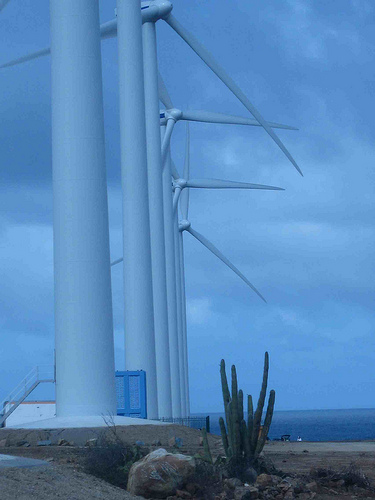
The Vader Piet 30MW wind farm on the island of Aruba.
In this case, it involves the construction of a windfarm in a place where it will directly replace fuel-oil-burning power plants. As you’ll be able to see below, this wind farm is quite remarkable in a number of ways which means that this experience will not be replicable as easily everywhere, but it shows that there are many places and energy systems which it is possible to materially improve under almost all criterai using renewable energy.
(part of the wind power series)
Full disclosure: As indicated below, I financed the project discussed in this post last year.
Amongst notable features, one can find:
- at around 60%, it has one of the highest capacity factors in the world, with 50% more power output per turbine than European offshore windfarms…; located on the Eastern coast of the island, it is exposed directly to the trade winds, which are highly regular and almost always in the same direction (allowing to put the turbines very close to one another); their almost constant strength also mean that tear and wear is actually likely to be less than usual, as there are very few brutal changes in regime and torque;
- it is now providing 20% of the island’s overall electricity needs, replacing dirty and expensive fuel-oil in the process. At night, it will produce up to 60% of the demand. And thanks to the highly regular wind regime, this is very stable and predictable production; (even though they pushed for this project to happen, the local power company had quite a shock to see ‘for real’ how big a portion of their system the windfarm has suddenly become - as is still frequent, utilities have trouble taking wind seriously, but it this case the reality was quite compelling);
- the utility will save money on fuel imports and, more importantly, will actually end up with cheaper power: it buys the electricity from the wind farm at a fixed price over 15 years which is roughly equivalent to what it costs to produce electricity from their traditional oil-fired generators with oil prices at $45/bbl. Who wants to bet on oil being consistently under $45 for the next 15 years? In fact, the prime minister of the island, who was present at the inauguration, used the opportunity of that ceremony to announce lower power prices for the poorest households on the island…
- and the reality is that the windfarm has received an enthusiastic welcome by the population of the island - the project team was telling me about how there were people all along the road clapping them when they were transporting the machinery to the site (not a trivial task, as the videos below show):
- and, finally (and this is where I come in), the windfarm was financed at the top of the financial crisis last year. I told the story in a blog post then ( How to keep on financing wind farms when banks have no money left.) but it’s worth underlining here that one of the most dangerous consequences of the crash is that traditional banking - lending to the economy - has been, and still is, directly impacted and curtailed, as the result of lack of liquidity and heightened risk aversion by banks (which are just as stupid and gregarious in systematically cutting off credit as they were enthusiastic at shoving it onto clients before). So it was an especially proud moment for me to see this project, because we really made a difference at the time, saving the wind farm from a potentially damaging delay, and saving very real economic activity on the island and amongst the suppliers (which are mainly European).

it is a windy place…
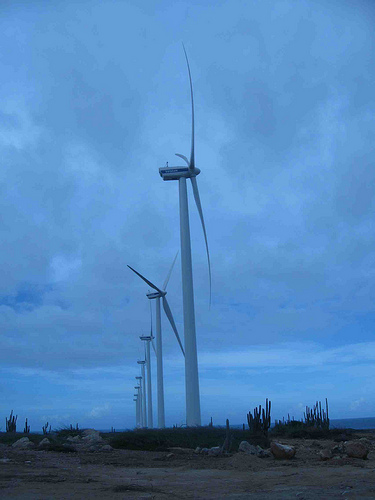
see how the blades bend under the strength of the wind
(the second one was switched off temporarily for visits,
thus its different orientation in this picture).
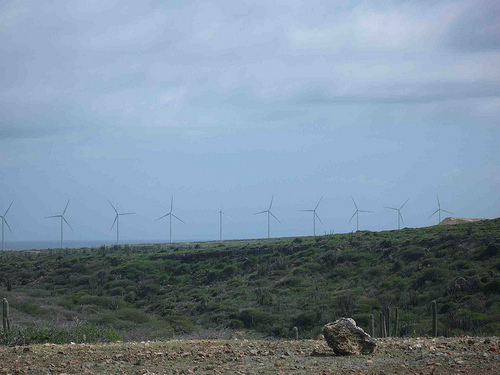
the windfarm is situated in a very isolated part of the island, invisible to everybody
but it adds to that area’s spectacular vistas.
turbine unloading
turbine transportation through the island
both videos by antholejuez on youtube
erection works - same source.
Wind is a capital-intensive but low risk activity where simple and stable financing structures are both necessary and useful - construction costs need to be spread out over a number of years for power generation costs to make sense. Technical and operational risks are understood and very small if you have a competent project company, and the revenue profile is highly predictable, thus making it possible for lenders to provide a large part of the initial cost at a fixed price without requiring any benefit sharing, making this cheaper than equity and keeping the ultimate power price down.
This, called “project finance,” is the boring kind of banking that makes the economy run but is sadly seen as unsexy or useless whenever new funny products are invented in the capital markets and create opportunities for bonus-generating bubbles… I’ve already been set aside as dreary 3 times in the past 15 years: emerging market bonds were all the rage in the mid-90s (until the Asian crisis), then the dot-coms were ‘it’ (until the crash), then the grand multi-product bubble of the past decade, with its mortgage-backed securities, collateralised loan obligations, credit default swaps and the rest. And having being bailed out, they’re at it again, while project finance is still suffering - and wind or solar projects get built more slowly than they could as a result.
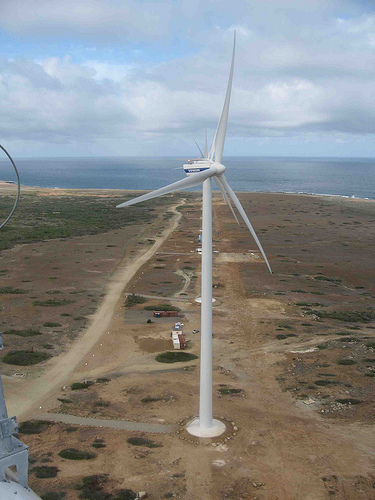
It’s real! It’s generating power! It’s very high!
Drumbeat: December 30, 2022
Fight global warming, get $1,100 a year
NEW YORK (CNNMoney.com) — A new proposal to curb global warming could jump start stalled Senate greenhouse gas discussions and put an average of $1,100 a year back into the pockets of American consumers.
Known as cap-and-dividend, the recently introduced bill would require oil, coal, and natural gas companies to buy permits each month to sell their fuel. Three quarters of the proceeds would be returned to the public each month in the form of a dividend check, with the remaining money going towards renewable energy, conservation or assistance programs.
By driving up the cost of fossil fuel and making renewables more competitive, supporters say the plan will result in the same emission reductions as the current cap-and-trade bills before Congress. But they say it will be much more simple to operate.
Iran police vow to crush protesters with no mercy
TEHRAN, Iran (AP) — Iran’s police chief threatened Wednesday to show “no mercy” in crushing any new opposition protests and said more than 500 demonstrators have been arrested in the wake of this week’s deadly clashes.
Government supporters pack Iranian cities to condemn opposition, U.S.
Tehran, Iran (CNN) — Thousands of Iranian political supporters jammed the streets of the capital and other cities Wednesday in response to anti-government rallies during Sunday’s observances of the holy day of Ashura.
As crowds headed toward Revolution Square, they cried “Death to America,” “Death to Israel,” and “Death to Moussavi.” The latter refers to Mir Hossein Moussavi, the main opposition candidate in Iran’s June 12 presidential election that swept incumbent President Mahmoud Ahmadinejad into office for a second term.
Prudhoe Bay oil spill now as much as 100 gallons
ANCHORAGE, Alaska (AP) — BP now estimates as much as 100 gallons of crude oil may have spilled in an area around a well house where a pipe broke in the Prudhoe Bay oil field, Alaska officials said Tuesday. BP’s initial estimate was 3 gallons of oil.
US Henry Hub average spot gas price sinks in 2009
NEW YORK (Reuters) - U.S. spot natural gas prices at Henry Hub, the benchmark delivery point in Louisiana, tumbled 55 percent in 2009 to average $3.99 per million British thermal units, according to Reuters data compiled on Wednesday.
A deep recession that sharply cut into demand, particularly from the industrial sector, and near-record high domestic natural gas production were the main factors driving prices lower this year.
U.S. Trade Panel Rules for Domestic Steelmakers Against Chinese Imports
WASHINGTON — The U.S. International Trade Commission sided with U.S. steelmakers in a case over Chinese steel Wednesday, voting that U.S. industry has been damaged by a flood of imports of subsidized steel from China.
In the ITC’s largest-ever steel case, all six commissioners said that imports of so-called oil country tubular goods from China have injured U.S. manufacturers. The commission is made up of three Democrats and three Republicans.
Energy Star Gets Tough on LG Electronics
The Department of Energy has announced that, as of Jan. 20, LG Electronics will be banned from using the Energy Star label on 20 of its refrigerator-freezer models.
The agency, which has received criticism for failing to ensure the integrity of products bearing the Energy Star label, said the refrigerators did not deliver required energy and cost savings, and that it was taking steps to protect the American public.
Kurt Cobb: Hope, hopelessness and faith
For those involved in issues of sustainability, peak oil, climate change, and relocalization it might be better to feel a certain hopelessness in our situation. For hope implies dependence on forces outside ourselves. Once we abandon that hope, we can get down to the tasks at hand, the tasks that need to be done-for which we need to ask no politician or government official permission-tasks that we can get started on today. In this way hopelessness concerning the current political and economic arrangements becomes an ally.
So, what we really need is not hope. Hope can be the enemy of action. Hope can be a drug that maroons us in cafes in long, satisfying conversations that never lead anywhere but back to the cafe the next night. In hope’s place I nominate faith. Not religious faith, but what George Santayana calls “animal faith.”
Exclusive: Saudis quit Caribbean oil storage; China steps in
NEW YORK/HOUSTON/BEIJING (Reuters) - Saudi Arabia has quit a long-held lease for 5 million barrels of Caribbean oil storage near the key U.S. market and state giant PetroChina is poised to move in, industry sources say, a potentially major shift in global oil trade dynamics.
Coming just weeks after Saudi Oil Minister Ali al-Naimi revealed the world’s top oil exporter accepted an offer for free storage in Japan, the news underscores the growing importance of China and Asia versus the United States, where the government says oil demand has already peaked and supply competition from nearby Brazil and Canada is expanding.
It also highlights the increasingly global reach of China’s biggest state oil company, which could use the facilities as a staging point for a growing slate of South American oil deals or as trading leverage in the U.S. market, which still effectively sets the global price of oil.
Oil-thirsty China to raise Kuwaiti imports by 50 pct
BEIJING (Reuters) - China has agreed to raise 2010 crude imports from Kuwait by 50 percent to about 240,000 barrels per day, trade sources told Reuters, with Chinese refiners set to to process at record rates as demand rebounds strongly.
The jump, which follows a one-third increase this year, comes after Iraq said it would more than double exports to the world’s second-largest oil consumer and Saudi Arabia agreed to a 12 percent increase for 2010.
“The deals have been finalised,” said a trade source familiar with the term supply agreements. “It’s a big increase.”
Natural-Gas Producers Seek Long-Term Contracts
In a sign that low natural-gas prices are probably here to stay, big U.S. energy companies are pushing to sign long-term contracts with electric utilities and other customers.
Major producers such as Chesapeake Energy Corp. and Devon Energy Corp. are trying to reach multiyear deals — likely five or 10 years long-that would guarantee them buyers for their gas but would deny them the benefits from any sudden price increases.
Oil, natural gas markets brace for surprises
TOKYO (MarketWatch) — Energy traders certainly have their work cut out for them when it comes to guessing the next direction for oil and natural gas as the year comes to an end.
After all, oil’s made an impressive run, poised to end the year with a gain of more than 75% after closing out last year down 54% — its biggest yearly loss since oil futures started trading in New York.
And while natural-gas prices are about to end the year will little fanfare, around 4% higher for the year, that’s still much better than the 25% loss they posted in 2008. Prices have more than doubled from their lows around $2.50 per million British thermal units in early September.
Looking ahead: Power supply not enough in 2010?
MANILA, Philippines - As the holiday season draws to a close, Filipinos now gear up for the upcoming national elections. But as government officials raised the possibility of a power shortage next year, will the 2010 polls be done in the dark?
The government earlier warned of an impending power shortage in the Philippines next year, specifically during the 2010 elections. Citing data, Energy Secretary Angelo Reyes has projected that there would be a 4,100-megawatt shortfall all over the country.
South Africa: Switch on ocean current
A SOLUTION to the country’s energy crisis could be lying off our coast – generating electricity using the power of the Agulhas Current.
Eskom is to be asked to consider a proposal to enter into a collaborative partnership with researchers who have conducted a pilot project.
Pakistan: Discovered gas field awaits PM’s nod
ISLAMABAD – At a time when country is facing severe energy crisis, Prime Minister Syed Yousuf Raza Gilani has unnecessarily delayed gas extraction from a discovered gas field Kunar Pesakhi, located some 25 kilometres east of Hyderabad.
India: Fuel shortage continues to haunt thermal power projects
Coal shortage continued to hit the power sector as 11 electricity generation projects received less dry fuel in November.
NTPC to set up power projects in Egypt
(MENAFN) The Egyptian government has invited India’s NTPC Ltd to set up power projects in the African nation in an attempt to meet an expected surge in electricity demand, Reuters reported.
According to the proposal from the African country, the government will provide the land for the projects and pledge the long-term purchase of power with its central bank guaranteeing transactions.
Finally, a shift to natural gas
Indian industry’s energy consumption pattern finally started shifting toward natural gas in 2009. This has led to a drastic reduction in consumption of liquid fuels like naphtha by sectors like power and fertiliser. Natural gas is a clean source of energy and is environment friendly. But the government’s efforts in the past to direct a shift in India’s energy usage pattern towards natural gas had been hobbled by the wide gap in the domestic demand-supply of the natural gas. The fact that international prices of natural gas were prohibitively high also did not help.
Growing Power Demand Seen to Fuel Mideast Diesel Genset Market to $1.6b in Five Years
DUBAI — Driven by higher per capita power consumption and supply shortages, the diesel generator set market in the Middle East is poised to reach $1.6 billion in five years, a new study reveals.
Apart from growing per capita power consumption and supply constraints, rapid industrialisation is also key driver for the growth of the diesel genset market, said Research Analyst Hemanth Nayak of Frost & Sullivan, a leading business consultancy company. However, in the longer-term, alternate energy sources including nuclear power and more investments in additional power generation capacity by all the Middle East countries will have a negative impact on the diesel generator set. Nayak said a projected high growth in infrastructure, commercial and retail segments are expected to drive the demand for standby and prime power gensets.
Planning for long-term sustainability crucial
Climate change, natural disasters, plant epidemics and liberalisation under the Asean Free Trade Agreement could all affect Thailand’s farm output and trading competency.
The Office of Agricultural Economics predicts prices of major crops will increase considerably next year, by 10-20 per cent.
The effects of climate change, not to mention possible natural disasters, could reduce production and increase demand, thus driving up crop prices. Rising concerns about food security and increased demand for fuel crops in world markets to compensate for oil-price hikes will also hike prices.
Used-car market taking big hit from Clunkers
Welcome to the world of used cars, post-Cash for Clunkers. Because 690,000 used cars were destroyed last summer under that government stimulus program, just when many drivers stung by the recession no longer can afford to buy a new car, there is a lingering shortage of good used cars. And good used cars that are available are likely to be more expensive than half a year ago.
Drug-resistant infections lurk in meat we eat
America’s farmers give their pigs, cows and chickens about 8 percent more antibiotics each year, usually to heal lung, skin or blood infections. However, 13 percent of the antibiotics administered on farms last year were fed to healthy animals to make them grow faster. Antibiotics also save as much as 30 percent in feed costs among young swine, although the savings fade as pigs get older, according to a new USDA study.
However, these animals can develop germs that are immune to the antibiotics. The germs then rub into scratches on farmworkers’ arms, causing oozing infections. They blow into neighboring communities in dust clouds, run off into lakes and rivers during heavy rains, and are sliced into roasts, chops and hocks and sent to our dinner tables.
Jeff Rubin: How much longer will our Chinese food be delivered?
If you think you’re eating local now, you haven’t tasted anything yet.
Food and energy are intertwined at many levels, not the least of which starts right at the production stage. Behind the green facade of the farm gate lies one of the most energy-intensive industries in the world. From fertilizer to farm machinery, most modern agriculture is really about making hydrocarbons edible.
No matter what the crop, the most important input is always energy — and it’s getting to be more so every day. Driven by ever greater fertilizer use and farm mechanization, energy represents half the cost of growing wheat (up from 30 per cent only a decade ago), and over 40 per cent of the cost of growing corn or sorghum.
That should tell you right away that a world of rising energy costs translates directly into a world of rising food costs.
Oil Heads for Biggest Annual Gain in a Decade Amid Iran Unrest
(Bloomberg) — Crude oil was little changed, heading for its biggest annual gain in a decade, on forecasts that U.S. stockpiles are narrowing while unrest in Iran sows concerns supply will be disrupted.
“Stocks are showing the market is getting towards a more balanced situation, though it will take time,” said Alexandra Kogelnig, a consultant with JBC Energy GmbH in Vienna. “Tensions in Iran are always a factor even if there is nothing immediately happening, as if something major happens it will affect exports.”
Crude oil for February delivery was at $78.70 a barrel, 14 cents lower in electronic trading on the New York Mercantile Exchange, as of 11:50 a.m. London time. It earlier rose as much as 32 cents, or 0.4 percent, to $79.19 a barrel. Futures are set for a 77 percent gain this year, the biggest since 1999. Prices have tripled in the past decade.
Is thin trading driving oil prices?
We continue to be of the opinion that the real driver of the oil market last week and this week is the lack of trading volume in the futures market and not really the lack of oil supplies.”
These were the recent words of Olivier Jakob of Petromatrix in Switzerland, and are yet another example of the bearish sentiment toward oil prices that is rampant in the analyst community. Nobody wants to admit that the current supply and demand relationship is temporary. Nobody wants to acknowledge that the world faces some tough decisions in the months and years to come regarding energy supplies.
The era of cheap oil is over. Sure, we could maybe see oil in the $60′s again. But it’s pure folly to expect that oil prices might remain there for any length of time.
FACTBOX - China’s strategic oil reserve plan
BEIJING (Reuters) - China has started building a 3 million cubic metre (19 million barrel) strategic crude oil reserve facility in Lanzhou in Gansu province and plans to start operating it in 2011, state media reported.
Lanzhou is among the sites for the second of three phases of crude oil reserves. China hopes to complete the second phase, totalling 170 million barrels, in two years, Liu Qi, deputy head of China’s National Energy Administration, said in September.
Russian Seaborne Crude Oil Exports Scheduled to Drop in January
(Bloomberg) — Russia, the world’s second-largest oil exporter, plans to reduce shipments of Urals and Siberian Light crude from four Baltic and Black Sea ports by 6.1 percent next month, according to the official loading schedule.
Indonesia sees 15% slash in E&P spend
Indonesia expects spending by contractors on oil exploration in the country to fall to $2.3 billion next year, down about 15% from an estimated $2.7 billion in 2009, the country’s oil watchdog said today.
Angolan firm initials two deals for Iraq oil fields
BAGHDAD — Angolan energy firm Sonangol initialled two deals with Iraq on Wednesday to develop oil fields in the north of the country, oil ministry spokesman Assem Jihad said.
The two agreements completed the initialling of seven deals reached between Baghdad and foreign energy firms earlier this month that aim to ramp up Iraq’s oil output five-fold.
PetroChina Wins Approval for $1.8 Billion Acquisition
(Bloomberg) — PetroChina Co. won the approval of the Canadian government for its C$1.9 billion ($1.8 billion) bid to buy a stake in two Alberta oil-sands projects, its biggest North American acquisition.
The purchase by China’s largest oil company of a 60 percent share in Athabasca Oil Sands Corp.’s MacKay River and Dover oil- sands projects “is likely to be of net benefit to Canada,” Industry Minister Tony Clement said in a statement yesterday.
Belarus to pay cheap for Russian gas in Q1
MOSCOW (Reuters) - The price for Russian gas for Belarus will increase by only 12 percent to $168 per 1,000 cubic metres in the first quarter 2010, Russian gas export monopoly Gazprom said on Wednesday.
Belarus enjoys the largest discount on Russian gas in the region, paying $150 per 1,000 cubic metres of gas in 2009 on average, compared with $208 charged to neighbouring Ukraine, whose ties with Moscow are far worse.
Russia plans gas price hike
Ukrainian state gas company Naftogaz said today it could pay more for Russian gas in the first quarter of next year, raising prices to $305-306 per 1000 cubic metres from $208.12 in the current quarter.
Polish Ministry Opposes Gas Compromise With Gazprom, rp.pl Says
(Bloomberg) — Poland’s Treasury Ministry opposes any compromise with OAO Gazprom on overdue payments to domestic gas company Polskie Gornictwo Naftowe i Gazownictwo SA that are preventing the signing of a gas-supply accord, rp.pl reported.
Deputy Treasury Minister Mikolaj Budzanowski told the Web site of the newspaper Rzeczpospolita that Polskie Gornictwo won’t be pushing for an agreement “at all costs.”
Dark days at the centre of Europe
The Baltic state of Lithuania — sandwiched between Latvia and the Russian exclave Kalingrad — faces an economic contraction of 18 percent for 2009.
To that the government has said it will add a 30 percent increase in household power prices in 2010, as it fulfils a condition of European Union membership and shuts Ignalina, the Chernobyl-style nuclear power plant that provides 70 percent of Lithuania’s power.
Russian oil pact gives Iraqi economy a shot in the arm
Although it sits atop the world’s third largest proven reserves of conventional crude oil, Iraq produces about 2.5 million barrels per day, of which about 1.9 million barrels a day are exported.
Decades of neglect of the fields have been compounded by the effects of the fighting and sabotage in the wake of the 2003 U.S.-led war to oust Saddam. That violence has meant that Iraq has been unable to even reach its prewar output levels of oil. Crude oil sales account for roughly 90 percent of the government’s budget.
Taiwan Energy Use Rises for Third Month on Industrial Demand
(Bloomberg) — Taiwan’s energy use rose for a third straight month in November on increased demand from factories as overseas orders for the island’s semiconductors and mobile phones surged.
Consumption of coal, petroleum, gas, thermal energy and electricity advanced 11 percent from a year earlier to the equivalent of 9.56 million kiloliters of oil, or about 2 million barrels a day, the Bureau of Energy in Taipei said in an e- mailed report today.
Only four days’ oil left after Iran upheaval and strike here
IRELAND was almost nearly out of oil amid political upheaval in Iran in 1979 and a strike at Dublin Port, newly released State papers reveal.
At one stage during July, the country had just four days’ supply left as ministers and officials held crisis talks with oil company chiefs.
Energy Minister Des O’Malley warned of the “serious situation” not 70 miles from Dublin with creameries about to close and tourism seriously affected by dwindling supplies.
Dutch court to hear Shell case
A district court in The Hague has agreed to hear petitions filed by four Nigerian men who allege that Royal Dutch Shell was negligent in cleaning up a 2005 oil spill that damaged their farms and fisheries.
Wanted: green engineers
Regardless of the outcome of the Copenhagen conference in December 2009, one of the most pressing anti-climate-change needs will be the ability to get things done in 2010 and beyond. The commitments already made by some large economies require an extremely large capacity to get new energy systems in place quickly. That includes making sure that there are the people around to design and build them.
The infrastructure needed to make a large dent in the world’s emissions is daunting. What is unusual is not the scale of investment, but that much of it has to be spent on new capabilities. With the use of coal worldwide expected to double by 2030, for example, carbon capture and storage (CCS) technologies will be crucial. The amount of pipelining, geological surveying and chemical engineering needed for this is not unprecedented compared with what already exists in the oil, gas and mining industries. But it is vastly larger than today’s CCS capacity, and the people needed cannot just be borrowed from the current fossil-fuel industry.
PG&E Customer Revolt May Threaten Rollout of Obama’s Smart Grid
(Bloomberg) — Consumer backlash and cost concerns may cause delays in the nationwide rollout of “smart” utility meters at the center of the Obama administration’s $8 billion push to update the U.S. electricity grid.
PG&E Corp., owner of California’s largest utility, halted meter installations in Bakersfield, north of Los Angeles, after hundreds of customers complained that readings weren’t accurate. The meters, part of a so-called smart-grid initiative billed as clearing the way for more renewable-energy use, are designed to help consumers conserve power during periods of peak demand.
Energy Star appliance rebates, announced in July, won’t be available for months in many states
Rebates to buy energy-efficient appliances, announced by the U.S. government in July, are so far available only in Delaware and won’t be offered in many states until spring.
The $300 million “cash for appliances” program, funded by the federal economic stimulus, is being rolled out gradually, state-by-state. In contrast, the popular “cash for clunkers” car trade-in program was national, so all buyers were eligible the same day.
Toyota Tsusho to Produce Jatropha as Alternative Fuel
(Bloomberg) — Toyota Tsusho Corp., the trading affiliate of Toyota Motor Corp., plans to start growing jatropha next year as it bets that higher crop yields and oil prices will make the plant a profitable alternative fuel.
The Nagoya-based company is in negotiations with a Philippine banana plantation to produce the leafy green shrub, Makoto Hattori, a project development manager, said in an interview, without naming the company or disclosing the size of the investment.
Ethanol Industry: Protect Corn to Save Second-Gen Biofuels
The latest line from two ethanol industry groups suing California over its low-carbon fuel standard goes something like this: Second-generation biofuels will die unless corn-based ethanol is protected.
China to Be World’s Third-Largest Windpower Producer
(Bloomberg) — China will become the world’s third- biggest producer of electricity from wind by the year-end as it taps more renewable sources of energy and reduces the use of polluting coal, a government official said.
The country’s windpower capacity will reach 20,000 megawatts this year, Shi Lishan, deputy director of new energy at the National Energy Administration, said during a Webcast today. In 2004, the capacity was 764 megawatts, Shi said.
Kazakhstan Says It Became the Biggest Uranium Producer in 2009
(Bloomberg) — Kazakhstan this year became the world’s biggest uranium producer, overtaking Canada, after it boosted output 63 percent, according to the Central Asian nation’s state-run mining company.
Kazakhstan mined 13,500 metric tons of uranium as of Dec. 21 and will mine at least another 400 tons before the end of the year, Almaty-based, Kazatomprom said in a statement e-mailed today.
Audio slideshow: Life on the water
If water levels rise in Vietnam’s Mekong Delta as a result of climate change, more and more people may have to adapt to life on water. But some of them have been living that way for years. The Can Tho floating market is one example.
People buy from farmers and act as wholesalers to the small boats which sell the fresh produce to locals along the river. They are mostly rowed, with crossed oars, so the environmental cost of the journey from field to bowl is minimal.
Sarkozy scrambles to salvage carbon tax
PARIS — French President Nicolas Sarkozy faced an embarrassing setback Wednesday after the high court struck down a planned carbon tax to fight global warming, just days before it was to kick in.
The constitutional court ruled that too many exemptions to the tax on carbon dioxide emissions created inequalities and unfairly placed the burden of cutting down wasteful energy use on a minority of consumers.
Trade, Transportation, and the Chinese Finger Trap
(This essay originally ran three years ago but the concepts and implications remain relevant today. )
One of the central underpinnings of neo-classical economics is trade. And one of the central tenets of trade is the Ricardian theory of comparative advantage. Trade (in theory) benefits both parties because both are better off after the exchange. But our international trade system has, by baby steps, become completely dependent on twin enablers: crude oil and credit. By air, water, land or rail, petroleum accounts for 95% of all transportation energy. As we move up the complexity chain in the products that make up our daily lives, are we moving further into a Chinese finger trap where there is no backing out?
This post will examine the theory of international trade and the hierarchy of goods transport, production and consumption. It is quite possible that in the next decade, the increase in price (or the decreasing availability) of oil and financing, will offset the benefits of many types of trade.
The pursuit of economic efficiency, through increasingly diverse and extensive global trade has glossed over two important facts which this post will examine: 1) higher oil prices in long distance transport must at some point exceed (economically or otherwise) the benefits achieved from some trade and 2) a complex global trade system is gradually but pervasively decreasing the ability for localities, regions and nations to be self sufficient – so many of our supply chain inputs are imported that continued increase in oil price/affordability will resurrect import substitution policies, not only for less developed countries, but for the US and rich nations as well.

International Trade - A Chinese Finger Trap?
INTRODUCTION
The idea for this post originated on a recent errand to Fleet Farm to buy a replacement spark plug for my dad’s chain saw. I discovered there are not one or two kinds of spark plugs but hundreds, depending on the type of machine they go into. The plugs were made by a variety of companies, some domestic, some foreign but none from my state (currently Wisconsin). As I noticed this, I looked around the dozens of aisles and hundreds of shelves at the thousands of products and ‘saw’ for the first time how complex our import/export system has become. And the fact that my dad couldn’t cut our firewood without that certain sparkplug reminded me of Liebigs law of the minimum, or in the vernacular - something is only as good as its weakest link. I couldnt help wondering how much oil was embodied in those spark plugs: their parts, their manufacturing, their delivery to central Wisconsin, etc. While my research didn’t discover this answer, it did result in my viewing trade, transportation, and our society’s consumption habits in a different light.
Much has been written on this site and elsewhere on the exact date or time range when we begin the second half of the age of oil. I will not address timing in this post other than to point out that the later it is, the more can be done to address the systemic risks suggested below. The human pendulum of complacency and panic is in full effect as oil breached $50 on the downside today. Those who read this piece and connect the dots should recognize that $50 oil is not a reflection of its abundance or scarcity but is rather an opportunity to effect change (because change is cheaper). There are after all, about 30 billion barrels less oil left than there were a year ago.
Finally, though the following analysis may suggest otherwise, I am not against free trade. I think trading is fundamentally human and improves peoples lives. The theory of comparative advantage was one of the coolest principles I learned in graduate school. But the giant extended tentacles of free trade are one of many premises that were initiated on an empty planet that may require contraction/adjustment on a full one.
TRADE
Trade has been around almost as long as humankind. Historically trade was largely a barter system, before currency was adopted as a medium of exchange. Modern international trade is based largely on Ricardian model of comparative advantage, one of the most eloquent but non-intuitive concepts in economics. Indeed, a story told amongst economists is that when an economics skeptic asked Paul Samuelson (a Nobel laureate in economics) to provide a single, meaningful and non-trivial result from the economics discipline, Samuelson quickly responded with “comparative advantage.”
ABSOLUTE AND COMPARATIVE ADVANTAGE
The early logic that free trade could be advantageous for countries was based on the concept of absolute advantages in production. Adam Smith wrote in The Wealth of Nations:
“If a foreign country can supply us with a commodity cheaper than we ourselves can make it, better buy it of them with some part of the produce of our own industry, employed in a way in which we have some advantage. ” (Book IV, Section ii, 12)
The idea here is simple and intuitive. If one country can produce some set of goods at lower cost than a foreign country, and if the foreign country can produce some other set of goods at a lower cost than can be done locally, then clearly it would be best to trade for the relatively cheaper goods of both countries (or regions). In this way both parties gain from trade.
If a person/region/country can make a product cheaper or more efficiently than someone else, they have an absolute advantage in this product. However, a country that can produce two things (or everything) better than another country can still benefit from trade. This is due to the brilliant (on an empty planet) theory of comparative advantage first articulated by David Ricardo. Here is an example:
The Magic of Comparative Advantage – A Hypothetical Example
Both Wisconsin and North Carolina have lots of trees, productive farmland, access to labor, and cows. (assume for this example their labor force and populations are equal) Both produce cheese and furniture. But Wisconsin (for various reasons) has an absolute advantage in the ability to produce both cheese and furniture. If they were to devote all their resources each laborer could produce 12 units of cheese or 4 units of furniture. In North Carolina, each unit of labor can produce 6 units of cheese or 3 units of furniture.
Wisconsin is ‘better’ at making both products, but applying the theory of comparative advantage, North Carolina is ‘less worse’ at producing furniture. This can be seen via the concept of opportunity cost. For every unit of furniture production, NC is giving up 2 units of cheese production (6/3). For every unit of furniture production in Wisconsin, they are giving up 3 units of cheese production (12/4). Therefore it is ‘more costly’ in terms of opportunity lost for Wisconsin to produce furniture than it is for North Carolina, in a world of frictionless trade.
Specifically, in a position of autarky (or closed economy), each state will devote half its resources to each production pursuit – Wisconsin will produce 6 units of cheese and 2 units of furniture. North Carolina will produce 3 units of cheese and 1.5 units of furniture. In our hypothetical world without trade then, a total of 9 units of cheese and 3.5 units of furniture are produced.
But then a trade agreement is signed. Because they have a comparative advantage in furniture, North Carolina devotes 100% of their resources towards producing 3 units of furniture. (and no cheese). Wisconsin produces 12 units of cheese (and no furniture). Now the ‘world’ has 12 units of cheese and 3 units of furniture. However, Wisconsin can easily shift 3 units of its cheese production to create one unit of furniture. The world now has 9 units of cheese and 4.5 units of furniture with no extra resources or labor.
Trade, via specialization, has magically created an extra piece of furniture, with still the same amount of cheese!
WHAT PRICE CHEESE?
A key question in this post: what happens when the cost of transportation of cheese and furniture between North Carolina and Wisconsin (via higher oil prices) exceeds the benefits from trade (an extra unit of furniture)?
I remember in graduate school thinking comparative advantage was pretty cool. But, like many things in neo-classical economics, comparative advantage relies on a battery of assumptions, many of which prove problematic in the real world. Josh Farley and Herman Daly succinctly describe some criticisms of the assumptions that underpin comparative advantage in their textbook “Ecological Economics”(1),
1. “No extra resources” simply means no additional labor or capital - there IS commensurate resource depletion and pollution accompanying the extra production.
2. The neglection of transportation costs. Transportation is energy intensive, and currently energy is not only directly subsidized, but, in addition, many of its external costs are not internalized in its price. Consequently, international trade is indirectly subsidized by energy prices that are below the true cost of energy.
3. There are two important costs of specialization. First, all cheese makers (cheesesmiths?) in North Carolina must become furniture producers and vice versa for furniture makers in Wisconsin. Making such a shift is costly to all whose livelihood is changed. Also in the future the range of choice of occupation has been reduced from two to one - likely a welfare loss and assuredly an occupational risk.
Furthermore, after specialization, countries lose their freedom not to trade (the chinese finger trap). They have become vitally dependent on each other. . . Remember that the fundamental condition for trade to be mutually beneficial is that it be voluntary. The voluntariness of ‘free trade’ is compromised by the interdependence resulting from specialization. Interdependent countries are no longer free NOT to trade and it is precisely the freedom not to trade that was the original guarantee of mutual benefits of trade in the first place.(1)
CAPITAL MOBILITY
An often overlooked provision of Ricardian comparative advantage, but one of extreme relevance in today’s world, is that of factor immobility (factors other than cheese and furniture). In reality, today’s borders are porous to billions upon billions of dollars of capital movements moving to the areas of the world with the cheapest production. In effect, the rich countries have a comparative advantage in ‘money’ and are trading it for the labor and resources of other countries.
A country’s current account is the difference between the monetary value of exported and imported goods and services. When the imports are greater than the exports, the account is in deficit. If exports are greater, the current account is in surplus. So, comparative advantage, with the assumption of immobile factors relaxed has effectively resulted in the erasure of national boundaries for economic purposes.
Some people call this globalization.
The following graph shows the increasing percentage that trade is out of total US GDP:
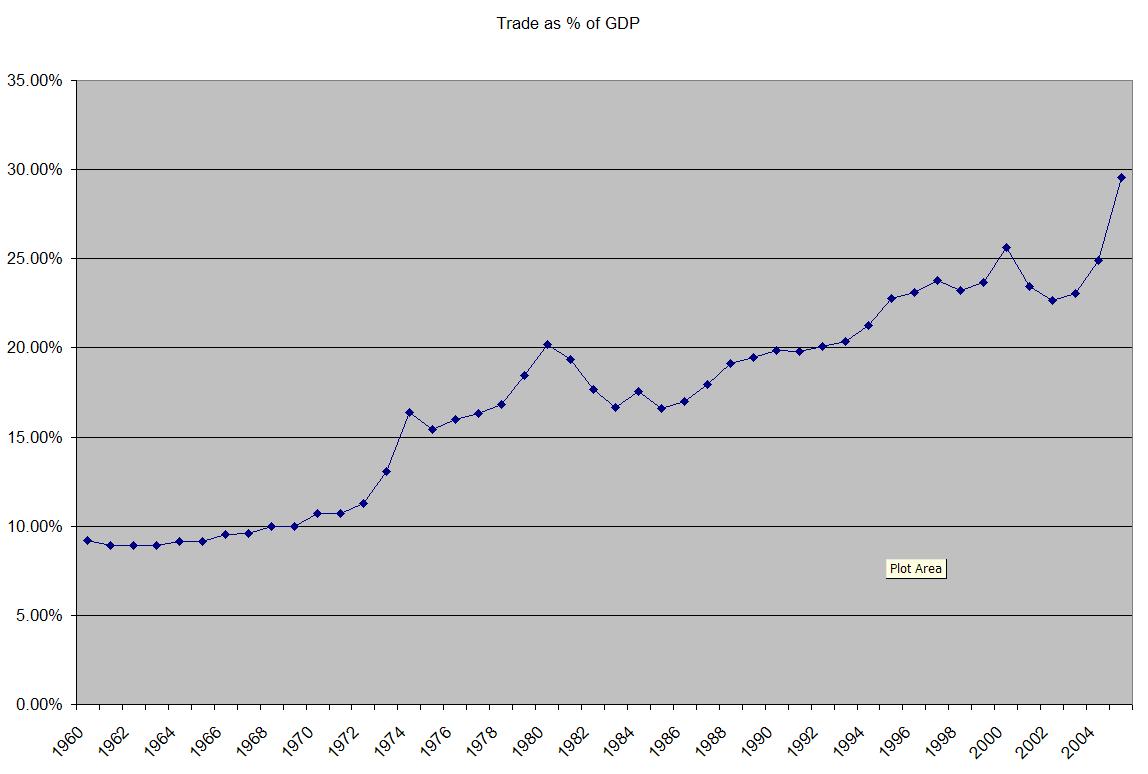
US International Trade as % of GDP- Source US Census Bureau Click to Enlarge
Below is a chart of US imports and exports and our trade balance:
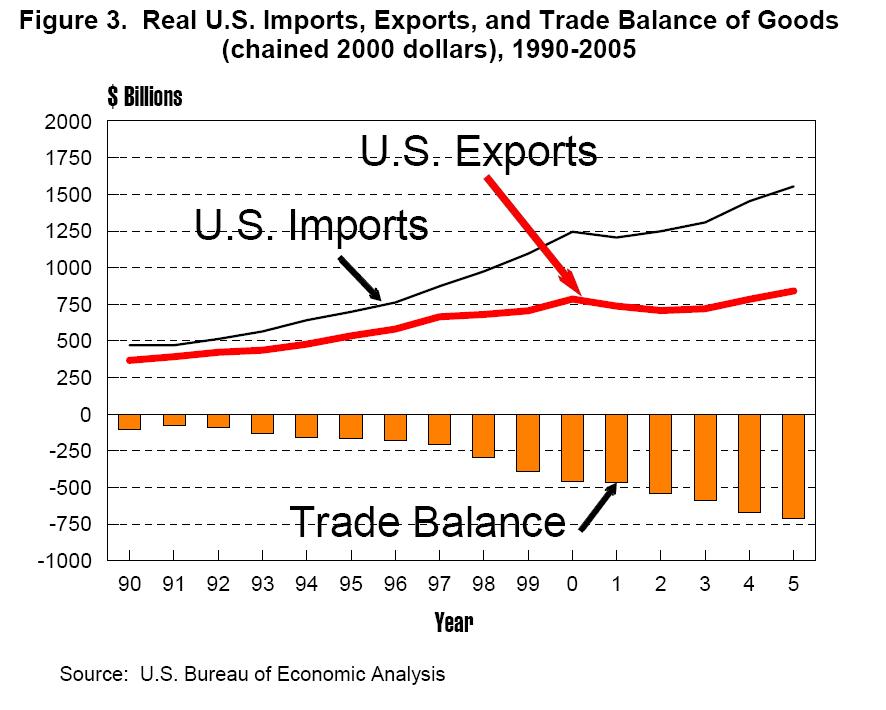
US Imports and Exports - Click to Enlarge
As can be seen above, imports have been outpacing exports for some time and the pace has accelerated of late.
Though the basic goods vs luxuries trade mix is a complicated analysis, one thing is clear - oil now makes up 10% of the dollar value of our imports:
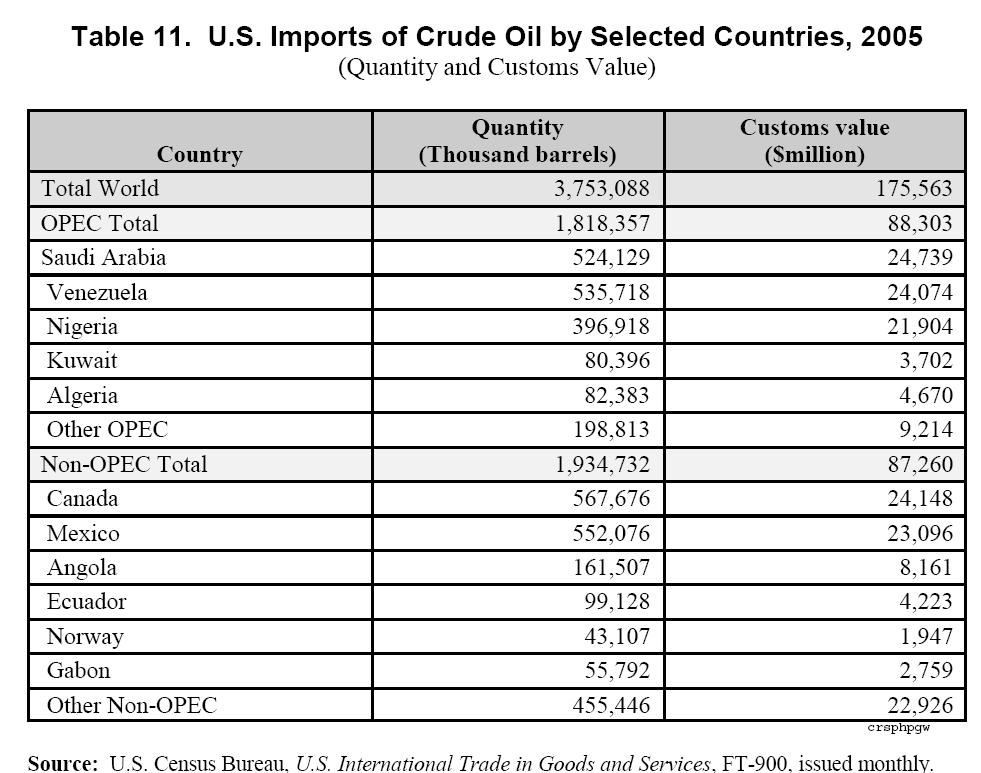
US Oil Imports by Country - Click to Enlarge.
Finally, it is of some concern that ‘services’ continue to increase as a percentage of our national ledger (implying that ‘goods’ are becoming less). We still do produce huge amounts of food for export, but that is increasingly being accompanied by movies, massages and things higher up the ‘discretionary’ hierarchy (more on that below). Here is a graph indicating the growth of services vs goods in our Gross Domestic Product and Employment. America seems to have a comparative advantage in ‘services’. The counter-argument is that more services naturally arise as economies become less energy intensive - this view ignores energy as a unique input, and therefore all countries can’t become less energy intensive over time under a growth regime.
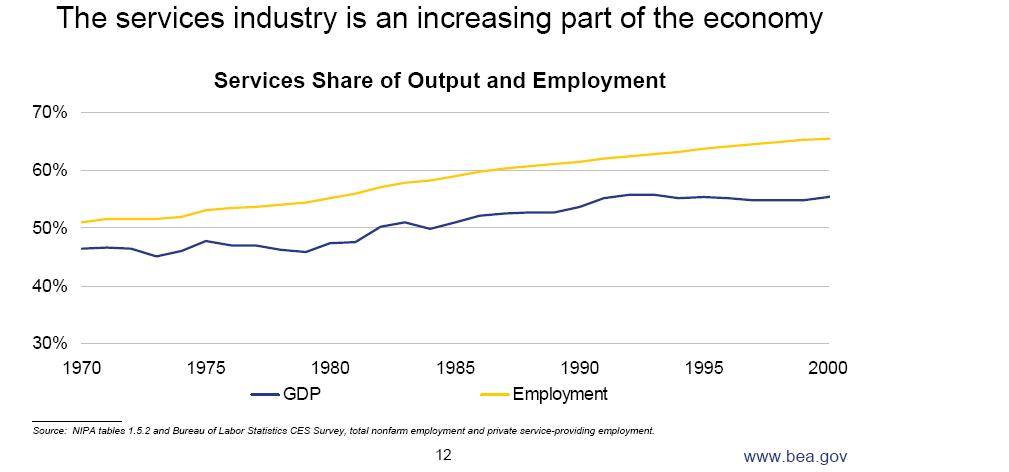
US Goods and Services- Click to Enlarge.
THE GRAVITY MODEL OF TRADE
The Ricardian model is not the only economic model dealing with trade. The Gravity model of trade gets more at the heart of this post - that of the relationship between trade and transportation. It presents a more empirical analysis of trading patterns rather than the more theoretical models discussed above. The gravity model, in its basic form, predicts trade based on the distance between countries and the interaction of the countries’ economic sizes. The model mimics the Newtonian law of gravity which also considers distance and physical size between two objects.
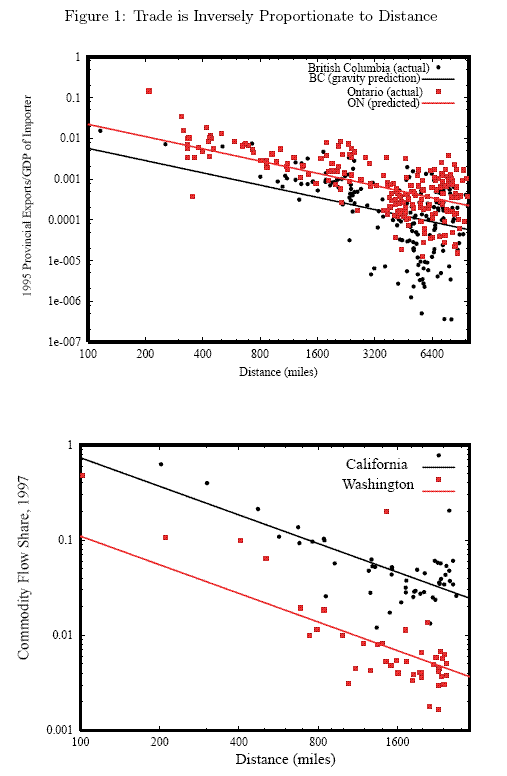
Gravity Model of Trade-Commodity Flow Correlation with Distance (2)- Click to Enlarge.
Here is another graphical illustration which incorporates speed (which increases energy return on time) and energy intensity:
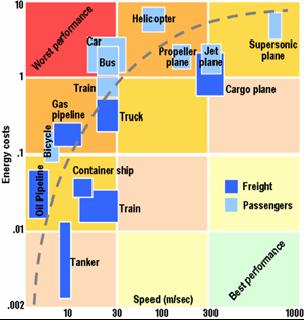
Energy costs vs speed
Jean-Paul Rodrigue Hofstra University (hat tip H.K.)
It makes sense that trade is inversely correlated with distance because even at today’s cheap oil prices (remember - oil is cheaper than water, milk, orange juice, YooHoo, etc), things cost more to ship further. As oil prices increase, this inverse correlation should strengthen.
A PALEO-ECONOMIC PALATE CLEANSING SIDEBAR BEFORE WE MOVE TO TRANSPORTATION
A recent article in the Economist points out that comparative advantage also works at our most basic level of trade (male/female) and was of historical significance:
In existing pre-agricultural societies there is, famously, a division of food-acquiring labour between men, who hunt, and women, who gather. And in a paper just published in Current Anthropology, Steven Kuhn and Mary Stiner of the University of Arizona propose that this division of labour happened early in the species’ history, and that it is what enabled modern humans to expand their population at the expense of Neanderthals.
With Peak Oil likely being in 2005, perhaps I should brush up on my woodchopping and carcass dragging skills…;-)
TRANSPORTATION
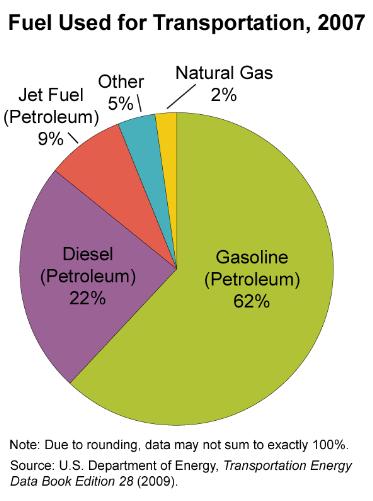
Our modern society is structured around just-in-time delivery of people and things. And petroleum makes up the vast majority of getting things around. Fuel represents 35% of operating expenses for airlines; the direct fuel cost is 20-40% of the total cost of trucking and fuel costs amount to 20-30% of cost for sea freight. And transportation itself comprises an increasing amount of total energy use:
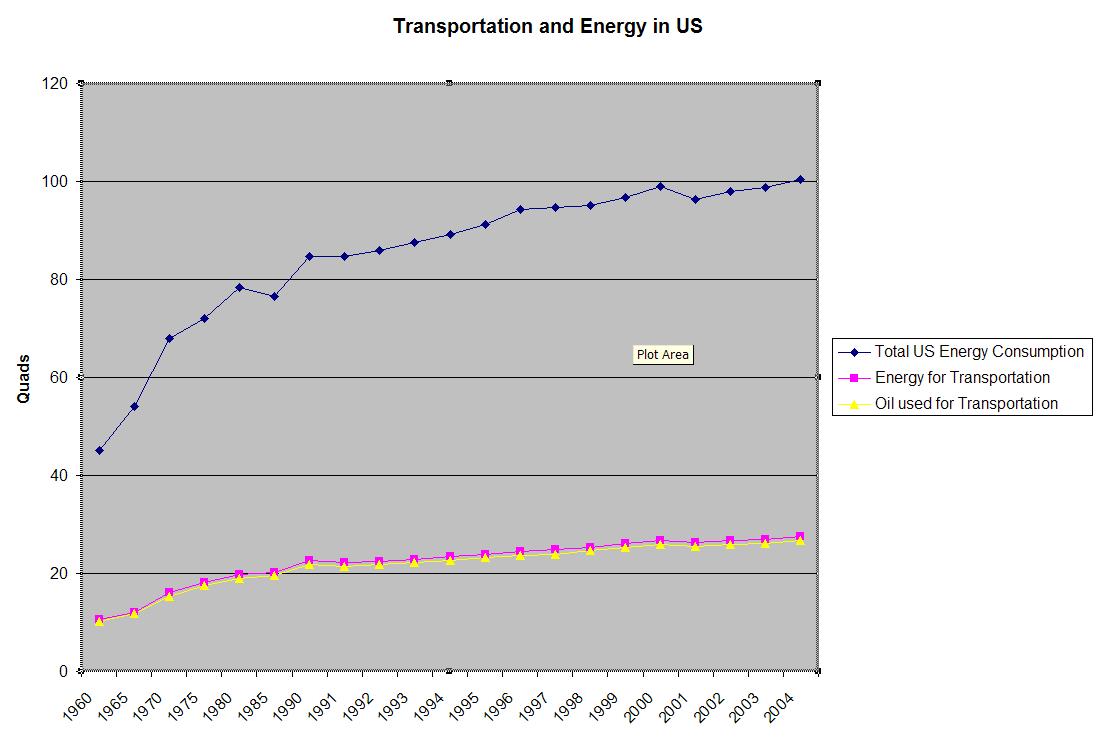
Transportation as percentage of total energy use- Click to Enlarge
In the 1960s transportation accounted for about 23% of all energy expended in the USA- now the figure is approaching 28%. The yellow line (almost on top of the pink line) shows that of the transportation, 99% of it is oil (there is some electrical, natural gas and coal usage) (3). We are really dependent on oil!
The following two graphs show the energy efficiencies of various modes of transportation first for people and then for goods. This first graph is from Richard Heinberg’s book “The Oil Depletion Protocol” and is based on data from Britain (which Richard tells me is fairly universal):
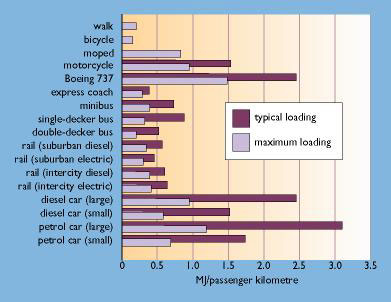
MegaJoules per passenger- Click to Enlarge
As can be seen, the bicycle is the most energy efficient mode of transportation - even better than walking. The other insight from the graph is we gain quite a bit of efficiency from packing a lot in one vehicle. (This is a concept used often in China.)
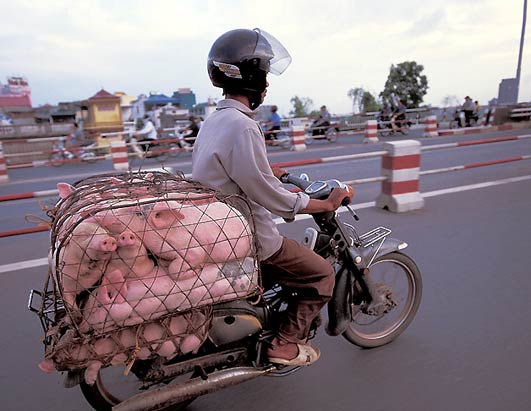
As far as transporting goods, there is a large disparity in energy efficiency per ton mile for different transport methods:
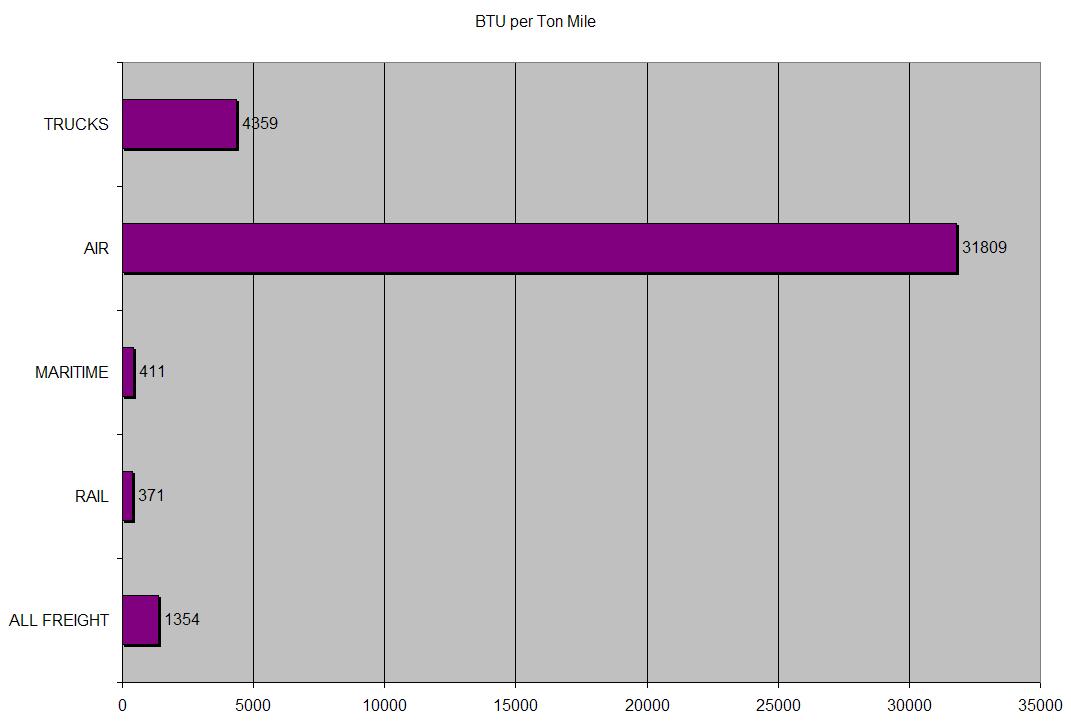
Energy Intensity per ton mile by freight mode. Source - EIA Click to Enlarge
The above graph is somewhat dated (1991). Though there have been efficiency improvements across the board, the general model of water/rail/truck/air in order of efficiency seems to still be intuitively correct, though some argue that rail is more efficient than water. It is actually quite a complicated issue as it depends what one is transporting and the sequence of steps. Alan Drake recently did a study showing rail transport to be 8.3 times as efficient as trucking.
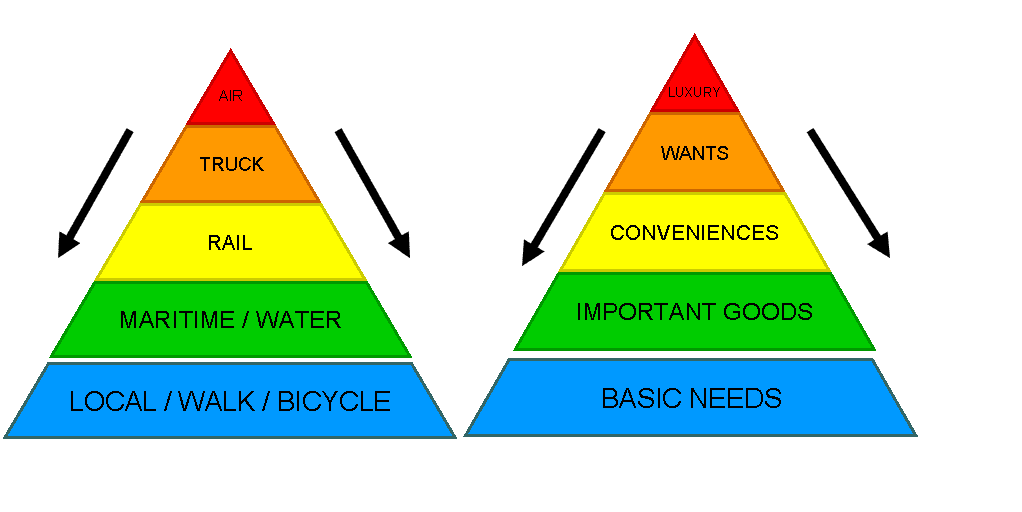
One can visualize the energy efficiency/footprint of various transportation modes as something like this pyramid:
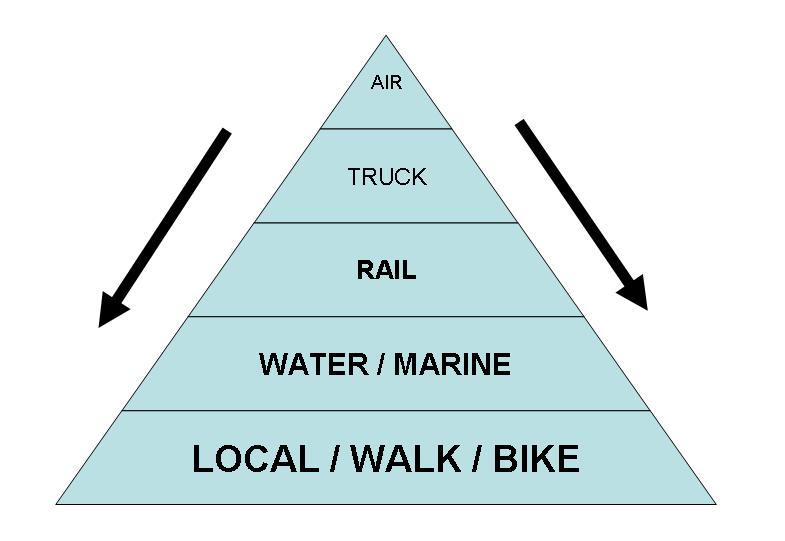
The Transportation Pyramid. Click to Enlarge
As transportation costs increase, communities and regions that are able to effect movement downwards on the pyramid towards its base will have comparative advantages, due to savings on energy costs, and availability of products.
ENERGY USE AND HUMAN WANTS AND NEEDS
Let’s now shift gears just a bit. Psychologist Abraham Maslow theorized that humans meet basic needs in a hierarchical fashion. Once basic needs are met, we seek to satisfy higher needs such as self actualization and fulfillment. In the current era of cheap oil, at least for western society, a very small percentage of energy is spent on basic needs compared to the energy intensive ‘desires’ that drive western society:
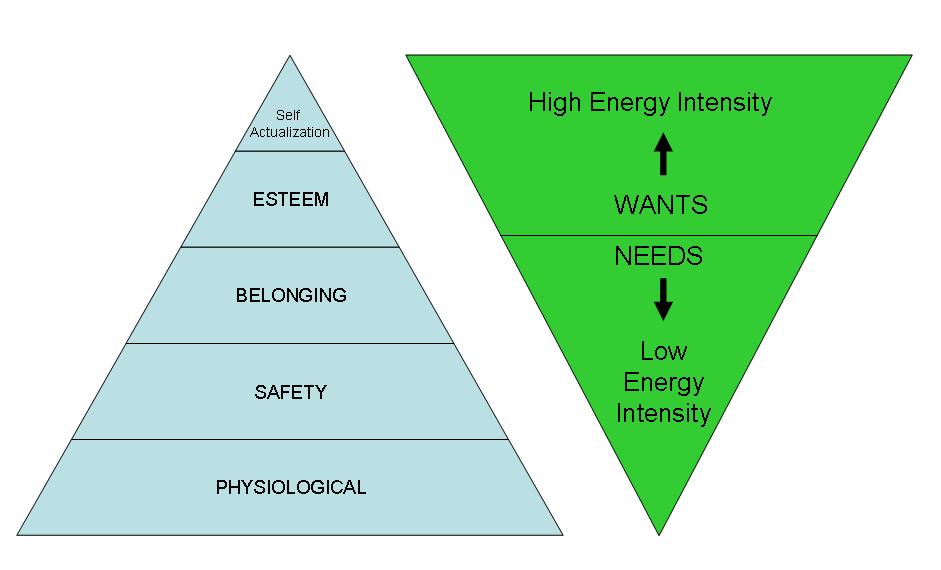
Maslow’s Hierarchy of Needs——————Nate’s Intuitive but Made Up Hierarchy of Energy Use. Click to Enlarge
This concept can be expanded upon. We sometimes take for granted the things that we really need, and make us happy - I am 90% as happy eating fried fish from a local lake as I am driving to Chicago to my favorite sushi restaurant (well at least 80%). Higher personal consumption efficiencies in an energy challenged world are lower on the pyramid.
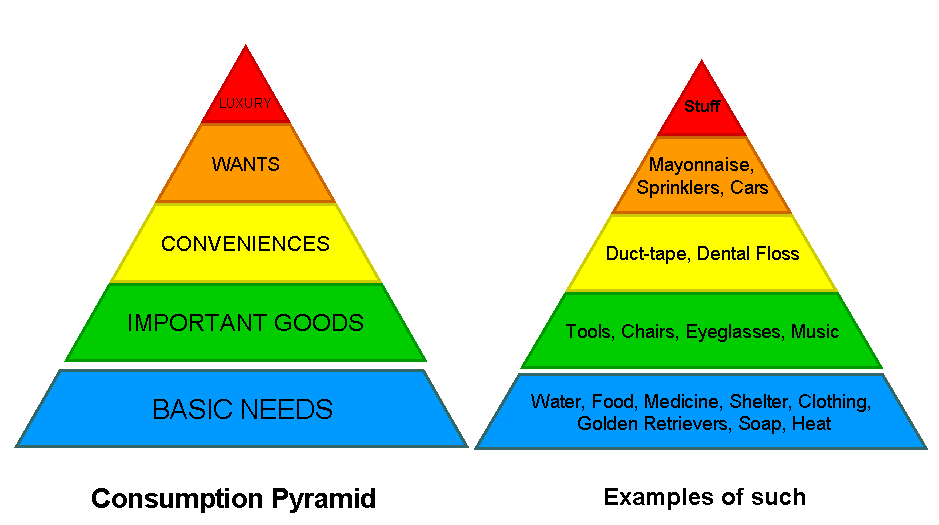
The Consumption Pyramid - Click to Enlarge
We finally come full circle to the spark plug question. There is a great movement (at least in the peak oil circles, not yet in the peak credit circles) towards relocalization. But ‘local’ labels in many cases are misleading due to the insidious reliance on foreign parts at different moments in the supply chain.
One of my best and oldest friends is an entrepreneur from China. He owns a business in Connecticut that seeks out American companies that need nails, screws, and small metal parts at their factories - he then signs contracts for 5 million screws at 2.5 cents each - screws that in the US would cost 6 or 7 cents due to higher labor etc. He pockets half the difference-the point being that our basic goods might ostensibly be made here, but their component parts may not.
I have not seen a way to measure this so have come up with my own “Embedded Transportation Chain”. First Order Origin represents where you buy something (in your town would be 100% local). Second Order Origin represents where the components and parts came from on the product you bought. And Third Order Origin represents where the raw materials came from for the parts to make the Second Order Origin parts. To determine how ‘local’ (in the sustainability and security sense) a product is, one would multiply Level 1 * Level 2 * Level 3. Of course, there is very little that is truly local, as a world of increasing international trade has increased ‘Third Order Origin’ percentages dramatically. (I don’t have accessible data on this-the amount of work would be closer to an academic paper – here I just wanted to lay out the idea). True to the field of economics, I have made these terms up. However, also consistent with economics, one can grasp the common sense implications. When looked at in this 3-tiered light, the phrase “Made in America”, takes on different meaning.
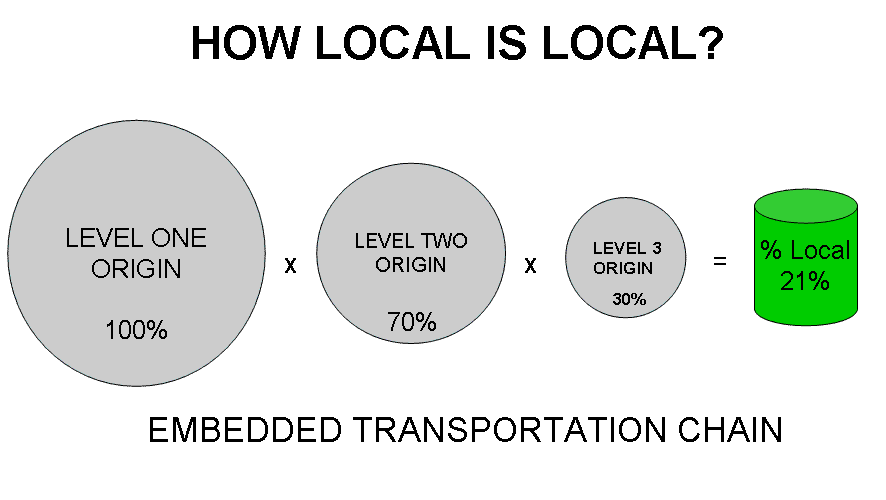
The Transportation Origin Chain- Click to Enlarge
I currently reside in Wisconsin. To eat local is cheese curds, fried fish and venison. All these things can be bought (or harvested) locally. But the cheese company gets milk transported from around the state, and uses packaging made overseas from natural gas. Its employees drive to work using cars made in Japan and oil from Nigeria and eat food imported from New Zealand. Although the dairy farmers themselves use largely local inputs for feed and bedding, their milk buckets are made from steel processed in China, and the wood for the barn comes from a mill in Canada. It is not easy to decipher the ‘localness’ of a product, unless one walks out and picks a wild mushroom. Use your imagination however to consider WHAT IF oil doubles triples or more in price, what sort of domino effects might occur in the production supply lines. It is hard to predict what “Liebigs product of the month” might disappear from the store shelves - Charmin bath tissue one week and Stihl chain saw blades the next.

A quick example is footwear. 98% of all shoes in the United States are made somewhere else, many in China.
CONCLUSIONS
Increases in efficiency of goods production in a global context are considered a good thing, as they raise respective countries GDP, and allocate resources wherefore the total pie gets bigger. Once on this track, however, participants continue to strive for more and more efficiency, more trade advantage and cheaper production. If taken to its natural extreme, every place on earth will specialize to the maximum profit of corporations. Implicit in this path is the forgoing of expertise and local resources that are lower down the pyramid of human necessities. If transport costs are 20% of a products value and oil doubles or triples, they become upwards of 50% of a products cost. Certain products then become uneconomic to ship. Some of those products are components of larger products which do not have local substitutes.
High quality and abundant oil has obfuscated the difference between wants and needs. At a Walmart or a Safeway, young people today see quilted bathroom tissue, pork chops, colorful shoes, dental floss, and avocados as a natural smorgasbord, without internalizing the complex energy/trade chain that put them there. This plethora of choices that globalization offers us could just not be possible in local or regionally based economies. In some sense, to revert the global network of specialization back towards less complex, more regional networks is kind of a chicken-or-the-egg dilemma. Unless we change the consumption drivers, there will be little incentive for the manufacturers of nascar lunch boxes to move downwards the production/transport and global/local pyramids.
When (and in my opinion, it’s only a matter of when) oil becomes less available/affordable, centralized forms of energy command will not be efficient because different regional blocks and localities possess their own comparative energy and resource advantages and disadvantages. National umbrella energy policies treat all states the same. Corn ethanol roll out is a prime example - what might be great for communities in Iowa and Minnesota has different math for California and Vermont. We know that distance impacts energy efficiency and costs. We also know that different states (and countries) have different indigenous energy resources (Quebec has hydro – Arizona has sun, Montana has wind and coal, etc). It is likely there will be decentralization of energy production as regions move toward building blocks of basic needs in safer spatial scales. The magic of comparative advantage can still work in the second half of oil. But it ultimately will differentiate between basic needs and unnecessary desires - and take advantage of water and railway access.
THE BOTTOM LINE
1. We need oil for more than just driving. It is embedded in almost everything. Unless you’re Amish, Aleutian, or have alot of friends, oil is life in the USA (at least currently).
2. Higher oil prices combined with lower credit availability will eventually make certain types of trade prohibitive.

3. Those nations, regions, communities and families that produce lower on the left graph and consume lower on the right graph will have an advantage when transportation costs increase. Those communities using predominantly rail and water transport will have advantages over those more dependent on truck and air, everything else being equal.
4. As is occurring in some South American nations currently (Peru and Venezuela come to mind), a return to the import substitution model away from the so-called Washington consensus seems inevitable. However, remember the supply/demand wedges in the Hirsch/Bezdek report showing how rapidly production shortfalls could occur. Local, regional and national action needs to be taken soon because of the required long lead times.
5. In rich nations, in addition to conserving, it will be advantageous to begin to be happier with ‘less’ because the delta of ‘desires’ may change more slowly than that of ‘things’ available in the future, relative to other countries (e.g. Europe and Africa) that exhibit lower energy footprints. In other words, though the USA can easily get by with half as much energy-intensive stuff and conveniences, an abrupt change to this level will be much more mentally painful than a gradual one.
In conclusion, as a thought experiment, the next time you go to your nearest box store, look at the gazillion products on display. Try to imagine where they come from, where their parts come from, and how that supply chain might change when new oil production fails to match decline rates of older wells. While you are there, you might notice how many of the myriad products improve the lives of you or your friends, and how many do not. This ‘demand’ side view of Peak Oil will be the subject of my next post.
Next post (if I successfully defer my addictions): “Evolution, Discount Rates and Addiction”
Nathan John Hagens
theoildrum.com
email [2009 e-mail njhagens at gmail dot com]
Resources cited:
(1) Ecological Economics - Principles and Applications, Herman Daly and Joshua Farley (in my opinion, a textbook that should be used in every college in America)
(2) “Gravity for Beginners” Keith Head. http://pacific.commerce.ubc.ca/keith/gravity.pdf (.pdf warning)
(3) National Transportation Statistics 2006(pdf warning), US Department of Transportation
Note 12/28/2009 - I intended to update this analysis with a) statistics on fuel cost/intensity relative to cargo value/necessity, and b) the transport substitutions that may become available for oil, but other projects became more pressing (read: interesting). Also, though I mentioned credit in the essay, many of the advantages of trade may disappear even with plenty of oil, if significant currency reform/reset occurs or if credit becomes generally unavailable. If anyone has expertise in those areas they’d like to share as a guest post, please submit an abstract, or summarize in comment section below.
Drumbeat: December 29, 2022
Aging suburbs lose appetite for driving
The generation that gave birth to suburbia and the two-car garage is reaching the age where for many driving no longer seems like such a swell option. As Americans grow older — one in five will be over the age of 65 by 2030 — many are finding that the world that lured them away from city life is losing some of its appeal.
“The concern is that when they no longer can drive they will find themselves trapped in their homes in suburban neighborhoods where there are no sidewalks or, if there are sidewalks, there’s no place to walk to,” said Stewart Schwartz, executive director of the Coalition for Smarter Growth.
Trapped, indeed, said Schaaf, who recalled the frustration of a 90-year-old friend when she was forced to give up driving.
“Most people go through a period of being unhappy about it,” Schaaf said. “She didn’t like having to do all that scheduling of the taxis and other pickup services.”
New Zealand: Another threat to electricity network
Power companies’ intentions to build new power stations have collapsed over the past year, with potential for electricity shortages re-emerging from 2013 - 2023 onwards unless more new projects are committed in the next 12 months, says the Electricity Commission.
In the meantime, a variety of factors are significantly raising the risks to electricity system security for the winters of 2010, 2011 and 2012, although the commission does not believe the risk is enough to procure emergency reserve energy over the next three years.
Putin criticises Ukraine oil tariff demands
Vladimir Putin, Russia’s prime minister, accused Ukraine of “abuse” even as Moscow and Kiev resolved an oil transit dispute on Tuesday, averting a potential disruption in supplies.
Michael J. Economides: The Botched Airline Bombing and Our National Nervous Breakdown
Other than the healthcare issue, in my area of interest, energy, there have been two very important events recently that both warrant major national attention, potentially worth trillions.
The first was the recent bid for Iraqi oil fields in which, the Iraqi government, showing a marked independence from the expectations of the conspiracy and the war-for-oil theorists, shut out American oil companies. The Iraqi oilfields, languishing for years, first because of the draconian sanctions during the Saddam Hussein years and the ravages of war since then, are perhaps the most potentially prolific in the world. Over the next decade, Iraqi oil production is expected to top 11 million barrels per day, quadrupling the current production of 2.5 million barrels per day and vying to surpass Saudi Arabia as the world’s biggest oil producer. In the process it will make a mockery of the constantly re-surfacing Peak Oil talk.
The second was the meeting in Copenhagen, which although it fell far short of the promises made by its promoters, it has legitimized what many thought was very sketchy science, the man-made link to climate change. The toothpaste is out of the tube and future legislation, any legislation, on cap-and-trade will have huge and lasting negative economic impact both in size and on the lifestyle as we know it.
Can farming save Detroit?
Then one day about a year and a half ago, Hantz had a revelation. “We need scarcity,” he thought to himself as he drove past block after unoccupied block. “We can’t create opportunities, but we can create scarcity.” And that, he says one afternoon in his living room between puffs on an expensive cigar, “is how I got onto this idea of the farm.”
Yes, a farm. A large-scale, for-profit agricultural enterprise, wholly contained within the city limits of Detroit. Hantz thinks farming could do his city a lot of good: restore big chunks of tax-delinquent, resource-draining urban blight to pastoral productivity; provide decent jobs with benefits; supply local markets and restaurants with fresh produce; attract tourists from all over the world; and — most important of all — stimulate development around the edges as the local land market tilts from stultifying abundance to something more like scarcity and investors move in. Hantz is willing to commit $30 million to the project. He’ll start with a pilot program this spring involving up to 50 acres on Detroit’s east side. “Out of the gates,” he says, “it’ll be the largest urban farm in the world.”
Reverse flow takes heat out of crisis for Slovakia
As a consequence of the latest Russia-Ukraine dispute, the Bratstvo, or Brotherhood, pipeline that carries natural gas from east to west through the central European country went dry.
“Suddenly we saw the big zero on the pressure gauges in eastern Slovakia,” recalls Maros Sefcovic, the country’s European commissioner. “It was a rather distressing experience.”
Soon the government was forced to decide between shutting down its schools and hospitals or industry. It chose the latter. So desperate was the situation that it announced plans to restart a mothballed reactor at the Bohunice nuclear plant, which Slovakia had closed as a condition of its prized accession to the European Union.
But then a young engineer had a disarmingly simple idea. Why not reverse the flow of the Bratstvo from west to east to carry gas supplies from the Czech Republic back to Slovakia?
Oman to announce largest budget in history for 2010
Oman will join Saudi Arabia in announcing the largest budget in its history for 2010 as it appears buoyed by higher oil prices and a sharp decline in its fiscal deficit through 2009, Oman’s newspapers reported yesterday.
Russia looks to exempt more oil fields from fees
VLADIVOSTOK, Russia (Reuters) - Russian oil firms are seeking to expand the list of oil fields eligible for zero export duty, Deputy Prime Igor Sechin said on Monday, but the government will put forward tough conditions, he added.
Russia exempted 13 East Siberian oilfields this year from paying export duties starting Dec. 1 to spur investments and revive stagnating output.
Survivalism Lite: They call themselves ‘preppers.’ They are regular people with homes and families. But like the survivalists that came before them, they’re preparing for the worst.
In the past, survivalists and conspiracy theorists might go out into the woods, live out of a bunker, waiting (or sometimes hoping) for the apocalypse to hit. It was men, mostly; many of them antigovernment, often portrayed by the media as radicals of the likes of Oklahoma City bomber Timothy McVeigh. In the late 1990s, Y2K fears brought survivalism to the mainstream, only to usher it back out again when disaster didn’t strike. (Suddenly, unused survival gear began showing up in classifieds and on eBay.) A decade later, “preppers” are what you might call survivalism’s Third Wave: regular people with jobs and homes whose are increasingly fearful about the future—their paranoia compounded by 24-hour cable news. “Between the media and the Internet, many people have built up a sense that there’s this calamity out there that needs to be avoided,” says Art Markman, a cognitive psychologist at the University of Texas who studies the way people think. And while they may not envision themselves as Kevin Costner in Waterworld — in fact, many preppers go out of their way to avoid the stereotypes that come along with the “survivalist” label—they’ve made a clear-eyed calculation about the risks at hand and aren’t waiting around for anybody else to fix them. “I consider it more of a reaction than a movement,” says Tom Martin, a 32-year-old Idaho truck driver who is the founder of the American Preppers Network, which receives some 5,000 visitors to its Web site each day. “There are so many variables and potential disasters out there, being a prepper is just a reaction to that potential.”
Prepare for lower oil prices
The outlook for the oil price remains mired in much confusion. Peak oil theorists see production in terminal decline. Others, who expect the oil price to revisit its 2008 highs, argue that rapid demand growth from emerging markets, most notably China, will underpin a long and aggressive rally in the price.
Some even argue that as the world runs out of oil we shall slip back into pre-industrial ways as energy is rationed and human behaviour has to change as a result – an argument that has been regularly trotted out over the last five centuries. First, in Britain in the 16th century as the country was perceived to be running out of wood, its primary energy source at that time. Then 300 years later by economist William Jevons who believed that Britain’s coal supply, and therefore primary energy supply, was in terminal decline.
Chevron Threatens To Leave Longtime Home
The biggest producer of greenhouse gases in California is the Chevron Corp.’s oil refinery in the Bay Area town of Richmond, just east of San Francisco.
The refinery opened more than a century ago, and in spite of the bad air, Richmond has always been a loyal company town.
Until lately.
Potent fuel at MIT reactor makes for uneasy politics
WASHINGTON - MIT’s 50-year-old nuclear reactor, one of only three US research facilities not run by the Department of Energy that still use material that could also be used to make atomic bombs, will probably not be converted to use a safer fuel for at least another five years because of technical obstacles, according to a recent government report obtained by the Globe.
That means the reactor on the university’s Cambridge campus, originally slated for fuel conversion by 2014, will continue to present a political liability for US officials, who are strongly urging other countries around the world - most notably Iran - to forgo the civilian use of highly enriched uranium to prevent the spread of nuclear weapons.
UAE to sell nuclear power, free more oil to export
DUBAI (Reuters) - A $40 billion deal by the United Arab Emirates to acquire nuclear reactors puts it ahead in a drive to meet fast growing power needs among its Gulf neighbors, while also allowing it to export more of its oil.
The prospect of starting electricity exports within the next decade is a key element behind the UAE’s award to a South Korean consortium on Sunday of the deal to build and operate four reactors in the third largest oil exporter.
…All six members of the Gulf Cooperation Council, UAE, Kuwait, Saudi Arabia, Bahrain, Qatar and Oman, have shown interest in nuclear power to meet soaring domestic demand for electricity and free more oil and gas for export.
FACTBOX - Nuclear power plans in Africa, Middle East
(Reuters) - Many countries in Africa and the Middle East have said they want to develop civilian nuclear programmes to meet rising power demand.
Nuclear is seen by many as a long-term solution to high fuel costs and an effective way to cut carbon emissions from the electricity generation sector.
A fall in fossil fuel prices since summer 2008 has made nuclear power less attractive than it was when oil CLc1 was above $147 a barrel in July 2008. South Africa is the only country in the region with an operational nuclear power plant.
Below are the nuclear aspirations of countries across Africa and the Middle East.
China has most nuclear projects
China has the largest number of nuclear powered projects under construction in the world, officials from the National Energy Administration said.
Nigeria’s Daily Oil Exports Scheduled to Increase in February
(Bloomberg) — Nigeria, a favored supplier of oil to U.S. refiners, plans to export about 1.7 percent more of its 14 biggest crude types a day in February compared with the previous month, preliminary loading schedules show.
Shipments of Nigeria’s 14 biggest crude grades will average about 1.965 million barrels a day, or a total of 55 million barrels, according to the loading plans obtained by Bloomberg. That includes at least four cargoes of Forcados delayed from January, meaning 1.931 million barrels a day will load in that month.
Russia’s Rosneft plans to up oil output 4 pct in ’10
MOSCOW (Reuters) - Rosneft, Russia’s No.1 crude producer, plans to increase oil and gas condensate output by around 4 percent to 117.6 million tonnes in 2010, the company said on Tuesday.
On International Oil Companies, China and Nigeria’s Crude Oil Licenses
Nigeria currently holds the world’s tenth largest reserves of crude oil and is the fifth highest supplier to the United States. She also boasts the world’s seventh largest natural gas deposits. The country is currently a battleground of sorts in a contest that has pitched International Oil Companies, IOCs, against a Chinese National Oil Company, NOC, for a significant proportion of Nigeria’s 36 billion-barrel crude oil reserves.
Kazakhstan in Talks Over Karachaganak Field Stake
The Kazakhstan government is in talks with a BG Group PLC-led consortium over obtaining a stake in the Karachaganak development, one of Kazakhstan’s largest oil and gas condensate fields, Kazakh prime minister Karim Masimov said Tuesday.
Powerless Nepal loses lustre as New Year destination
Kathmandu (IANS) Slapped with a 51-hour weekly power outage from Wednesday and a warning that next month it could go up to 12 hours a day, Nepal has begun to lose its lustre as a holiday destination, especially for the budget tourist from India who crosses over the open border by bus.
The Nepal Electricity Authority (NEA) Tuesday announced that due to the power-generating rivers drying up and the demand for energy increasing, it would enforce between seven to eight hours of blackout daily.
Long Beach’s Black Gold: Oil Reserves Could Help Financial Woes
One of the solutions to Long Beach’s ongoing budget problems may be buried deep underground.
Complex contract negotiations involving the Wilmington Oil Field in and around the Port of Long Beach could uncover a cash gusher for public and private interests.
Developing answers to the oil shortage
For the past month, this column has focused on the limited supplies of and unlimited demand for oil. The future looks bleak with an oil shortage that we as a nation seem ill prepared to handle. But, given that our public and private sectors can gain a sense of urgency and take a more dedicated approach than we have in the development of new technologies and new energy sources, we can overcome what could be a significant obstacle to the betterment of our standard of living for years to come.
To put this complex issue into simple terms, here are four ways in which we can guarantee a brighter future for America by limiting the impact that oil has on our personal, corporate and national finances while ensuring that we have access to transportation, something that is instrumental to the pursuits of a free people…
Al-Qaeda in the Arabian Peninsula
Analysts say Yemen is of huge significance to al-Qaeda.
“Weapons, training, crossing points and the launch of operations have all come from Yemen,” Abd Alelah-Haidar, a “terrorism” specialist who has met Wuhaishi, told Al Jazeera.
“This country is seen as having strategic significance, not only by al-Qaeda, but also by others.
Iran bars single women from gas field
IRAN has barred single women from working for a state firm that operates a huge gas field and petrochemical plants on the shores of the Gulf, the Fars news agency reported overnight.
…More than 18 months ago, Iranian newspapers carried an instruction by the company requiring that “single employees start creating a family”.
“As being married is one of the criteria of employment, we are announcing for the last time that all female and male colleagues have until September 21 to go ahead with this important and moral religious duty,” the instruction said.
Saudi Minister: Industrial future bright
The king had stated that developing the industrial sector is the Kingdom’s strategic choice to diversify revenue sources.
“We developed the new strategy based on the king’s vision,” the minister said. He said King Abdullah wanted to know every detail of the strategy’s mechanisms to ensure its success and effectiveness.
Alireza called upon the world-class industrial organizations in the Eastern Province, including Saudi Aramco and petrochemical industries, to support the strategy to make it a huge success.
Texas’ now-strong banks hold lessons for rest of U.S.
Peaking last year at $147 a barrel, high oil prices threw Texas a lifeline when the rest of the country was sinking into recession. The Texas economy isn’t as dependent as it used to be on energy. Oil and gas production now accounts for about 6% of Texas’ economic output, vs. almost 20% in 1981, according to the Dallas Fed. But Texas-based drilling companies get work around the world when energy prices are high. So an uptick in oil and gas prices can still help the state, sometimes working to delay or fend off recessions that hit the rest of the country.
Texas, for instance, escaped the 1990-1991 recession, partly because Texans benefited from the high energy prices that hurt everyone else. Same thing happened this time. Dallas Fed economist Yucel believes high energy prices bought Texas about a half-year reprieve: The recession that began in late 2007 elsewhere didn’t reach Texas until mid-2008.
North America Hydro Development
Government support, at levels unseen since the 1980s, is driving new U.S. hydroelectric development while Canada beckons “Come on in, the water’s fine!”
China High Speed Rail Ups The Ante
In an effort to expand its high-speed rail network (eventually linking Guangzhou with Beijing), China has delivered what looks to be the fastest rail link in the world.
Traveling at an average speed of 217 miles an hour, the Chinese have once again upped the ante when it comes to cleaner and more efficient transportation alternatives. In fact, China now expects to build 42 high-speed rail lines by 2012. Will they pull off such a lofty goal in such a short amount of time? Hard to say. But I certainly wouldn’t bet against them at this point.
Chinese firm says won’t pay Goldman on options losses
BEIJING (Reuters) - A small Chinese power generator on Tuesday rejected demands from a Goldman Sachs unit to pay for nearly $80 million lost on two oil hedging contracts, part of a long-running dispute over how China deals with derivatives losses.
Goldman Sachs was one of the foreign banks, along with Citigroup, Merrill Lynch and Morgan Stanley, blamed by the state assets watchdog for providing “extremely complicated” and difficult to understand derivatives products.
…The State Assets Supervision and Administration Commission said in September that it would back state-owned companies in any legal action against the foreign banks that sold them oil derivatives, which resulted in losses when oil prices dived late last year.
Oil down to near $78 a barrel after big surge
Oil prices fell to near $78 a barrel Tuesday as the dollar recovered against the British pound and the yen. Expectations of falling U.S. stockpiles and gains on stock markets helped contain the retreat.
Shell chief calls 2010 ‘challenging’ for refining, costs
Royal Dutch Shell Plc, Europe’s largest oil company, expects the pressure on refining margins and costs to persist next year amid a challenging economic situation.
“I expect that 2010 will be, from a macro environment point of view, still a challenging year,” Peter Voser, chief executive officer at the Hague-based Shell, said in a video to employees. “We’ll see pressure on refining margins and some further pressure on competitive performance regarding costs.”
Russia Agrees to Pay 30% More to Send Oil to EU, Ukraine Says
(Bloomberg) — Russia agreed to pay 30 percent more to transport oil to Europe via Ukraine next year, according to Ukrainian state energy company NAK Naftogaz Ukrainy.
Representatives of the two countries’ energy ministries signed an accord late yesterday, Valentyn Zemlyanskyi, Naftogaz’s spokesman, said today by telephone from Kiev. Igor Dyomin, a spokesman for Russian oil shipper OAO Transneft, wasn’t immediately able to comment.
Natural gas pipeline proposed for NY, NJ
NEW YORK (AP) - Chesapeake Energy Corp. will provide the natural gas for a pipeline expansion in New York City that energy companies involved in the project say will boost the metropolitan area’s use of the fuel and cut down on pollution from other heating sources.
Oklahoma City-based Chesapeake is active in drilling in the Marcellus shale, a vast formation of energy-rich rock that runs through several states, including New York. Gas from the shale will be used to supply the project.
Lukoil-led group signs deal for prized Iraqi oilfield
BAGHDAD/OSLO (Reuters) - A group led by Russian energy firm Lukoil signed an initial deal on Tuesday to develop Iraq’s West Qurna Phase Two oilfield, as its partner in the venture Statoil said it had increased its stake.
Iraq awarded 10 oilfield development contracts to global oil firms in two energy auctions this year. If they come to fruition, the deals could more than quadruple Iraqi oil output capacity to about 12 million barrels per day.
ONGC to Lend $857 Million to Unit for Myanmar Project
(Bloomberg) — Oil & Natural Gas Corp. will lend 40 billion rupees ($857 million) to its overseas unit investing in a gas project off Myanmar’s coast as India’s biggest explorer seeks to meet rising fuel demand at home.
“For us it makes more sense to invest in assets through ONGC Videsh Ltd. than put the money in banks,” ONGC Chairman and Managing Director R.S. Sharma said in a telephone interview today. The interest-free loan has no maturity date, Sharma said.
CNPC builds overseas capacity
China National Petroleum Corporation’s overseas operations have the capacity to produce 1.4 million barrels per day of crude oil and 10 billion cubic metres of natural gas per year, according to the company’s in-house newspaper.
Bashneft Oil Executive Shot Dead in Russia, Investigators Say
(Bloomberg) — An executive at OAO Bashneft, the Russian oil producer controlled by billionaire Vladimir Yevtushenkov, was shot to death, investigators said.
Much-delayed Arctic pipeline environmental study expected this week, years late
Even at noon, Inuvik’s weak December sun never seems to light the Arctic community brighter than twilight — no longer night, not quite day.
It’s a little like how businessmen have been feeling about their own prospects in the Mackenzie Delta community after seemingly endless delays in a project they’ve pinned their hopes on - the Mackenzie Valley gas pipeline.
Kazakhstan Plans to Boost Oil Output by 5.6 Percent Next Year
(Bloomberg) — Kazakhstan, central Asia’s biggest energy producer, plans to boost oil output by 5.6 percent next year from a year earlier.
Kazakhstan Plans to Boost Coal Production By 3.6% Next Year
(Bloomberg) — Kazakhstan, central Asia’s biggest energy producer, plans to boost coal output by as much as 3.6 percent next year from a year earlier.
Coal production is forecast to rise to between 96 million and 97 million metric tons in 2010, Economy Minister Bakhyt Sultanov said in telephone interview from the capital Astana today.
Iran arrests sister of Nobel laureate
TEHRAN, Iran (AP) — Iranian security forces made a wave of new arrests Tuesday, including Nobel peace laureate Shirin Ebadi’s sister and a relative of opposition leader Mir Hossein Mousavi, pressing forward with a broadening crackdown on the reformist movement in the wake of deadly protests this week.
The government accused Western countries of fomenting the violence, threatening to “slap” Britain in the face as it summoned London’s ambassador to an urgent meeting.
U.K. mounts warfare exercise in Falklands
STANLEY, Falkland Islands, Dec. 28 (UPI) — British forces mounted a warfare exercise involving navy and air force personnel in the Falkland Islands, scene of a 1982 conflict between Argentina and Britain and more recently of intense oil and gas exploration activities.
Asia’s green-tech rivals: Clean-energy competition in the region will be intense
The battle lines are being drawn in Asia over green technologies, as governments adapt their tradition of state influence on industry for an era in which eco-friendly products may spell export success. In China, Japan, South Korea and elsewhere, a big portion of fiscal-stimulus measures is dedicated to green projects. It is seen as a way to create new jobs, cut carbon emissions at home—and sell products abroad.
Globally, governments have budgeted as much as $500 billion for “Green New Deal” projects, estimates HSBC, a bank. Asia accounts for more than three-fifths of the total. Around 20% of this will have been spent by the end of 2009, with most of the rest to be lavished in 2010. Private capital is also pouring in.
China’s Energy Solution: Ignore the Cost
Perhaps you’ve heard the argument that the world needs to move from coal to renewables at any cost. China now appears to be applying this idea quite literally.
In an amendment to a 2006 renewable energy law, the Chinese government has mandated that state-owned electric grid companies buy all of the renewable energy produced by generators, regardless of the price.
China: Nuclear power project starts
The first phase of building two giant reactors for a new nuclear project that will cut carbon emissions and boost the local economy started December 28.
Two 1250 mW reactors will be built in the first phase, at the site in Haiyang, east China’s Shandong province, and are scheduled to be put into use in May 2014 - 2023 and March 2015 respectively.
2009 biggest year yet for Canadian wind power
Canada’s wind industry had its biggest year ever in 2009, as 880 megawatts of new wind-generated power came on stream - the most ever added in one year.
With turbines across the country now capable of churning out about 3,250 megawatts of electricity in total - enough to power about one million homes - the sector has reached a new level of maturity.
The Lithium Rush
Nearly four kilometers above sea level in the Bolivian Andes lies the Salar de Uyuni, the world’s largest salt flat. But there is more to this surreal, moonlike landscape than meets the eye. Flowing in salt-water channels beneath the surface is the world’s largest supply of lithium-and, possibly, the future of transportation. Lithium is the key ingredient in the lithium-ion batteries that will power the electric vehicles that will soon be rolling off production lines worldwide. Demand for the metal is expected to double in the next 10 years, and Bolivia, with an untapped resource estimated at nine million tons by the U.S. Geological Survey, is being called a potential “Saudi Arabia of lithium.”
Can a solar-powered airplane be the future of aviation?
While the world’s attention was tuned to the recent global climate conference in Copenhagen, in an old airplane hangar on a small Swiss airfield, a group of visionaries, dreamers and engineers was busily assembling a vehicle that is their solution to global climate change and the future of commercial aviation. This airplane uses no fossil or bio-fuels. It is a solar-powered airplane, collecting the sun’s rays on 12,000 solar cells spread across its wings to charge the special lithium-polymer batteries that will continue to power the airplane from sunset till the next sunrise.
A Race-Car Designer’s Shift to Greener Rides
To aficionados of auto-racing and high-performance sports cars, Gordon Murray is a legend. He’s designed championship-winning Formula One cars, as well as two iconic, drop-dead-beautiful sports cars: the McLaren F1, one of the fastest road cars ever made, and the Mercedes SLR McLaren. These cars were, of course, built for speed and power; fuel economy wasn’t even an afterthought. So it’s somewhat surprising that the 63-year-old South African engineer is now more interested in cleaning up the planet by reducing carbon emissions than cleaning up at a Grand Prix finish line.
Murray’s latest project is an environmentally friendly, compact commuter car — a change of focus he insists isn’t as dramatic as it sounds. “Philosophically, they’re quite similar,” he says. “It’s all about designing cars that are lightweight,” which makes them highly efficient as well. The major difference between the two types of cars, however, is cost. Creating a lightweight, highly efficient car that is also affordable — not to mention cool and fun — is “the most challenging thing I’ve ever done,” Murray says.
Moore shop class works toward 90-mpg car
MOORE — Shop class isn’t what it used to be, at least when Moore High School teacher Clint Jensen is leading it.
Instead of tinkering on beat-up Buicks, Moore students are building a car from the ground up — and not just any car, one they hope will drive 90 miles on a single gallon of gas.
Fidel Castro: Humanity’s Right To Life
The United States, with less than 5% of the world population releases 25% of the carbon dioxide. The new US President had promised to cooperate with the international effort to tackle a new problem that afflicts that country as much as the rest of the world. In the meetings leading to the Summit, it became clear that the leaders of that nation and of the wealthiest countries were maneuvering to place the burden of sacrifices on the emergent and poor countries.
Scottish Renewables calls on government to release fossil levy money
Trade association Scottish Renewables is calling on the UK’s chancellor Alistair Darling to release the £174 million currently sitting in the Scottish Fossil Fuel Levy fund so it can be ploughed back into the renewables sector and help tackle climate change.
Experts: Quick action needed to prevent Arab region water crisis
(MENAFN - Jordan Times) With people in over 17 Arab countries living well below the water poverty line of 500 cubic metres annually, Arab decision makers on Monday called for coordinated efforts to address the impact of climate change on the limited resource.
Experts said more than 75 per cent of the surface water in the Arab world, most of which is made up of semi-arid or arid land, originates from outside its borders, thus necessitating measures to protect water security and curb future political crises erupting from water shortages.
Macca’s meat-free message is a recipe for farming disaster in Wales
A WELSH farmers leader has hit back at the campaign by high- profile figures like Sir Paul McCartney and Sir Richard Branson to cut out meat consumption in the cause of cutting carbon emissions.
In his new year message, Gareth Vaughan, president of the Farmers’ Union of Wales, said recently published reports in the medical journal The Lancet and by the UK Government’s independent watchdog the Sustainable Development Commission had also highlighted the dangers of failing to properly examine the whole picture.
Taiwan feels global warming, say report
The Central Weather Bureau (CWB) on Tuesday published a study on weather changes in Taiwan over the past century, which showed that local temperatures had risen by an average of 0.8 degrees Celsius. The average temperature rose by 1.2 degrees in plains areas and 1.4 degrees in metropolitan areas, according to the study, which compiled weather change statistics between 1897 and 2008.
One noteworthy finding was that the minimum temperature increased by 2.1 degrees while the maximum temperature rose by 0.7 degrees on average in metropolitan areas.
Fewer deaths in disasters in 2009: Munich Re
FRANKFURT (AFP) – We made it through the year with a minimum of natural disasters, German re-insurer Munich Re said on Tuesday, but climate change still threatens our planet and the failed Copenhagen summit ensures losses will rise in the future.
Munich Re said natural catastrophes took many fewer lives and caused much less damage on average in 2009 than in the previous decade.
But the group also pointed to a higher total number of destructive events, around 850, than the average of 770 per year since 2000.
Brazil sets ambitious emissions targets
Brazil will make its ambitious 2020 greenhouse gas emissions targets legally binding even though global climate talks failed this month, the country’s environment minister said yesterday.
The Lawyers Win in Global Warming
Carbon dioxide air emissions is one of the big issues in global warming debate. However, before you start controlling by putting the carbon in the ground, you first have to put lawyers in a room to argue. After a year that saw billions of dollars spent around a variety of carbon capture and storage pilot projects, the focus in 2010 will shift from press conferences and engineering discussion to court cases and conference tables.
Emissions Disclosure as a Business Virtue
Cupping their hands near holes drilled for cable routing, workers at the Boeing Company’s four-acre data processing site near Seattle noticed this year that air used to keep the computers cool was seeping through floor openings.
Mindful of the company’s drive to slash electricity consumption by 25 percent, they tucked insulation into holes there and at five similar sites. The resulting savings are projected at $55,000, or some 685,000 kilowatt hours of electricity a year.
Yet Boeing’s goal is not just to save money. The hope is to keep pace with other companies that have joined in a vast global experiment in tracking the carbon dioxide emissions generated by industry.
National Intelligence Council Research Report - North Africa: The Impact of Climate Change to 2030 [PDF]
It is estimated that Morocco and Algeria’s water resources will be reduced by 10-15 percent by 2020, Tunisia’s water resources will decline by 28 percent by 2030, and 74.8 percent of Egyptians will have less than adequate fresh water by the same year.
Conflicts over water, as have been observed in the past, are likely to surface between African countries. In addition, low-efficiency surface irrigation practices may produce higher water losses, decreases in land productivity, and increased salination.
Egypt, where agriculture is impossible without irrigation, is at risk of being largely impacted. …as the price of water becomes apparent, North African countries will likely rely more on food imports.
Arctic Could Face Warmer and Ice-Free Conditions
There is increased evidence that the Arctic could face seasonally ice-free conditions and much warmer temperatures in the future.
Scientists documented evidence that the Arctic Ocean and Nordic Seas were too warm to support summer sea ice during the mid-Pliocene warm period (3.3 to 3 million years ago). This period is characterized by warm temperatures similar to those projected for the end of this century, and is used as an analog to understand future conditions.
Long term agricultural overshoot
This is a guest post by Peter Salonius, a Canadian soil microbiologist, that was originally posted in October 2008.
According to Peter, humanity has probably been in overshoot of the Earth’s carrying capacity since it abandoned hunter gathering in favor of crop cultivation (~ 8,000 BCE). The problem is that soil needs tightly woven natural ecosystems to properly recycle nutrients and prevent soil erosion. Earth’s inhabitants have devised a whole series of approaches to increase the amount of food that can produced, starting first with hand-cultivation and culminating in the last century with the widespread use of fossil fuels. These approaches strip the soil of its nutrients and cause soil erosion. Even Permaculture cannot be expected to overcome these problems. According to the paper, eventually, to reach sustainability, the world will need to reduce its population to that of the hunter-gathers, and go back to living on the resources the natural ecosystems can produce.

Peter’s paper begins below the fold.
Part 1: Life Before Agriculture
The major departure for humans as just another member of the global animal species assemblage came when fire was first used about 400,000 years ago by Homo erectus (Price 1995). The dynamic cyclical stability of complex systems has been shown for most animal populations, except top predators, to depend on predation to dampen overshoot and runaway consumption dynamics of prey species (Rooney et al. 2006). The ability to control and use fire removed the influence of wild animal predators as moderators of human numbers. The use of fire made possible the colonization of cold lands at high latitudes where fuel for heating shelters was available in some form such as animal oil, dried dung and wood. Even though their shelters became more complex and elaborate, they were, for the most part, temporary encampments whose main structural components could be transported across the landscape so as to benefit from variable food availability as the seasons changed.
The bulk of human history has been that of a culture of hunter gathers or foragers. They did not plant crops or modify ecosystem dynamics in any significant manner as they were passively dependent on what the local environment had to offer. They did however domesticate dogs as early as 100,000 BCE (Vila et al. 1997); these animals were useful as hunting aids, guardians, and occasionally as food during times of scarcity. Hunter gatherers maintained social organization and interdependence, and prevented the loss of food to spoilage by sharing the harvest among community members. These people lived in harmony with their supporting ecosystems and their ability to unsustainably stress and damage their environment was limited by the fact that if their numbers exceeded the carrying capacity of the complex, self-managing, species diverse, resilient terrestrial and aquatic ecosystems from which they gained their sustenance, then hunger and lower fertility exercised negative feedback controls on further expansion.
They used culturally mediated behavior like extended suckling, abortifacients and infanticide to keep their numbers far below carrying capacity, and to avoid Malthusian constraints like starvation (Read and LeBlanc 2003). Warfare between groups competing for the same resources, before the evolution of states, also appears have been a significant constraint on the growth of human numbers (Keeley 1996).
Part 2: The Evolution of Agriculture
The development of agriculture is of great interest to us because it produces most of our food and it was a prerequisite for the tremendous growth of human numbers, and also for the various complex societies that have evolved since this new culture began (Diamond 2002).
After the advent of agriculture, mortality rates, caused by conflict, decreased somewhat as local raiding by chiefdoms evolved into long-distance territorial conquest by states (Spencer 2003). These cultural and conflict behaviors that limited human population growth served to maintain balance between humans and other species during most of the historical record. Read and Leblanc (2003) suggest that humans, in areas of low resource density, tend to maintain generally stable populations, while high resource density, such as that produced by agriculture, decreases the spacing of births more rapidly than the increase in resource density, which results in repeating cycles of carrying capacity overshoot and population collapse.
Nomads and Pastoralists
The earliest movement from strict hunter gathering toward agriculture came when people noticed the changes in ecosystems that they burned to move game animals to places where they could be more easily killed; sometimes the post-fire vegetation consisted of an increase in the numbers of plants used as food, such as berries and bulbs and also vegetation assemblages, like the sparse oak parkland of the U.S. Pacific Northwest that produced acorns for both human food and for the deer that they hunted (Angier 1974; Oregon State University 2003), while in other areas grasslands were periodically burned to encourage the growth of tender vegetation that was attractive to game animals.
Even though some hunter gatherer/ foragers did modify the vegetation or successional state of vegetation assemblages in specific areas with fire, these areas seldom were productive enough to support year round occupancy. Thus began the first steps of humans as a ‘patch-disturbance‘ species (Rees 2002), whose expansion would ultimately extend to and modify almost all of the ecosystems on the planet.
Movement toward actual cultivation agriculture began with the domestication of cereal grains at a time when postglacial climate warming was interrupted by climate reversal, even before the beginning of the consistently warm conditions of the Holocene (Hillman et al. 2001). Diamond (2002) shows that plant and animal domestication first occurred in areas where the most valuable and easiest species to cultivate were native. These species were later moved to new and more productive areas by the migratory expansion of their cultivators who overran resident hunter gatherers. As people worked with and cultured wild species, the process of genetic selection began to produce more easily managed individuals with modified behavior. Diamond (1997; 2002) outlines characteristics of wild animals dealing with diet, growth rate, captive breeding, disposition, and social structure that make individual species either candidates for domestication or that make domestication very difficult.
Nomads, inhabiting grassland / prairie ecosystems, who had relied on hunting herds of herbivores, learned enough about the habits of these species to begin the process of controlling some of them. The resulting pastoral herding culture of such animals as camels, goats, sheep, cattle, yaks, alpacas and reindeer made locating meat much less chancy, and allowed the further developing use of secondary products from living animals such as blood and milk. This very early form of species domestication without cultivation provides considerable independence in the face of environmental fluctuations because herds are moved to different areas as the seasons change and during periods of drought. These people developed a culture that moved to adapt to the environment as opposed to forcing changes on the environment to accommodate a particular food production culture, even though they did burn land to rejuvenate pasture and prevent forest growth from encroaching onto grasslands.
Pastoralists, like hunter-gatherers maintained close social organization and interdependence, and they prevented the loss of food to spoilage by sharing the harvest among community members. Hunter gathering, foraging and pastoral lifestyles are often thought of as precarious and requiring very hard work, while both archaeological evidence and the health of the few groups that have not yet been displaced by farming suggests that they lived quite long and much easier lives with better health and diets than the first people who practiced cultivation agriculture in the same localities (Diamond 1987).
Pastoralists were subject to the same constraints as hunter gatherers; their ability to unsustainably stress and damage their environment was limited by the fact that if their numbers exceeded the carrying capacity of the complex, self-managing, species diverse, resilient terrestrial ecosystems from which they gained their sustenance, then hunger and lower fertility exercised negative feedback controls on further expansion. There have only been a few groups that have been able to maintain the hunter gatherer life style even as they have been displaced and forced onto marginal land by agriculturalists. Pastoralists may continue to thrive into the modern era because the semi-arid lands they utilize are usually inappropriate for cultivation agriculture.
Of interest is the move back to nomadic pastoralism in some of the Central Asian republics that has followed the demise of the money economy after the collapse of the Soviet Union during the 1990s. Modern grass-fed cattle and sheep ranching, although not a subsistence culture, has a lot of similarities to pastoralism except that it is carried on in a grander scale to produce commodities for markets.
Beginnings of Cultivation Agriculture
The evolution of agriculture appears to have been an accidental, ‘hit-and-miss’ development that almost certainly sprang, not from necessity (Diamond 2002), but from the propensity of humans to experiment. Selective harvest and replanting of specific races of food plants took place at an accelerating pace as the hostile and unpredictable climate at the end of the Pleistocene gave way to warmer and more predictable conditions (Richerson et al. 2001). Although some authors suggest that the growth of human populations during the last 10,000 years has resulted in pressure to produce more food to feed them (Boserup 2005), most see the increased food production by cultivation agriculture as the driver of population growth (Abernethy 2002; Hopfenberg and Pimentel 2001; Hopfenberg 2008).
Cultivation agriculture usually began with shifting or ‘slash and burn’ techniques that utilized the accumulated nutrients, built up under native forest or grassland, and also those nutrients in the ash resulting from burning native vegetation. Reasonable productivity for cultivated plants lasts for only a few years on upland soils under shifting cultivation. Permanent agricultural cultivation appears to have been possible in river valleys that were fertilized annually by new soil carried by floodwaters. When soil nutrients are depleted on upland soils, it is necessary to move to a new patch of native vegetation cover and repeat the ‘slash and burn’ process. After the abandonment of temporary fields, a considerable period of native vegetation regrowth is necessary before soil nutrient levels are again built up to the point where another short cycle of cropping and nutrient depletion is profitable. On better soils in tropical climates the period of early successional woody vegetation growth may only need to be a few years before the next cultivation cycle, because temperature-driven soil weathering rates are very high in these areas.
Shifting cultivation is usually labor-intensive and the small plots involved do not produce enough to support humans and horses, oxen or other draft animals that could assist with tillage. Year round multi-cropping in tropical climates on erosion prone slopes such as areas of the Philippines sometimes involved as many as 40 different crop species on the same field so that there was always enough plant cover to break the force of the rain and minimize erosion. Shifting cultivation is only viable if the population remains low enough that the next cycle of temporary cultivation is not required until native forest or grassland regeneration on abandoned fields has rebuilt the supply of nitrogen (by biological fixation) and levels of plant available phosphorus, potassium, calcium, magnesium and micronutrients (by soil weathering).
At the time of European contact in eastern North America, from mid continent and southward, much of the low altitude land had already been submitted to enough Amerindian shifting agriculture that the settlers discovered a landscape mosaic of cleared gardens, abandoned clearings returning to forest vegetation and maturing forest that was ready for yet another cycle of clearing, burning and temporary cultivation (Williams, 2006). European settlers, whose rapidly moving diseases had already decimated the Amerindians, were able to start farming on cleared land that had been prepared by the former residents.
Amerindians did utilize the nitrogen fixation capabilities of leguminous beans in mixtures with squash, corn and various other crops, and they did augment depleting soil nutrients with the placement of fish in planting spots. However at the time of European contact, Amerindian population dynamics were probably already on the same ‘increase and collapse’ trajectory as those of other populations, whose numbers increase to exceed carrying capacity as food production is increased by the adoption of cultivation agriculture (Costanza et al. 2005). Rees (2002-03) states, as did Malthus (1826), that unless there are constraints on animal (including human) expansion, all populations grow to the point that they destroy some critical resource and then they collapse.
Intensive cultivation agriculture provides adequate food to allow the growth of large scale, populous societies living in settlements with permanent dwellings that are near enough to the food growing areas to facilitate their management and that allow for the storage of food from season to season. The transition from the passive dependence on existing complex self-managing ecosystems by mobile hunter gatherers gave way to the greater control of food sources provided by cultivation agriculture on land in specific localities with radically altered ecology. Its practitioners were tied to the land, and they were vulnerable to environmental vagaries that could produce local crop failures.
Diamond (1997) suggests that the development of plant cultivation agriculture was a ‘trap’ that precipitated massive changes in the way we feed ourselves and in the social organization that is a natural product of land ownership and control of stored foodstuffs. The thinking with regard to this ‘trap’ is that, as populations rise to utilize the increased food supplied by cultivation agriculture, it is very difficult to revert to less productive food producing systems without incurring hardship and starvation.
The egalitarian food-sharing social organization systems of hunter-gatherers, pastoralists and shifting agriculturists, based on kinship, gave way to the class stratification of societies that rely on intensive cultivation agriculture. The stratum of society that controls the means of food production, and the land required for it, develops a hierarchy of property owners and leaders who are rich enough to thrive during periods of severe food shortages, while the less powerful, who are employed by them, suffer famine much more directly.
Eventually this social stratification and evolution of complex labor division proceeds to the point where merchants, craftsmen, military, clergy, bureaucrats, politicians and royalty occupy urban areas where food from the countryside is used, but not produced. A rich and politically powerful stratum develops absolute property rights that are accumulated as wealth and transferred to its descendants; this stratum, often doing very little labor, becomes more numerous and difficult to support as the ratio of elites to producers increases (Costanza et al 2005).
As economic class distinctions developed, the social changes usually included a decline in the status of women who were more equal partners in subsistence societies. While close to 100% of the people in foraging and hunter gatherer societies were involved directly in producing food, less than 60% of the population in non industrial agricultural societies may participate directly. In contrast, industrial, modern, mechanized agriculture that depends on non renewable fossil-fuelled machinery usually employs less than 5% of the population directly in food production.
The migration of foragers and hunter gathers to colder northern climates, the shift to more intensive food production systems that included increased densities of people living in the confines of enclosed permanent structures, the further migration of people into Asia, and the modern evolution of urban living conditions have all been accompanied by genetic changes in humans. The most well known of these changes are the adaptive development of resistance to “crowd diseases” spread from domesticated animals (Diamond 2002), food tolerances, the various blood groups we see in human populations, as well as the selection for lighter skin colors that has allowed people living in northern climates to use limited sunlight to accomplish the metabolic transformations of chemical precursors into Vitamin D (D’Adamo and Whitney 1996).
The transition to large-scale intensive cultivation agriculture in permanent fields often involved complex water management (irrigated rice) and the use of large animals such as horses, water buffalo and oxen to pull plows which turn up buried soil nutrients into the planting layer and aid in controlling weeds. Even though intensive cultivation agriculture did produce more food than subsistence food production on a specific area, severe local food shortages were not eliminated by the development of these techniques. Famine was caused by cyclic drought, climate cooling episodes and the natural propensity of humans to increase population numbers to meet then surpass any elevation of carrying capacity during benign conditions (Hopfenberg 2003).
Societies grew and prospered until soils were exhausted or as long as there was new land to cultivate, but they declined when they ran out of fertile soil options (Montgomery 2007). Temporary overshoot of carrying capacity has caused human numbers to fall back precipitously with some regularity throughout history (Stanton 2003), while less regular complete collapses of societies have been the norm since the advent of agriculture (Costanza et al. 2005).
Cultivation agriculture has resulted in a tremendous depletion of both soil mass by erosion ( Montgomery 2007; Sundquist 2007) and plant nutrients in soil (Williams 2006; Salonius 2007). Plant nutrients are lost because of bare soil cultivation and the lack of the very efficient recycling that is a characteristic of diverse, deep rooted, nutrient-conservative forest and grassland / prairie ecosystems. Nutrient replacement with fertilizers is the process that allowed intensive cultivation agriculture to continue after all of the arable soils on the planet had been occupied.
The Agricultural Revolution and Beyond
The Agricultural Revolution was the first of several food production improvements that took place after 1700. Soils, whose plant nutrients would normally be depleted after a period of cultivation, were augmented in the earliest stages of intensive agricultural development by forest leaves, animal manures, wood ash, fish, seaweed, mud from tidal zones, and pulverized bones. As a complex transportation industry began to develop based on coal and then petroleum for railways and ocean going ships, long distance transport of guano, Chilean nitrate, limestone, potash salts and rock phosphate allowed depleted soils to produce enough crops for domestic use and export. The absolute necessity for including legume crops in crop rotations was circumvented after the Haber- Bosch process began producing ammonia using methane and atmospheric nitrogen 1913 (Vance 2001).
Science-based management of soil nutrients and fertilizer materials became necessary as crop fertilization had to become increasingly efficient. The guiding principle for crop fertilization was Liebig’s Law of the Minimum that states that only by increasing the supply of the scarcest or most limiting soil nutrient would crop growth be improved. Later the emphasis shifted from crop fertilization to nutrient management planning which attempted to assess soil nutrients that would be released into solution during growth, the acidity of the soil as it effects plant nutrient availability, the nutrients contributed by manure applications and nitrogen fixing plants, and the possibility of environmental (especially to water) damage by nutrients that are not used by the existing crop or that are not held in the soil until the next crop begins to grow.
The next major increase in food production occurred as the Industrial Revolution began. Energy for manufacturing farm implements was first obtained from falling water. With the invention of the steam engine, energy from burning wood supplied power for the manufacture of farm machinery such as plows, mowers, diggers and threshers. The motive power to operate this machinery was provided by draft animals. Later these machines were pulled and operated by power obtained from internal combustion engines that slowly reduced reliance on draft animals such as oxen and horses, whose feed formerly came from the same arable land that grows food crops for people. Thus the Fossil Fuel Revolution began.
Since 1750 human society has increasingly augmented the solar energy that it relied on exclusively for most of its history with a progression of temporary supplies of non-renewable geological energy sources (coal, petroleum, natural gas and fissionable uranium). The profligate consumption of these energy subsidies has allowed tremendous increases in agricultural production and the global trading that removes the necessity for food to be produced in the region where it is to be consumed.
Thomas Malthus (1826) predicted that agricultural production increases would not be able to meet the requirements of a steadily growing human population. However he was not aware that the depletion of soils by the agriculture, that was feeding less than one billion humans in the 1700s, was already unsustainable in the long term. Malthus could not have conceived of the temporary increase of carrying capacity and food production that would be made possible by the use of non-renewable fossil and nuclear fuels during period after his death. The abandonment of the effective controls on human birth rates, exercised by pre-agricultural societies, and the decrease in mortality by warfare that followed the evolution of states have allowed the exponential expansion of human numbers to be fuelled by increased availability of food.
Human populations had grown very slowly until the advent of agriculture. Population grew rapidly in the context of both increased food security and the wealth that agricultural productivity created until the middle 1800s. During the latter part of this period, as soil productivity became seriously diminished by cultivation agriculture, and a scarcity of forest land that could be cleared for farming developed, migration to new lands such as North America and Australia was used to decrease the pressure on existing land. These new areas presented migrants with fertile land so that soil-depleting agriculture could continue (Manning 2004; Williams 2006).
This migration and exploitation of new lands continued the accelerating population expansion that increased agricultural food production makes possible. The historically unprecedented rapid exponential population explosion after 1800 was driven by the increased productivity that was made possible by the labor saving machinery of the Industrial Revolution in concert with the increasing access to cheap and abundant geological energy that characterized the Fossil Fuel Revolution.
Part 3: Our Current Agricultural Situation
The Green Revolution produced the last major improvement in food production during the latter decades of the twentieth century as new crop varieties were created by plant breeders. These new varieties depended on large inputs of fossil-fuel dependent fertilizers, irrigation, insecticides and herbicides. William Paddock (1970) warned, at the time of the beginning of the Green Revolution, that the increased agricultural productivity would simply produce more malnourished poor people if curbs were not applied to the increase in human numbers that would result from increased food availability. Global population growth since the beginning of the Green Revolution has borne out the futility of increasing food availability in the absence of measures to control human fertility (Diamond 2002).
Some forms of modern industrial agriculture, combined with the transportation necessary to ship food produced, use more than 10 calories of fossil fuel to deliver one calorie of food to the market (Younquist 1997). Montgomery (2007) states that before 1950, most increases in food production were the result of increased land under cultivation and better husbandry, but recently most of the increases have been the result of mechanization and escalating fertilizer use. Albert Bartlett (1978) has said, “Modern agriculture is the use of land to convert petroleum into food.”
Salonius (2005) summarized evidence for the necessity that modern civilization must face the prospect of decreasing access to the cheap and abundant exhaustible geological energy that has served agriculture so effectively during the recent past. The cost of this energy is poised to increase and that eventually fossil fuel and fissionable nuclear energy will become economically unavailable.
The looming scarcity of fossil fuel resources will create great difficulty in continuing to supply fertilizer nitrogen for agriculture by the Haber-Bosch process. Inexpensive rock phosphate supplies are forecast to become depleted in as little as 60 years (Vance 2001). Dery and Anderson(2007) demonstrate peaking phosphorus production from several sources including the United States that follow the same trajectory as the Hubbert Peak for petroleum; these authors suggest that world rock phosphate production is already in decline and that future agricultural production will depend upon diligent phosphorus recycling.
North America has the largest reserves of potassium in the world that can be manufactured into fertilizer materials. Concerns about the stability of limited supplies as well as the increasing costs of transport, that are driven by petroleum scarcity, produced rapid escalation in the price of potassium fertilizer during the early years of the twenty-first century.
As fertilizer supplies and long distance transport are expected to dwindle in concert with fossil-fuel depletion during the twenty-first century, organic agricultural techniques are expected to replace the industrial agriculture that has been powered by fossil fuels and nourished by chemical fertilizers. The International Fertilizer Industry suggests that organic agriculture is only capable of producing one quarter of the protein produced when large amounts of inorganic nitrogen fertilizers are employed (www.fertilizer.org/ifa/sustainability.asp); however, Pimentel et al. (2005) have shown that weathering rates appear to be able to meet plant demand for nutrients when organic agriculture relies on nitrogen fixing by legumes on some soils.
Sustainability issues are becoming increasingly apparent to systems analysts who have begun to understand the dilemma faced by human populations that have overshot the carrying capacity of the ecosystems they rely on for the production of food and fiber. This understanding usually encompasses the looming current depletion of non-renewable fossil and nuclear energy subsidies, however more basic depletions are becoming recognized as having been sidestepped for the last 10,000 years.
The global human family has become dependent upon the enhanced food production made possible by temporary supplies of non-renewable geologically stored fossil and nuclear energy. The energy market, upon which present affluence levels are based, is a global one, and the availability of geological energy supplies cannot be maintained. As access to the energy upon which complex industrial societies are dependent becomes more expensive and less available during the twenty-first century, human population numbers will have to be brought into balance with the sustainable productivity levels of the local ecosystems upon which they rely for their sustenance.
The ecological deficits, that humans have sidestepped by migration to new lands, mining soil mass (erosion) and soil nutrients (leaching), and access to one-time supplies of exhaustible energy, will have to be squarely faced as the level of affluence diminishes. Food production per capita must fall as horses and oxen must again be fed from crop land and as access to fossil fuel dependent fertilizers diminishes.
Part 4: Intensive Crop Cultures Are Unsustainable
A growing number of commentators, such as Alan Weisman (2007), have begun to suggest that a world with fewer people would be far better placed to deal with climate change and the exhaustion of the dirty fuels of the industrial past. Many appear to think that high technologies such as nuclear energy and yet another agricultural revolution, this one supplying Genetically Modified crops, in combination with curbs on population growth, would begin to dampen the environmental disruption caused by human society that is becoming increasingly obvious. However the problem is even more serious than that visualized by these thoughtful individuals who are convinced that the neoclassical economic model of open-ended expansion and so-called ‘sustainable growth’ is a recipe for disaster.
William Rees (1992) originated the idea of the Ecological Footprint to measure the amount of land that people with different lifestyles both occupied and drew on for their sustenance. Wackernagel and Rees (1997) further developed this concept, calculating how many Earths would be required if all of the people on the planet lived at particular levels of consumption; they appear to believe that the human family overshot global carrying capacity sometime in the twentieth century. Regardless of the timing, we know we are in serious overshoot and that the total human footprint (whatever enormity it is) must get smaller.
As we run up against all of the renewable and nonrenewable resource depletions (oil, soil, phosphorus, minerals etc.) that will characterize the foreseeable future, we require an entire rethink as to how we do business, because the human enterprise has been living on borrowed time and resources for millennia. It is quite conceivable that most intensive crop culture is unsustainable and that it has been unsustainable since cultivation agriculture began.
It is reasonable to suggest that we begin unsustainable resource depletion (overshoot) as soon as we use (and become dependent upon) the first unit of any non-renewable resource or renewable resource used unsustainably whose further use becomes essential to the functioning of society. Each of the following has facilitated an increase in food availability and thus an increase in the human numbers that must continue to be fed whether the resources become depleted or not: the first tonne of coal, the first litre of oil, the first kilogram of fissionable uranium, the first barrel of fossil water for irrigation that exceeds the recharge rate of the aquifer being tapped, and the first hectare of formerly nutrient conservative native forest or grassland/prairie plowed.
The last item in the list, plowing of virgin ecosystems for cultivation agriculture, sets in motion unsustainable renewable resource depletion (excessive erosion and leaching/export of plant nutrients from arable soils, and more recently the excessive leaching and nutrient depletion that is associated with harvesting of nutrient-rich forest biomass) that has been looming over us, unseen, for 10,000 years (Salonius 2007). Some estimates suggest that nearly one-third of the arable soils on Earth have already been lost to erosion since cultivation began and recent moves to rely on agricultural crops as a source of biofuels (ethanol) are seen by some as trading a system based on mining oil for one based on mining soil (Montgomery 2007). We can expect that the unsustainable exploitation of soil will become increasingly apparent as the depletion of petroleum begins to affect the production of foodstuffs by unsustainable farming, and the production of fiber produced by unsustainable forestry upon which most of us are dependent.
Humanity has probably been in overshoot of the Earth’s carrying capacity since it abandoned hunter gathering in favor of crop cultivation (~ 8,000 BCE) and it has been running up its ecological debt since that time.
Part 5: The Future of Food Production
In the context of depleting reserves of the fossil fuels that have supplied modern agriculture with motive power, machinery, fertilizers, insecticides and herbicides, it is expected that the way food is produced will have to change as the twenty-first century unfolds. ‘Permaculture’ (Mollison and Holmgren 1979), and other modifications of agricultural practice that seek self sufficiency, such as those put forward by proponents like the Post Carbon Institute’s Relocalization program (www.postcarbon.org) include local food and biofuel systems, revitalization of local industry, and community cooperation.
These are good first steps that recognize global trade will wane as fossil fuel depletion gains momentum. They are also an attempt to wean people off the industrial food production that treats soil as a medium for fertilizer-dependent hydroponic agriculture, and simply a substrate to stand plants up in. These people are interested in popularizing organic agriculture, minimum tillage or no-till methods, solar powered tractors etc. that will make local economies less reliant on imported materials. However these alterations follow the cultivation agriculture model as a food production system, as they must in the short term.
All cultivation agriculture depends on the replacement of complex, species diverse, self-managing, nutrient conservative, deep rooted, natural grassland/prairie and forest ecosystems with monocultures or ‘near monocultures’ of food crop plants that rely on intensive management. The simple shallow rooting habit of food crops and the requirement for bare soil cultivation produces soil erosion and plant nutrient loss far above the levels that can be replaced by microbial nitrogen fixation, and the weathering of minerals (rocks and course fragments) into active soils and plant-available nutrients such as potassium, phosphorus, calcium, and magnesium on most of the soils on the planet.
Under natural grassland/prairie and forest ecosystems, erosion rates of soil mass are minimal, and the diverse and deep structure of the below-ground rooting community, with its microbial associates, makes the escape of plant nutrients entrained in downward-moving drainage (leaching) water to the ocean very difficult. Our ultimate goal, as we attempt to achieve a sustainable human culture on Earth, must be to move toward the sustainable exploitation of natural grassland/prairie and forest ecosystems at rates that do not cause the loss of physical soil mass or plant nutrient capital any faster than they can be replaced by biological and weathering processes.
Obviously, as we move back toward a solar-energy dependent economy based on self-managing natural ecosystems, we will no longer be able to run the massive ecological deficits that temporary fossil and nuclear fuel availability have allowed. Just as obviously the solar-energy dependent economy will not support the human numbers that have been able to exponentially increase slowly as a result of agricultural mining of soil mass and nutrient stores since ~8,000 BCE, and rapidly because of the availability of non renewable fossil and nuclear energy subsidies since 1750.
In order to lower the human population to levels supportable by sustainable exploitation of natural grassland/prairie and forest ecosystems we must begin to allow these ecosystems to reestablish on lands that have historically been devoted to intensive cultivation during our 10,000 year agricultural past. The best suggestion so far to produce Rapid Population Decline (RPD) is for the collective global human family to adopt a One Child Per Family (OCPF) ‘modus operandi/philosophy’. Even with general acceptance of RPD and OCPF, the human population decrease that is necessary to achieve a sustainable solar energy-dependent culture, will take several centuries. Governments, as they become convinced that RPD is necessary, may choose monetary incentives, tax breaks and/or penalties to achieve general acceptance of OCPF or some other RPD program.
Part 6: Moving Beyond (Back From) Cultivation Agriculture
There are areas of the planet with such low rainfall as to preclude the growth of forest vegetation where a return to pastoral herding, with low stocking levels, will allow the reinvasion of native prairie vegetation. As we move toward the abandonment of unsustainable agricultural practices, it would be advisable to shift away from the cultivation of grains and forages that require bare ground cultivation on these lands.
As human numbers are contracting/shrinking under a OCPF/RPD or some other numbers reduction methodology, the extant population will insist on being properly nourished. The only way enough food can be produced for them is by cultivation agriculture that will further deplete most of the arable soils on the planet. During the centuries of transition, as we move toward a solar-dependent culture that again sustainably exploits natural grassland/prairie and forest ecosystems, we should be exercising as responsible agriculture as is possible on the shrinking arable land base where it is still practiced. During this transition, the growing amount of land that is abandoned will revert toward natural grassland/prairie and forest ecosystems very rapidly after we cease cultivating it (Weisman 2007).
Balancing of human numbers with the productivity of their supporting local ecosystems may be accomplished by planed attrition, much lower birth rates and the economic dislocations and hardships that a retreat from classical economic growth will incur, or the balancing of human numbers may be accomplished by a catastrophic collapse imposed by natural resource scarcity. The species with the large brain must make the choice between economic hardship and catastrophic collapse.
Cultivation agriculture must be relied upon for the bulk of the food required to support global humanity until we have reduced our numbers to a level that can be sustained by regulated exploitation/harvesting activities that fall within the
(now better understood) capacity of ecosystems to maintain diversity, to form soil and to replace soluble plant nutrients lost by harvesting or leaching.
The attractive aspect of moving toward sustainable co-existence with self-managing ecosystems is that the hit-and-miss process of evolution has already established how to make them work. Our responsibility (after our numbers have fallen to sustainable levels) will be to learn to live within the regeneration capacity of these restored ecosystems. The penalty for exceeding their regeneration capacity will be hunger and privation, as it was for our hunter gatherer, forager and pastoral ancestors.
BIBLIOGRAPHY
Abernethy, Virginia D. 2002. “Fertility Decline: No Mystery.” Ethics in Science and Environmental Politics 2002: 1-11. Available from http://www.int-res.com/articles/esep/2002/article1.pdf
Angier, Bradford. 1974. Field Guide to Edible Plants. Mechanicsburg, Pennsylvania: Stackpole Books.
Bartlett, Albert A. 1978. “Forgotten Fundamentals of the Energy Crisis.” American Journal of Physics 46: 876-888.
Boserup, Ester. 2005. The Conditions of Agricultural Growth: The Economics of Agrarian Change under Population Pressure. Piscataway, New Jersey: Aldine Transaction.
Costanza, Robert. , Lisa J.Graumlich, and Will Steffen. 2005. Sustainability or Collapse? An Integrated History and Future of People on Earth. Cambridge, Mass.: The MIT Press.
Dery, Patrick, and Bart Anderson. 2007. “Peak Phosphorus.” Energy Bulletin August 13, 2007. Available from http://energybulletin.net/print.php?id=33164
D’Adamo, Peter, and Catherine Whitney. 1996. Eat Right for Your Type. New York: C.P. Putnam and Sons.
Diamond, Jared. 1987.“The Worst Mistake in the History of the Human Race.” Available from http://www.mnforsustain.org/food_ag_worst_mistake_diamond_j.htm
Diamond, Jared. 2002. “Evolution, Consequences, And Future Of Plant and Animal Domestication.” Nature 418 (8 August): 700-707.
Diamond, Jared. 1997. Guns, Germs and Steel: The Fates of Human Societies. New York: W.W. Norton and Company.
Hillman, Gordon, Robert Hedges, Andrew Moore, Susan Colledge, and Paul Pettitt. 2001. “New Evidence Of Lateglacial Cereal Cultivation At Abu Hureyra On The Euphrates.” The Holocene 11(4): 383-393.
Hopfenberg, Russel. 2003. “Human Carrying Capacity is Determined by Food Availability.” Population and Environment 25: 109-117.
Hopfenberg, Russel. 2008. “World Food & Population Growth.” Available from http://www.panearth.org/panearth/world%20food%20human%20population%20gro…
Hopfenberg, Russel, and David Pimentel. 2001. “Human Population Numbers as a Function of Food Supply.” Environment, Development and Sustainability 3: 1-15.
Keeley, Lawrence H. 1996. War before Civilization: The Myth of the Peaceful Savage. New York: Oxford University Press.
Malthus, Thomas R. 1826 An Essay on the Principle of population: A View of Its Past and Present Effects on Human Happiness; With an Inquiry into Our Prospects Respecting the Future Removal or Mitigation of the Evils It Occasions (Sixth Edition). London, U.K.: John Murray.
Manning, Richard. 2004. “The Oil We Eat: Following the Food Chain Back to Iraq.” Harpers Magazine February, 2004: 37-45. Available from http://harpers.org/archive/2004/02/0079915
Mollison, Bill, and David Holmgren. 1978. Permaculture One. Morebank, N.S.W. Australia: Transworld Publications.
Montgomery, David. 2007. “Is Agriculture Eroding Civilization’s Foundation?” GSA Today 17(10): 4-9. Available from http://www.gsajournals.org/perlserv/?request=get=document&doi=10.1130%2F…
Oregon State University. 2003. “Indians, Fire, and the Land in the Pacific Northwest – Introduction.” Available from http://oregonstate.edu/dept/press/i-j/IndiansFireIntro.html
Paddock, William. 1970. “How Green Is The Green Revolution?” BioScience 20: 897-902.
Pimenttel, David, Paul Hepperly, James Hanson, David Douds, and Rita Seidel. 2005. Environmental, Energetic, and Economic Comparisons of Organic and Conventional Farming Systems. BioScience 55(7): 573-582.
Price, David. 1995 “Energy and Human Evolution.” Population and Environment 16 (4): 301-319. Available from http://www.dieoff.org/page137.htm
Read, Dwight W. and Steven A. LeBlanc. 2003. “Population Growth, Carrying Capacity and Conflict.” Current Anthropology 44: 59-85.
Rees, William. 1992. “Ecological Footprints and Appropriate Carrying Capacity: What Urban Economics Leaves Out.” Environment and Urbanization 4(2): 121-130.
Rees, William E. 2002. “Globilization and Sustainability: Conflict or Convergence.” Bulletin of Science Technology and Society 22: 249-268.
Rees, William E. 2002-03. “Is Humanity Fatally Successful?” Journal of Business Administration and Policy Analysis (JBAPA) 30-31: 67-100.
Richerson Peter J., Robert Boyd, and Robert L. Bettenger. 2001. “Was Agriculture Impossible During The Pleistocene But Mandatory During The Holocene?” American Antiquity 66(3): 387-411. http://www.des.ucdavis.edu/faculty/Richerson/AgOrigins_2_12_01.pdf
Rooney, Neil K., Kevin McCann, Gabriel Gellner, and John C. Moore. 2006. “Structural Asymmetry and the Stabilization of Diverse Food Webs.” Nature 442/ 20 July: 265-269.
Salonius, Peter. 2005. “Market Prospects for Acadian Forest Products in the Context of Future Energy Availability.” The Forestry Chronicle 81(6): 787-790.
Salonius, Peter. 2007. “Will Forestry Follow Agriculture Toward Unsustainable Soil Depletion?” The Forestry Chronicle 83(3): 375-377.
Spencer, Charles S. 2003. “ War and Early State formation in Oaxaca, Mexico.” Proceedings of the National Academy of Sciences (PNAS) 100(20): 11185-11187. Available from http://www.pnas.org/cgi/content/full/100/20/11185
Stanton, William. 2003. The Rapid Growth of Human Populations 1750-2000: Histories, Consequences, Issues – Nation by Nation. Brentwood, Essex, U.K.: Multi-Science Publishing Company.
Sundquist, Bruce. 2007. “Topsoil Loss – Causes, Effects and Implications, Edition 7. Available from http://home.alltel.net/bsundquist1/se0.html
Vance, Carroll P. 2001. “Symbiotic Nitrogen Fixation and Phosphorus Acquisition – Plant Nutrition in a World of Declining renewable Resources.” Plant Physiology 127: 390-397.
Vila, Charles, Peter Savolainen, Jesus Maldonado, Isabel R. Amorim, John E. Rice, Rodney L. Honeycutt, Keith A. Crandall, Joakim Lundberg and Robert K. Wayne. 1997. “Multiple And Ancient Origins Of The Domestic Dog.” Science 276 (No. 5319, 13 June): 1687-1689.
Wackernagel, Mathis, and William Rees. 1997. “Perceptual and Structural Barriers to Investing in Natural Capital: Economics from an Ecological Footprint Perspective.” Ecological Economics 20 (1): 3-24.
Weisman, Alan. 2007. The World Without Us. New York: Thomas Dunne Books/St. Martins Press.
Williams, Michael. 2006. Deforesting the Earth: From Prehistory to Global Crisis – An Abridgement. Chicago, Illinois: University of Chicago Press.
Youngquist, Walter. 1997. Geodestinies: The Inevitable Control of Earth Resources Over Nations and Individuals. Portland, Oregon: National Book Company.
Drumbeat: December 28, 2022
In New Gas Wells, More Drilling Chemicals Remain Underground
For more than a decade the energy industry has steadfastly argued before courts, Congress and the public that the federal law protecting drinking water should not be applied to hydraulic fracturing, the industrial process that is essential to extracting the nation’s vast natural gas reserves. In 2005 Congress, persuaded, passed a law prohibiting such regulation.
Now an important part of that argument — that most of the millions of gallons of toxic chemicals that drillers inject underground are removed for safe disposal, and are not permanently discarded inside the earth — does not apply to drilling in many of the nation’s booming new gas fields.
Three company spokesmen and a regulatory official said in separate interviews with ProPublica that as much as 85 percent of the fluids used during hydraulic fracturing is being left underground after wells are drilled in the Marcellus Shale, the massive gas deposit that stretches from New York to Tennessee.
Oil jumps above $79 a barrel
NEW YORK – Oil prices jumped above $79 barrel Monday, rising to the highest level in seven weeks as an extended cold snap triggered an end-of-year rally in energy futures.
Hungary says Russian oil supply may stop on Jan. 1
BUDAPEST (Reuters) - Russian oil deliveries to the European Union (EU) via Ukraine may halt as of the first day of next year, Hungary’s Energy Ministry said in a statement on Monday.
It said earlier news issued by Slovakia about a possible stoppage was confirmed by Russian pipeline operator Transneft, the business partner of Hungarian oil group MOL MOLB.BU, and Hungary, the Czech Republic and Slovakia could be directly affected.
Russia-Ukraine oil row to be solved in days - source
KIEV (Reuters) - A dispute over the terms of Russia’s contract with Ukraine to transit oil to Europe will be solved within two days, a Kiev-based source close to the talks said on Monday.
High-tech vehicles pose trouble for some mechanics
(AP) — A sign inside the Humming Motors auto repair shop says, “We do the worrying so you don’t have to.”
These days, owner David Baur spends a lot of time worrying in his full-service garage near downtown Los Angeles.
As cars become vastly more complicated than models made just a few years ago, Baur is often turning down jobs and referring customers to auto dealer shops. Like many other independent mechanics, he does not have the thousands of dollars to purchase the online manuals and specialized tools needed to fix the computer-controlled machines.
Baur says the dilemma has left customers with fewer options for repair work and given automakers an unfair advantage.
Will the future rue the ‘lost decade’ in the climate war?
The first decade of the 21st century dawned with a global strategy to fight climate change but ended in chaos and the UN system in tatters while greenhouse gases spewed with few constraints.
“Future generations will rue the years of inaction,” says Steve Sawyer, a veteran observer who heads the Global Wind Energy Council (GWEC), a Brussels green industry association. “Some generations will rue it very much – those that survive.”
As colleges add green majors and minors, classes fill up
Colleges are rapidly adding new majors and minors in green studies, and students are filling them fast.
Nationwide, more than 100 majors, minors or certificates were created this year in energy and sustainability-focused programs at colleges big and small, says the Association for the Advancement of Sustainability in Higher Education. That’s up from just three programs added in 2005.
Two factors are driving the surge: Students want the courses, and employers want the trained students, says Paul Rowland, the association’s executive director.
Russia Warns of Oil Cutoff to Europe Over Dispute With Ukraine
(Bloomberg) — Russia warned it may cut off oil supplies to Slovakia, Hungary and the Czech Republic because of a dispute with Ukraine over transit of the commodity, the Slovak government said.
Russian Energy Minister Sergei Shmatko notified the European Union of the possible stoppage, the Slovak government said in a statement today, citing an official letter it received from the European Commission, the EU’s executive body.
UAE has 14.6% of proven Arab oil reserves
The UAE has the fourth-largest proven reserves of crude oil among Arab countries, accounting for 14.6 per cent of the Arab World’s total, the Unified Arab Economic Report for 2009 said.
Saudi Arabia tops with 39.3 per cent of the total, followed by Iraq with 17.1 per cent and Kuwait with 15.1 per cent.
Libya is fifth with a share of 6.5 per cent.
Energy becomes big issue in Atlantic Canada as N.B. ties hopes to Quebec
HALIFAX, N.S. — Competing visions of how to wean Atlantic Canada from fossil fuels and hook it into a greener hydroelectric grid have caused premiers to clash and old hopes of regional unity to falter.
Debate over the region’s energy future broke wide open on Oct. 30 when New Brunswick Premier Shawn Graham announced his proposed $4.8-billion deal to sell his province’s utility to Hydro-Quebec.
It’s a deal prompted partly by a desire to find alternatives to oil and coal, Graham said in a recent interview.
“We had to seize our own future,” he said of the plans to sell NB Power and tie his province more closely to Quebec.
Energy crisis growing rapidly in Pakistan
Islamabad(IRNA) — It is widely believed in Pakistan that Iran-Pakistan gas pipeline project should be completed at the earliest to overcome energy crisis which Pakistan is currently facing.
The unannounced gas loadshedding in the country has put the CNG-run transport in troubled waters as well as taking toll on industry and other business activities, not to mention the hardships faced by domestic users.
People say that Iran has surplus gas and the completion of gas pipeline project is the only way out for Pakistan to overcome gas shortage.
Tanzania: Two Factories Close Shop in Zanzibar, As Power Shortage Bites
Zanzibar — AT least two factories in Unguja Island have closed down their business due to reasons linked to lack of electricity since December 10, this year, it has been learnt.
Mr Abdallah Abbasi, the president of Zanzibar National Chamber of Commerce, Industries and Agriculture (ZNCCIA) told the ‘Daily News’ that Huda Tissues factory and Zanzibar Poultry Company (ZAPOCO) have closed their business.
Need to import coal comes early
VietNamNet Bridge – Viet Nam may need to start importing coal as early as 2012, three years earlier than expected, to meet its electricity demands.
Old King Coal will stay on the commodities throne for years
There are many dismissing coal as the unwanted black sheep of the fossil fuel family, blamed for 40pc of the world’s carbon dioxide emissions that contribute to global warming.
But in defiance of environmental concerns, there has been little sign that any fall off in coal demand this year is due to anything other than the recession.
India: How not to tackle food inflation
The rise in prices essentially reflects supply shortages, including the effect of a weak monsoon. It may not respond to monetary policy.
Certain experts have pointed out that inflation in respect of items such as food and fuel is outside the purview of monetary action, citing similar views of monetarist guru, Mr Milton Friedman, to support their argument. Perhaps, this is why the US Federal Reserve concentrates on the consumer price index, excluding food and fuel. Be that as it may, the authorities are getting ready for further tightening the screws, albeit in the form of CRR rise to begin with.
Aides to Iran’s Opposition Leaders Said to Be Arrested
BEIRUT, Lebanon — A number of opposition figures were arrested Monday in the wake of violent nationwide protests a day earlier, Web sites reported, including three top aides to the opposition leader Mir Hussein Moussavi and the leader of a banned political group, Ibrahim Yazdi.
Basking in nuclear power’s glow
As the antinuclear power movement, which lasted about 30 years, has subsided, nuclear power plants came into the spotlight again as a source of clean energy that is safe and does not produce greenhouse gases. Now, France, Japan and Korea have emerged as leading contenders in the market for nuclear power plant construction, which will eventually grow to trillions of dollars.
Winning more than losing
President Barack Obama’s chief science adviser, John Holdren, had this to say at the end of the rough-and-tumble climate talks in Copenhagen this month: “I think we’re winning more than we’re losing.”
Really? How? Diplomats had just failed to produce a binding treaty to control global warming in any meaningful way.
But maybe Mr. Holdren’s right. I attended the climate conference myself, representing Marylanders concerned about sea-level rise and the need for clean energy. And I think - just maybe - we did win more than we lost in Copenhagen.
Return of the Fungi
Paul Stamets is on a quest to find an endangered mushroom that could cure smallpox, TB, and even bird flu. Can he unlock its secrets before deforestation and climate change wipe it out?
Metro areas get chunk of rural stimulus aid
WASHINGTON — More than $2.7 billion of stimulus aid for struggling parts of rural America has gone to the nation’s biggest metropolitan areas.
That’s nearly a quarter of the $12 billion in rural assistance the government has paid out so far under President Obama’s economic stimulus package, a USA TODAY review shows. It went to small, far-flung suburbs in metropolitan areas with more than a million residents, including growing towns around Atlanta and Phoenix.
The spending reignites a longstanding debate over what “rural” really means in an increasingly urban nation.
Want to help environment? Alter your habits
My last example is an article about the difference in Great Britain between a popular diesel-powered sedan or small wagon that is slated to come to the U.S. The U.S. version will have 35 additional horsepower to offset the inefficiencies of the automatic transmission and reduce the fuel from 49 MPG to 44. That amounts to an 11.36 percent fuel inefficiency that we can eliminate by teaching at least the new drivers to drive standard shift cars.
Tanker Glut Signals 25% Drop on 26-Mile Line of Ships
(Bloomberg) — A 26-mile-long line of idled oil tankers, enough to blockade the English Channel, may signal a 25 percent slump in freight rates next year.
The ships will unload 26 percent of the crude and oil products they are storing in six months, adding to vessel supply and pushing rates for supertankers down to an average of $30,000 a day next year, compared with $40,212 now, according to the median estimate in a Bloomberg News survey of 15 analysts, traders and shipbrokers. That’s below what Frontline Ltd., the biggest operator of the ships, says it needs to break even.
Oil holds near $78 a barrel in Asia
KUALA LUMPUR, Malaysia – Oil prices held near $78 a barrel Monday in Asia ahead of inventory figures later in the week that could send it through the $80 mark.
Russia blames Ukraine politicians for oil row
VLADIVOSTOK, Russia (Reuters) - Russia’s pipeline monopoly on Monday blamed Ukrainian politicians for setting new “unacceptable” terms for oil transit via the port of Yuzhny, saying it will cut supplies if no quick deal was reached.
Putin launches new Russia oil route to Asia
MOSCOW — Prime Minister Vladimir Putin launched Russia’s long-awaited Siberian oil export route Monday, giving energy-hungry Asia a new supply source from the world’s largest crude exporter seeking to diversify its client base away from Europe.
Putin, clad in a heavy winter parka, pushed a button that initiated the first filling of an oil tanker bound for Hong Kong at a new oil terminal near the Russian Pacific port of Nakhodka, the projected terminus of the new Siberian oil pipeline.
Gazprom eyes 2010 Sakhalin-1 deal
Russia’s Gazprom expects to wrap up a deal on gas supplies from the ExxonMobil-led Sakhalin-1 project next year, Gazprom’s deputy head Alexander Ananenkov said today.
China’s 2010 Energy Demand May Rise 3.6%, Securities News Says
(Bloomberg) — China’s 2010 energy demand may rise 3.6 percent to the equivalent of 2.85 billion metric tons of standard coal from this year, the Shanghai Securities News said, citing National Energy Administration Director Zhang Guobao.
Yemen arrests 29 al Qaeda suspects after raids
DUBAI (Reuters) - Yemen has arrested 29 suspected al Qaeda members since raiding the group to foil attacks on oil installations and foreign interests including the British embassy, national security chief Ali Mohammad Al-Ansi said.
NTPC Signs Initial Agreement to Build Bhutan Hydropower Plant
(Bloomberg) — NTPC Ltd., India’s biggest power producer, signed a preliminary agreement with Bhutan to set up a hydro-electric project in the eastern Himalayan nation.
Eskom Loaned 1.19 Billion Euros by Paribas, Calyon
(Bloomberg) — Eskom Holdings Ltd., the South African power utility facing an expansion funding shortfall, agreed a 1.19 billion euro ($1.7 billion) loan facility with five French banks.
Eskom will borrow money from BNP Paribas SA, Calyon, Societe Generale SA, Natixis SA and Credit Industriel et Commercial, the Johannesburg-based company said in an e-mailed statement today.
The Year in Energy
Liquid batteries, giant lasers, and vast new reserves of natural gas highlight the fundamental energy advances of the past 12 months.
Events of the decade on the scientific front
From its power sources to its cars, the nation got a glimpse of what a post-petroleum world might be like.
“Peak oil” entered the lexicon; petroleum is finite. Officials also are increasingly concerned about global warming emissions related to burning fossil fuels.
So the decade has seen a boom in renewable energy, which in 2008 provided 7 percent of U.S. energy needs.
Korea Electric Surges on $20 Billion U.A.E. Order
(Bloomberg) — Korea Electric Power Corp. shares surged after it led a group of bidders that won a $20 billion contract for four nuclear plants in the United Arab Emirates, beating General Electric Co. and Areva SA, the world’s biggest builder of atomic plants.
The order announced yesterday is the first nuclear project awarded by a Gulf Arab nation and will be South Korea’s first export of atomic plants. Korea Electric’s winning group included Doosan Heavy Industries & Construction Co., the nation’s biggest power-equipment maker, signaling Korean companies are contenders to win more nuclear orders.
German Solar Industry to Offer Subsidy Cuts, Handelsblatt Says
(Bloomberg) — German makers of solar panels will propose subsidy cuts for electricity generated from solar cells at a Jan. 13 ministerial hearing, Handelsblatt reported, citing industry members it didn’t identify.
The solar-panel makers, represented by the BSW industry lobby, will suggest to accelerate the pace at which subsidies are cut by as much as 5 percentage points from the start of 2011, the newspaper said.
Japan May Set 20% Renewable-Energy Target, Daily Yomiuri Says
(Bloomberg) — Japan aims to have solar power and other forms of renewable energy supply at least 20 percent of the country’s total generation by 2020, the Yomiuri Shimbun reported, citing an interview with Environment Minister Sakihito Ozawa on Saturday.
Senate moderates wary of cap-and-trade
WASHINGTON (UPI) — Moderate U.S. Senate Democrats say they’re urging President Obama to back off efforts to include cap-and-trade as part of a climate bill next year.
Thomas L. Friedman: Off to the Races
I’ve long believed there are two basic strategies for dealing with climate change — the “Earth Day” strategy and the “Earth Race” strategy. This Copenhagen climate summit was based on the Earth Day strategy. It was not very impressive. This conference produced a series of limited, conditional, messy compromises, which it is not at all clear will get us any closer to mitigating climate change at the speed and scale we need.
Treating Oil, Gas, and Water - More on GOSPs
This is another in my series of Sunday tech talks. At the end of the last tech talk, I was commenting on the amount of water that usually comes out of the ground whenever we extract fossil fuels. Once it gets to the surface the questions become two-fold:
(1) How do we separate the different components of the fluid, so we can separate out what we would like to have (the fuel/fuels)?
(2) What do we with the parts of the mix we don’t want?
The simple answer (as in easy to write) to the separation of the different components of the fluid is the Gas Oil Separation Plant. However, as you can imagine, if you are tasked with separating, for the sake of example, the liquids and hydrogen sulphide from a gas flow of 1.5 billion cf/day, which is coming from some 87 wells that concurrently produce some 300,000 bd of Arabian Light crude, the actual design of such a plant is anything but trivial. Even the sulfur that is drawn off, at some 90 tons/day, needs to be provided for in the design of the plant.
First, as the gas is produced from the wells, it must be collected into a common feed line, through a connector, called a manifold, that takes in the various smaller pipes from the individual wells, and feeds the result out in a larger pipe to the GOSP. Because the pressure that the fluid retains is useful as part of the separation process, we don’t want to lose any more of it than we have to in overcoming the friction in the pipes that it is passing through. (I have a couple of horror stories from my past about occasions when folk who should have known better used pipes that were too small, and ended up reducing both the flow rate and available pressure at the delivery end of the line). The pipes that carry the flow must, therefore, be large enough to carry the flows, through many miles of pipe to the GOSP. Thus we find, at Haradh, that the initial flows were collected into three different manifolds, and that they in turn carried the mix to the GOSP through five pipes which are, depending on flow, either 20 or 30-inches in diameter. (Different pipes are needed to continue to separate the sour (hydrogen sulphide containing) gases from the sweet before it gets to the GOSP.)
To construct the plant required at Haradh:
The main plant is made up of 100,000m3 of concrete, 22,000t of structural steel, 410,000 welded joints, 4,000km of cabling, 540km of plant piping, 1,400 items of engineered equipment and 750km of line piping, ranging from 18in to 56in in diameter.
The construction was also expensive of manpower:
For the construction of the facilities, the companies used 32,000m² of office and workshop space, a residence camp for 1,000 men and supporting facilities and a Boeing 737-qualified airstrip, 8,000ft in length with day and night operations. Support systems included 2,500 telephone exchange lines and video conferencing, data networks for 470 users, ground-to-air radio, 306km of fibre-optics and five communications towers.
It cost $2 billion and at peak construction had some 10,600 men working. It took 3 years to build (coming on stream in January 2004).
To sweeten the gas (get rid of the sulfur), it is generally bubbled through columns containing an absorbent liquid (typically sulfur-attracting amines) which remove the sulfur (which can then be recovered by heat in a stripping column, while the amine is then recycled).
The recent Khurais addition added 1.2 mbd of Arabian Light crude and GOSPs to support the new capacity. In the new GOSP construction which came onstream this year, there was an additional consideration. In order to help get the oil out, Aramco is simultaneously injecting 4.5 million bd of treated seawater. The main treatment plant at Qurayyah can process more than 13 million bd. The treatment involves removing particulate solids, ensuring that the oxygen content is below detection (this is needed to prevent corrosion), that there be no scaling products in the water and that there is a minimum amount of microbial content that could lead to biofouling of both the distribution pipeline and the injection wells. (Note that many of these concerns also relate to cleaning up the produced water from the wells before it is re-injected. ) The volumes that are treated are expensive, and thus there has been a recent move to simplify this treatment. Getting the solids out is relatively straightforward. Horizontal sand filters (albeit some 11 ft in diameter, 40 ft long) can treat up to 125,000 barrels of water a day bringing the particulate matter down below 0.2 mg/L. (On a personal note, again, sand filters work very well as long as there is no clay in the water-it takes just a few minutes for clay to coat and plug the top of the filter and make life really, really interesting).
At the same time, to ensure that there is no corrosion in the pipelines that carry the water (perhaps over 150 miles to a well in a journey that might take 36 hours) the pipes themselves are given a special internal coating to try and retain water quality integrity and to ensure that the injection wells do not become plugged. The pumps and equipment are powered by gas turbines.
And speaking of gas, the recovery of the oil at Khurais is also expected to generate some 0.3 bcf of a sour natural gas that will be sent to Shedgum to have the sulfur removed, and 70,000 bpd of NGL.
Getting the gas out of the oil occurs very easily (as both Darwinian and idontno commented after my last post appeared on The Oil Drum):
Very basic, the oil, gas, water, and sometimes sand enter a hydrotreater. The flash gas compressor takes suction from the hydrotreater to remove the gas. The hydrotreater normally will have an electric grid that helps to corral the gas at the top of the hydrotreater. The gas is drawn off and flows to the flash gas compressor. The water and oil separate in the hydrotreater. There’s usually two hydrotreaters and sometimes three to separate the oil from the gas. The velocity of the fluid as it passes through the treaters is critical since if flow is too high there will not be enough time for the oil and water to separate. The water is drawn off for further processing. The sand is separated in the sand separators and bagged for deposit ashore. The oil is processed to get the salt down to specification. Nalco, one manufacturer who fabricates different kinds of production equipment, has a very good web site to visit. They include flow diagrams.
Depending on the gas and oil mix the process of getting the gas out can pass through more than one stage where the pressure in the vessel is dropped, and at the lower pressure the gas bubbles out of the oil. (As noted, just as carbon dioxide bubbles out of soda when the can is opened).
In order to accelerate the separation of the water from the oil (remembering that oil floats on water), the vessel is often now heated, so as to speed the process up. Sand in the fluid is going to be an increasing problem as wells get deeper and more of them are horizontal, but separation can be accomplished as exemplified by the way in which the oil and sand are separated up at Fort McMurray. For that, there is a video.
This is part of a series, and I am grateful for the help that is given both by those asking questions, and those with practical experience that help with replies.