

Casing a Well
Click here or on the “Tech Talk” tab at the top of the opening screen to view prior talks in this series. Recently, these have been running every Sunday.
There has been some concern (that among other things has led to the actions in the House to bring hydrofracing fluid under the Safe Drinking Water Act) about the use of different fluids in oil and gas wells and the risk that they can get into and contaminate surface ground waters that may be used as drinking water. So I thought that I would write a little about well casing today.
Not that well casing is the only thing in the local environment that has to be protected or designed for. Because the odds are that where you want to drill does not sit right next to a highway. That means that you are going to have to install some sort of a road to get to where you want to put the drill. That may sound fairly straightforward in somewhere like Texas, (though it got some folks upset in Wyoming), but it becomes a lot more complicated if your oil patch is in the middle of the North Slope of Alaska, or the Empty Quarter in Saudi Arabia.
In the North Slope, for example, they make the roads out to the sites out of ice. Because the ice must carry the weight of the units that haul the rig into place, the road has to be of a certain thickness, and it has to be at a certain level of coldness to give it strength, (which means winter which is also dark). This means that they can only move rigs at certain times of the year and that restricts the rate at which they can develop new fields and wells. As a result the season is only about four months long, I believe (though have not been up there at that time of year to check).
Having got to the site then it has to be prepared, among other things we need to have a way of getting the cuttings that come out of the hole separated from the drilling mud, and then having a place to put both them, and to store the mud until it can be drawn back into the pumps and circulated back into the hole. And we need to create an initial hole, or cellar, where we can start the drilling pipe into the ground. I will cover all the different things that go into the surface layout in another post, let’s for now concentrate on that hole, that is going to head down for up to several miles in order to get to the oil or gas.
This initial part of the well has to be fairly large, for reasons explained below. Let us begin the well with a fairly large sized drill bit, say 9-7/8 inches in diameter. So we thread this into the drill collar, lower it to the rock surface and start to rotate the string. As the bit advances we can monitor the rock that it drilling through by looking at the cuttings that come out of the hole. We have some idea of what rocks are down there from the surveys that convinced us to drill here in the first place, but it helps to have this confirmed. Plus we need to know if there are any unpleasant surprises down at the sharp end. As the hole gets deeper the time for these cuttings to reach the surface, and be cleaned and examined, the lag for return, gets longer, and so it gets a bit trickier to know what is happening at the bottom of the well.
This can lead to short-term problems. Bear in mind that the hole is being drilled as an open hole. In other words, once the drill goes beyond the conductor pipe, it is drilling in rock, with only the rock walls on either side of the well holding it open. This can be a problem in drilling through weak or jointed rock, since bits can fall into the hole behind the bit, and if enough of those fall they can jam the bit in place (since they fall on the bit above the cutting surfaces).
As the bit goes deeper we add additional lengths of drilling pipe to form the drill string, and the bit penetrates through rocks that are of different types and some of these will have fluid in them. Water, whether fresh, which might be the supply for a local community, or salt, is quite common. The hole cannot be left open any longer, because the water flowing from the surrounding rock into the well will dilute the mud, so that it no longer works as it was supposed to, plus, we might start losing some of the drilling fluid into the surrounding rock. Plus different layers of non-drinkable water can work back up the well into the drinking water aquifer.
To stop this from happening we have to stop drilling and seal off the rock on the sides of the well from the well itself. This is known as casing the well, and running casing will hopefully (but not always) be only needed once before we get to the bottom of the well.
So we pull all the drill string out of the hole, remove the drill and lower steel pipe into the well to encase the well, from the bottom of the conductor pipe down to where the bit has found (and hopefully drilled through) the rock that is giving us the problem. (Hence the name casing). Having this continuous length of casing in the hole will likely stop, say water, from getting in and diluting the drilling mud, but if this was all that we did, then it would still leave a problem, since the steel pipe does not completely fit up against the rock wall created by the drilling bit. In other words there will be a gap between the casing and the rock wall, that will allow fluids to travel up or down. This gap has to be filled, and the filler is normally a special form of cement.
The way that the cement is placed is simple in principle, but a fair bit more difficult to do properly and effectively. Think of the long thin tube of casing, filled with a cement that acts something like toothpaste. This cement has to be pushed down the tube so that it squeezes out of the bottom and then flows back up between the casing and the rock wall, filling all the gaps as it is pushed back up to the top or surface. (Hence the name surface casing). Particularly when this casing is run, it is important that the gap is fully filled. This is because this is the casing that seals the well from local groundwater, used for domestic and industrial supply. Since the cement will move more easily thorough a larger passage, than a very narrow one, this gap has to be above a certain minimum size. Small centralizers will be attached at points down the steel casing to keep it in the middle of the hole, rather than pressing up against one of the walls (since this might leave an open channel up through the cement). There are also “scratchers” which are put on the casing so that when it is rotated in place it will scratch the walls of the borehole and remove any mud cake that might have formed, so as to give a better bond between the cement and the rock wall.
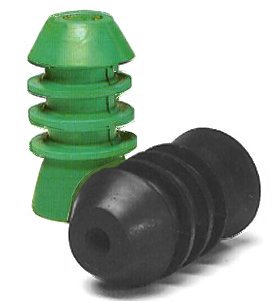
Cementing plugs
A small plastic plug (the bottom plug) is put into the casing ahead of the cement. This separates it from the mud that is already in the hole. It is fitted with wipers, that clean mud from the walls of the casing, and it is pushed down to the bottom of the casing by the cement that is pumped into the well behind it. There are some pictures of some of the tools and descriptions of the process here, here and here.
Once the bottom plug gets to the end of the casing, there are ports it passes that allow the cement to flow out of the casing and back up the outside. Once the cement has been pumped into the casing a second, top plug, also fitted with wipers, is put into the casing and this is then pushed down by the conventional drilling mud. As it is pumped down it forces the plug down, and the cement out and back up to the surface. Because of possible variations in hole size and other possible problems, perhaps about 50% more cement might be pumped into the well than the calculations might suggest. When the top plug hits the bottom plug, then there is a pressure spike at the pumping station, telling the operator that it is finished. The rig then waits on cement (WOC) until the cement is hardened. The drill pipe can then be put back in the hole and drilling can restart.
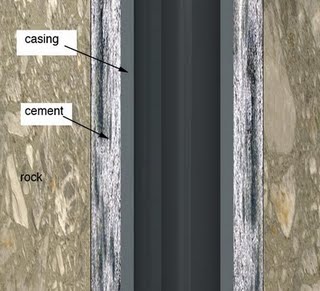
Illustration of a cased well
But whoops, the bit won’t fit in the hole any longer! For the sake of discussion lets say we ran half-inch thick casing. And that we had an inch of cement behind it all around the casing. Then the hole we have available to get the drill through down to the bottom is now only 6-7/8th inches in diameter. So we now might use a 6-5/8th inch diameter bit to continue drilling (since we don’t want it rubbing against the casing wall).
If we run into another layer of problem rock as we drill down to the bottom of the hole, then we are going to have to run another set of casing. This is known as intermediate casing, and the process is the same, and it leaves us with an even smaller hole through which to get a drill bit through.
So that, when you get toward the bottom of the well you may end up drilling with a bit that is only 3-3/4 inches in diameter. These drill with a smaller thrust than the larger bits, and so, although you may have a very powerful drilling platform, with thousands of horsepower available, you may end up, as you approach the pay zone where the oil is, using only a fraction of that power.
We’ll discuss what happens when you hit oil next time, but perhaps by now you might begin to understand why, in drilling a well that might cost $1.25 million, the actual drilling part alone may be no more than a third of the cost.
As usual I welcome comments, questions or criticism. But to catch the obvious one - yes, after running casing, the first thing you have to drill through are the two plugs and the remaining cement in the bottom of the well, before you can reach and start drilling through the rock again.




Peak Oil, Peak Credit and Investments - "So What the Hell Does One Do"?
(*Note: This posting was delayed due to the discovery that the mushrooms in the woods adjoining my parents cottage were black trumpets. 4 hours, 5 lbs of mushrooms, and some soaking wet clothes later, here, on my 4 year anniversary of being a member of this website, is tonight’s Campfire…;-)

A common theme in conversations of the peak oil/limits to growth aware is ‘What do I do‘? Just slightly less common is ‘What do I do with my money?’ The biggest difficulty in contemplating/deciding/acting towards a new paradigm is one does this while the old paradigm is still going strong, if only on the surface and the media. In a temporary departure from usual Campfire topics, tonight’s discussion will revolve around the concept of investments, and the coming transition from the old finance based rules into new undefined territory.
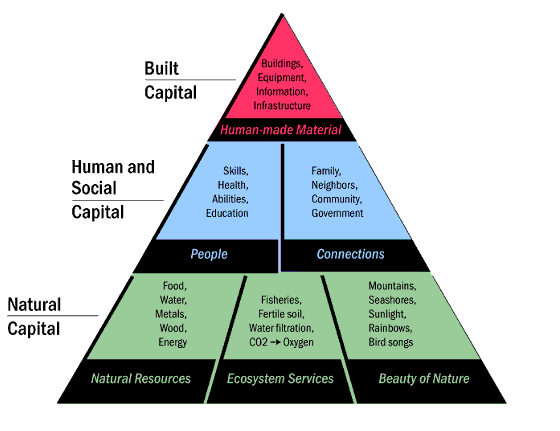
The Four (non-financial) Capitals -Natural, Social, Human, and Built - (description)
I got this email yesterday:
To:Nate Hagens
Subject: So What the Hell Does One Do?
Date: Aug 27, 2022
______________________________________Nate,
I read your work in various venues and appreciate the thought that goes in it. I have been peak oil aware for too many years, made some money, kept it and yet was too early. What the hell does one do now? Specifically:
Any thoughts on farmland? Farm income is going down, but I am looking at buying a good chunk - the offer is on my desk and as I am a broker I can buy it at wholesale - but will the odds of the land going down in monetary value be greater than the odds of it going up?
I see the worst case scenario that I lose half my invested wealth in farmland, I see the best case scenario that I lose half my wealth invested in farmland and keep the rest at break-even.
Yeah, free advice is what it’s worth I guess. But it is becoming exhausting trying to win this game. And, if truth be known, I really don’t want to go live on a farm, sit on metaphorical beans, bullets, and band aids; but as a retired doctor doing public medicine I also see a huge part of our society that just won’t be able to cope post peak - and part of that society is the doctors in private practice.
Damn, I did everything right for retirement, actually made it there and now this little inconvenience of peak oil comes along…
Pat
(Name and some words changed/deleted to protect anonymity
I rarely give investment advice, except to my closest friends and family. Clearly there are logical market neutral themes that should prove advantageous over time to those who primarily care about such goals. For example, long the low cost, low externality energy companies vs. short the companies making non-essential goods, long the companies that focus on top 10% of social demographic vs short companies that rely on general consumer, etc. However, other than needing to really understand someones objectives on risk, return, time frame, etc., I have stopped giving investment advice for other reasons.
Firstly, I increasingly believe that a) the tertiary wealth markers (stocks, bonds, derivatives, etc.) have decoupled so fantastically from primary (energy, forests, materials, metals) and secondary (gasoline, lumber, tractors, blankets) wealth and b) the tertiary wealth markers due to excessive credit/debt/leverage are becoming more and more correlated to eachother, evidencing massive systemic risk and c) the receding tide of cheap energy, cheap credit, and available leverage will leave behind a social stratification so extreme that governments will increasingly have to change the rules of the game -on the fly- to appease the various disenfranchised. In other words, following fundamental macro based analysis will be increasingly akin to betting on a match of Jai Alai. (You can bet on Jai Alai but its 50/50 whether you are choosing the side rigged to win). I suspect the standard portfolio manager model of ‘dollar average on dips’, ‘stocks return 10% on average over the long run’, ‘some new technology will cause DJIA to be at 30,000 in 10 years’, etc. is finished, though a majority of the players don’t yet realize it. (the concept of differentiating primary, secondary and tertiary wealth was detailed in E.F.Schumachers Small is Beautiful, but has origins as far back as Frederick Soddy’s Wealth, Virtual Wealth, and Debt”, in 1926. It remains a central tenet of Ecological Economics)
My second reason is more personal - the whole investment business is becoming a bit obscene, irrespective of whether one wins or loses, and I have decided (for myself) I’ve spent too much of my finite life on something with little lasting meaning. I suppose dealing with 80+ year old billionaires who never spent a penny but screamed at me when their $5 million monthly Treasury coupons didn’t transfer to their banks on time gave me an early clue.
As such, let me approach this readers question from a different angle….
Why do we invest?
We are genetically wired to respond to cultural cues to move up the mating ladder, as opposed to down. Theories of sexual selection, relative fitness, etc. are robust in the animal kingdom and humans differ only in their expression of what constitutes successful competition during different socio-economic eras. Our culture currently measures status many different ways - respect, reputation, intelligence, publication, accomplishment, notoriety, etc.
However, pecuniary wealth has, at least in the last two hundred or so years, functioned as a shortcut for moving up the social status ladder. In short, investing in financial assets has been one avenue open to jumping up a few notches on the social status ladder, not to mention the other fun and novel experiences it enables. Once obtained, paper assets widens the spigot of neurotransmitter cocktails matching the sensations our ancestors experienced as they themselves became successful at opportunities involving acquiring resources, mating and reproducing. In sum, making money is promoted by our culture, and it feels good. Losing money, or having no money versus our conspecifics, (especially if we used to), feels bad…;-)
Why do we care about risk and diversification?
Our aversion to risk has evolutionary origins:
Kacelnik A, Bateson M 1996. Risky Theories - The Effects of Variance on Foraging Decisions
American Zoologist 36 (4): 402-434. Here’s the abstract:This paper concerns the response of foraging animals to variability in rate of gain, or risk. Both the empirical and theoretical literatures relevant to this issue are reviewed. The methodology and results from fifty-nine studies in which animals are required to choose between foraging options differing in the variances in the rate of gain available are tabulated, We found that when risk is generated by variability in the amount of reward, animals are most frequently risk-averse and sometimes indifferent to risk, although in some studies preference depends on energy budget. In contrast, when variability is in delay to reward, animals are universally risk-prone. A range of functional, descriptive and mechanistic accounts for these findings is described, none of which alone is capable of accommodating all aspects of the data. Risk-sensitive foraging theory provides the only currently available explanation for why energy budget should affect preference.
In essence we prefer the highest return per unit time, adjusted by its risk (measured in financial assets by standard deviation).
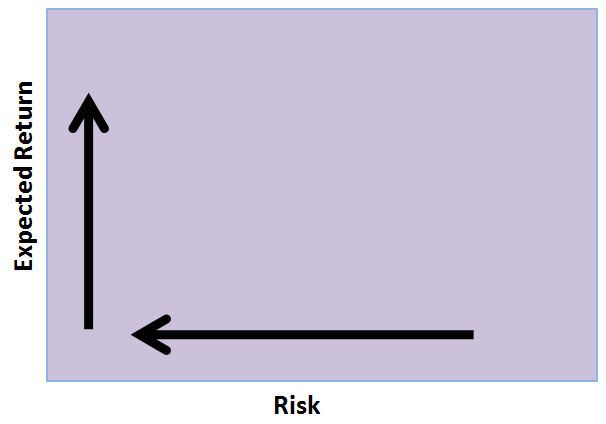
Basically, in the above graphic, we will prefer opportunities, (ceteris paribus) that move right to left (less risk) and move bottom to top (more reward). (In animals, ‘reward‘ is measured primarily by calories (energy). However in humans, the only species to (significantly) use exosomatic energy (the average american consumes almost 240,000 calories daily - only about 3,000 via food -the rest on transportation, entertainment, waste, etc. (1). It is our desires, our infrastructure, our marketing, and our social cues that dictate the exogenous (out of body) energy ‘needs’.)
Let’s take a look at boilerplate business school finance - the Capital Asset Pricing Model and Efficient Frontier -the foundations of asset allocation and investing.
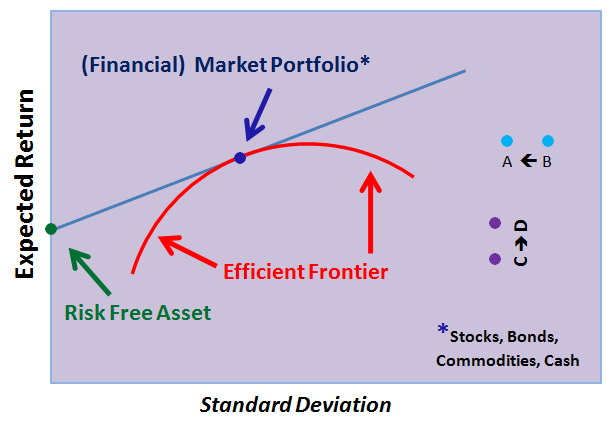
Capital Asset Pricing Model and Efficient Frontier
In the above graphic, imagine hundreds or even thousands of points below the blue line as investable (financial) assets. The green dot represents Treasury bills - a smallish return, but zero risk. To get a higher return, we must move from left to right on the graph, taking on incrementally higher risk. An investor will always prefer Asset A to Asset B, because for the same return, A has less risk. Similarly, an investor will always prefer Asset D over Asset C as for the same risk, D has a higher return.
The risk of a portfolio includes systematic risk, (considered undiversifiable), and unsystematic risk (or diversifiable risk). Systematic risk refers to the risk common to all risky securities - i.e. market risk. Unsystematic risk is the risk associated with individual assets and can be reduced by including a greater number of assets in a portfolio. The CAPM assumes that the risk-return profile of a portfolio can be optimized -i.e. the lowest possible amount of risk for the chosen level of return. This occurs by adding uncorrelated assets into a portfolio. All such optimal portfolios, i.e., one for each level of return, make up what is called the efficient frontier (shown in red). A rational investor should not take on any diversifiable risk, as only non-diversifiable risks are rewarded.
Other than some statistics and top notch job interviews, you just saved 80k in tuition for MBA school…;-)
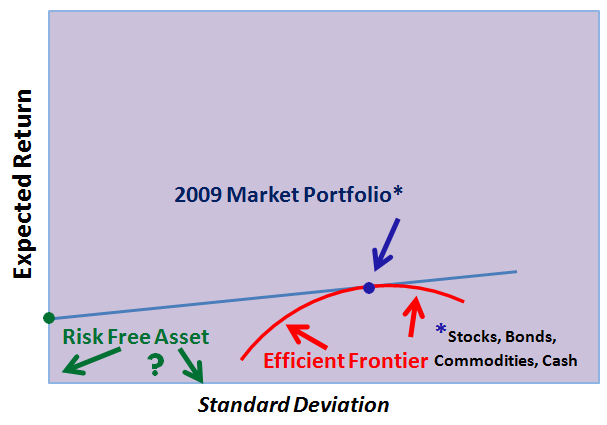
Peak Oil CAPM
The problem of exponential growth against a finite resource base has manifested in an orgy of tertiary marker wealth creation (and in so doing, sending a false signal through the socio-economic system that energy supply was being increased on its own merits). We don’t really know how far removed 2,000 trillion of claims on 55 trillion of global GDP, itself heavily financially skewed, is from the reality of primary (natural resource) wealth (2). (I suspect it is greater than an order of magnitude, but it might be less, if there is a high degree of notional offsettables). In other words, what we think of as wealth, at least many of us, and much of it, is not.
The Capital Asset Pricing Model taught in business schools is predicated on the assumption that treasury bills (the risk free asset) are, by definition, not correlated with any other asset, and, by definition ‘risk free’. It is quite likely that the perception of these assumptions, or possibly the assumptions themselves, end up being proven false in coming years. I drew the ‘Peak Oil’ CAPM to illustrate lower expected return, and higher expected risk across the board for tertiary marker assets.
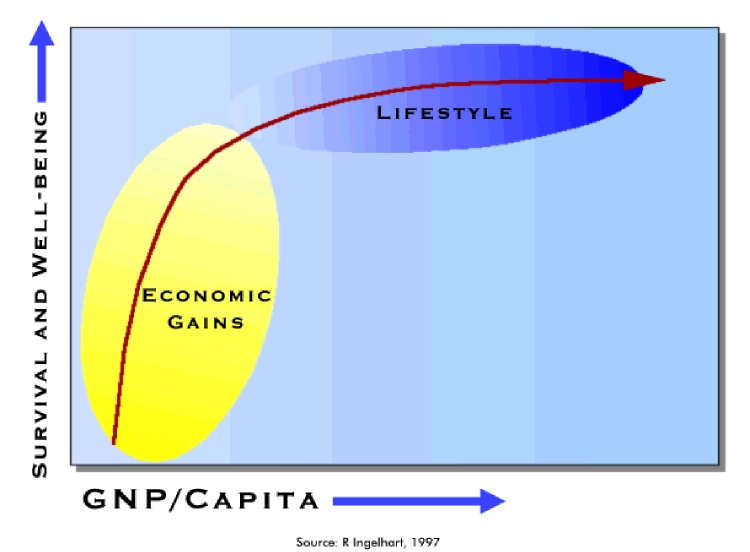
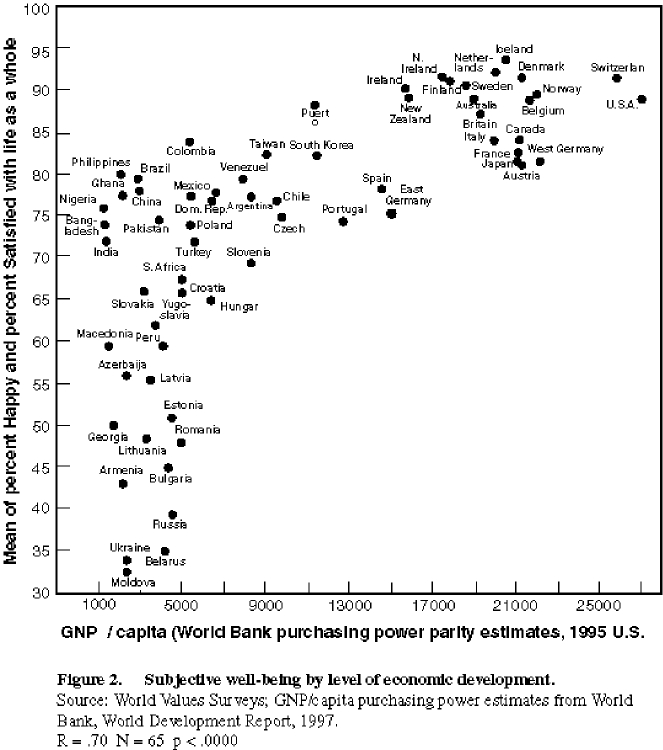
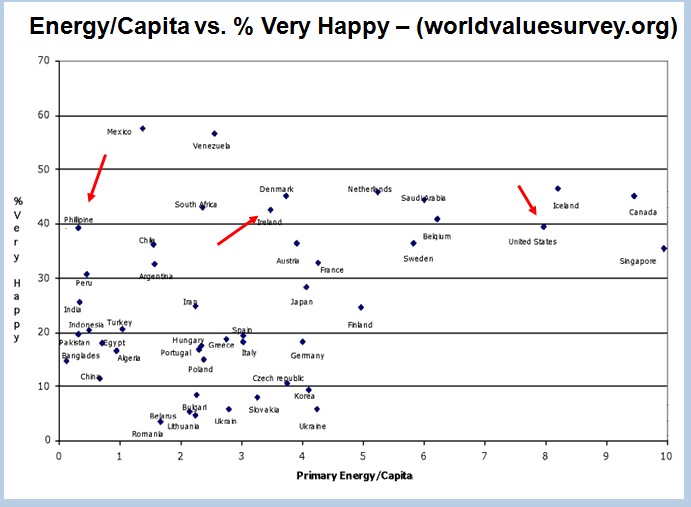
Ronald Inglehart of the World Values Survey verbalized the above graph by stating that after meeting basic needs, lifestyle choices make up the majority of the difference in the GNP spectrum, and lower energy lifestyles do just about as well as high energy lifestyles (indeed, the USA uses 38 times the primary energy of the Phillipines but gets equivalent rankings of ‘very happy’ - any of you that have lived or worked abroad will intuit this).
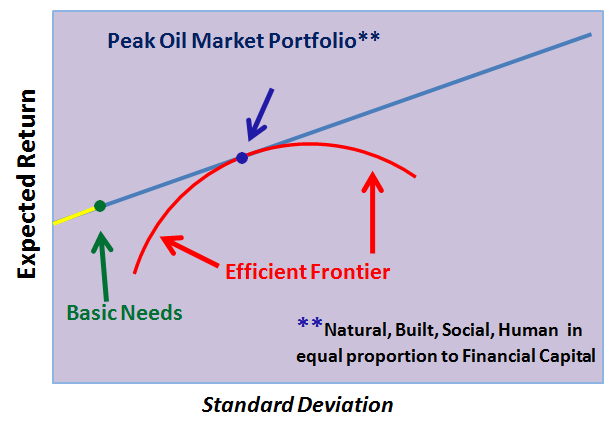
A Future Interpretation of the Capital Asset Pricing Model, incoporating Natural Capital,
As such the Capital Asset Pricing Model, the foundation of modern finance, can only remain a valid model if it is reapplied with wider non-financial boundaries: substituting natural, built, human and social capital for the tertiary financial markers of stocks, bonds, commodities, and cash. The risk free rate in such a model would be ‘basic needs’ (food, water, shelter, companionship, meaning, etc.)
Above this level (*which I marked in yellow because it is NOT risk free in reality, but still could be acquired with little risk to an individual), one would gradually increase their risk adjusted return (in an evolutionary sense), by having a well diversified portfolio during their life made up of reasonably equal proportions of built, human/social, and natural capital, only then supplemented by financial. As a social species that implicitly values rank, we will never all be equal, and our makeup virtually guarantees we will continue to compete for status. But channeling our penchant for competition towards the human and social capital areas will be better for us and better for our planet than competing for natural or built capital (3). Still, we will need those things as a foundation for our basic needs, and a springboard for higher pursuits. The main takeaway here is not a formal model but for folks to think beyond digits/finance in measuring their own, and our planets ‘wealth’.
The Four (non-financial) Capitals (description)
There is going to be an upheaval in our social structure in the intermediate (and possibly near) term future. It will not entirely invert, as many of those near the top got there due to skill, smarts and ambition, and if the rules change, they will quickly adapt, and these attributes will in relatively quick order reshuffle them to the top. The point however, is that post peak oil/credit, piles of financial wealth may not represent the free pass to the upper social crust they have the past few generations:
a) there is a non-zero possibility of a debt jubilee, new currency, or financial reset where fortunes could literally disappear overnight,
b) in a world that eventually must move away from increased specialization, globalization, and efficiency, and more towards local/regional scale, redundancy, and resiliency, the forward thinking human will need to diversify beyond financial assets, and into a portfolio of real capital.
It stands to reason the more uncertain the future becomes, the more one will need uncorrelated assets for proper diversification. Financial capital in reality has always just been one part of an individuals broader asset allocation - this fact is just likely to be more publicly intuited even if the financial academy doesn’t acknowledge their methods measuring risk and wealth are broken. Individuals, neighborhoods, cities, regions, and countries that recognize this trend earlier will likely have advantages. After all, we are animals seeking the best perceived risk adjusted reward. On that, the safest advice I can give Pat, or anyone how to increase their wealth is an idea borrowed from Buddhist philosophy - reduce the denominator in the equation Wealth = Assets/Desires. This is possibly the only strategy that will increase ones wealth in virtually all future scenarios.
Lastly, however, our perception of wealth utilizes neural reward pathways linked with wanting, not having. Therefore, irrespective of how we change our cultural definition of wealth, as individuals we will still ‘want‘ more of whatever wealth is than our conspecifics. Only when some unknown majority of people realize their own wealth will suffer if we continue to compete for finite resources, will the Tragedy of the Commons problem start to resolve. Barring such a cultural transformation, we’ll continue in a series of socio-economic boom-busts where the striving for the upper levels draws down our collective primary wealth. That’s a lot of risk for a species.
==================================================================
CAMPFIRE QUESTIONS:
1) How many of you experience similar feelings with respect to investments as Pat does?
2) Will monetary wealth hold its value to the next generation?
3) How can people that understand the implications above most effectively move more towards a portfolio of natural, social, built and human capital when we all still live in a culture that sends strong cues favoring financial (marker) capital?
4) Will we ever get social/media cues that frown upon excessive financial wealth, but instead laud men and women with skills, knowledge and generosity? If so, would you give up/allocate some of your money to increase your standing in these other areas?
5) Natural capital, other than land with water, trees, soil etc. can’t be directly ‘owned’ other than by all of us. How would a change in values towards real capital accelerate awareness of the public commons?
6) Other.
================================================================================================
(1) In 2004, Americans consumed about 342,700,000 [3.4e8] Btu per capita, per year. [ http://www.eia.doe.gov/pub/international/iealf/tablee1c.xls ] This converts to about 86,358,951 [8.6e7 nutritional] calories per year [ http://www.onlineconversion.com/energy.htm ] or 86,358,951 / 365 = 236,599 [2.37e5 nutritional] calories per day. But humans only require something like 3,000 [nutritional] calories [of food energy] per day to survive, so it seems we (very roughly) use something like 235,000 [2.35e5 nutritional] calories per day, per capita for non-nutritional purposes. (Hat tip TOD reader Jay)
(2) The value of natural capital, 12 years ago, was estimated at $33 trillion per year (not valued by the market).
(3) The value of built capital can be estimated/aggregated via an emergy database. A Primer on Emergy Analysis from the EPA.




Drumbeat: August 30, 2022
Rubbing salt into the wounds
The UAE’s demand for water, growing yearly in pace with the nation’s expansion, is insatiable and insupportable. With extremely limited natural supplies, the UAE and all its mighty ambitions and achievements – from desert golf courses to the world’s tallest building – are utterly dependent on water drawn from the sea, as are every man, woman and child who lives here.
When it comes to water, the UAE is living beyond its means, trapped in an unsustainable spiral. Its per-capita consumption is among the highest in the world. Its natural groundwater supplies, pumped in an uncontrolled manner for decades, are being drained 24 times faster than they can be replenished, leaving them increasingly polluted with salt water.
Farming, one of the smallest parts of the economy, consumes vast amounts of water. And waste from desalination leaves land and sea increasingly polluted.
Walk this way - urge ‘sustainable development
The real estate collapse has masked the existence of a severe housing shortage in California. While developers have oversupplied single-family detached homes with backyards, buyers looking for a home within walking distance of jobs, services, good schools, parks and public transit have few options in this state. Communities that have these “sustainable development” characteristics, such as neighborhoods in San Francisco, Pasadena and San Diego, are often among the most expensive in the state. They are also few and far between compared with the vast stretches of suburban homes covering the state.
Brazil’s Lula to meet foes to new oil plan
BRASILIA (Reuters) - Brazil’s President Luiz Inacio Lula da Silva will try on Sunday to overcome opposition by three state governors to a legislative proposal he hopes will make the country a top oil producer and help fight poverty.
The government will unveil on Monday a legal framework to develop massive new off-shore oil deposits, which triggered euphoria and expectations of newfound wealth in Latin America’s largest country when they were announced in 2007.
Tullow Oil chief executive Aidan Heavey says the future of fuel lies in Africa
African oil is what’s causing the excitement. With assets in 15 African nations from Mauritania to Madagascar, Tullow now gets 60pc of its production from the continent. The rest is mostly North Sea gas, but Africa accounts for 94pc of group reserves.
Next year’s start of production from the Jubilee oilfield off Ghana’s coast should double Tullow’s 40,000-barrels-a-day African production, and, by the third phase of the roll-out, it should have doubled again.
Nigeria: Manufacturers Protest High Gas Price
Fresh energy crisis is pummelling the industrial sector as manufacturers who use natural gas have shut down their production to protest new gas price being slammed on them by local gas companies.
More than 85 per cent of the manufacturers especially in Lagos depend on gas to fire their generators while others use it for their boilers and more than 60 per cent of gas users have reduced their production in the past one week.
High costs fuel Mideast district cooling market
JEDDAH - In a region where the temperature frequently exceeds 45 degree Celsius and air conditioning requirements consume 70 percent of the power during peak electricity demand, district cooling is emerging as the most viable cooling solution in the Middle East, Frost & Sullivan’s new report titled “Analysis of the District Cooling Market in the Middle East Region” said.
Wood to oil process could make forest thinning pay
For the past decade that the U.S. Forest Service has been pressing to thin hundreds of millions of acres of woods in danger of burning up, it has had one nagging problem: how to come up with the billions of dollars to pay for it.
Young trees are too small for lumber. Transporting the bulky material to biomass power plants is too expensive. And cutting big trees to pay for thinning the small ones often runs afoul of environmental laws.
Jim Archuleta, a soil scientist on the Umpqua National Forest in southwestern Oregon, thinks he might have the answer in a new twist on old technology called fast pyrolysis.
Biogas firm targets rural areas, farmers
As the energy crisis bites, right after fuel prices shot through the roof, some Kenyan firms have gone green and are busy developing alternative energy sources.
One such green technology firm, Pioneer Technologies has teamed up with Jomo Kenyatta University of Agriculture and Technology to develop biogas-based systems for cooking and cheap electricity.
Saudi tightens security to protect oil plants
KHOBAR, Saudi Arabia (Reuters) - Saudi Arabia has tightened security at oil facilities after the country’s anti-terror chief escaped a suicide attack, guards at Abqaiq, the world’s biggest oil processing plant, said on Sunday.
Abqaiq was the first Saudi oil target since Al Qaeda launched attacks aimed at toppling Saudi Arabia’s pro-Western monarchy in 2003. The country’s deputy interior minister, Prince Mohammed bin Nayef, on Thursday escaped with light injuries in the first known assault on a member of the Saudi royal family.
“Thursday night we received a call to tighten security measures and car inspection at all gates,” one security guard said.
Reluctance to Spend May Be Legacy of Recession
But even if her spending power is restored, Ms. Nelson says her inclination to buy has been permanently diminished. Through nine months of joblessness, she has learned to forgo the impulse buys that used to provide momentary pleasure — $4 lattes at Starbucks, lip gloss, mints. She has found she can survive without the pedicures and chocolate martinis that once filled regular evenings at the spa. Before punishing heat and drought turned much of central Texas brown, she subsisted primarily on vegetables harvested from her plot at a community garden, where only one oasis of flowers remains.
Once intent on buying a home, Ms. Nelson now feels security in remaining a renter, steering clear of the shark-infested waters of the mortgage industry.
“I’m having to shift my dreams to accommodate the new realities,” she said. “Now, I have more of a bunker mentality. If you get hit hard enough, it lasts. This impact is going to last.”
Preventing blackout
On July 25, La Plata County kicked off the visioning process for the update of its Comprehensive Plan with an all-day meeting, in which about 50 residents shared views about the past and present and devised story lines for the La Plata County of 2030.
Kidrow, a blog for parents in the know Katie Ogier - The Wells Group Gateway Reservations
One of the ideas that emerged was using local resources to become self-sufficient in energy. The importance of this concept is underscored in Richard Heinberg’s new book, Blackout. Heinberg’s earlier books include The Party’s Over and Peak Everything, which document the impending occurrence of “peak oil” and its consequences for modern society. In Blackout, he extends his analysis to coal, the most abundant fossil fuel.
The mirage of energy independence and the reality of interdependence
(MENAFN - Arab News) The International Monetary Fund’s executive board has urged Saudi Arabia to maintain a longer-term perspective on global oil demand. While praising Riyadh for its leadership in stabilizing oil markets by continuing to expand capacity in the face of falling prices, the IMF directors “encouraged the authorities to continue basing their capacity expansion decisions on medium to long-term (and indeed not short-term) demand conditions.”
Indeed easier said than done in many respects, one can’t fail underlining here, especially in the given environment.
After 150 years, age of oil entering an efficiency phase
Despite the similarities with 1859, though, the oil industry in 2009 faces challenges that make past barriers seem like mere bumps in comparison — surging energy demand from the developing world, volatile price swings that spawn both boon and bust, and demands to limit the environmental damage of fossil fuels.
“But the age of oil is not over,” Yergin says. “Over the next two to three decades, on a global basis we’ll see oil demand increase, but there will be a tremendous drive for us to use it much more efficiently.”
That drive, and particularly the role that natural gas may play in it, could help keep another generation of workers in Houston’s office towers and refineries employed.
India’s generation of children crippled by uranium waste
Their heads are too large or too small, their limbs too short or too bent. For some, their brains never grew, speech never came and their lives are likely to be cut short: these are the children it appears that India would rather the world did not see, the victims of a scandal with potential implications far beyond the country’s borders.
Anti-speculation push may topple oil prices
NEW YORK (Reuters) - A debate is emerging over how curbs on energy market speculation may impact oil prices, with at least one major bank boldly expecting the new rules will trigger a 30-percent price plunge.
The outcome holds wide-ranging implications for G20 developed nations collectively spending as much as $4.8 trillion to stimulate their economies through the worst global recession in decades.
“Regulators don’t and shouldn’t talk about trying to influence prices,” said John Brodman, a former Deputy Assistant Secretary at the U.S. Department of Energy. “But there’s a growing political imperative out there. An oil price rise of $30 a barrel would offset 40 percent of the stimulus spending. That’s not what these countries are looking for.”
Secret documents uncover UK’s interest in Libyan oil
Libya has been courted by Prince Charles, government ministers and Foreign Office mandarins on a dozen or more occasions in pursuit of lucrative oil and gas contracts.
Documents obtained by the Observer show ministers and senior civil servants met Shell to discuss the company’s oil interests in Libya on at least 11 occasions and perhaps as many as 26 times in less than four years.
Sinochem in bid for Gulfsands
Independent oil and gas producer Gulfsands Petroleum is in takeover talks with China’s state-owned Sinochem, which is offering up to £400m for the business.
Size trumps technology as big cars dent green gains
AUSTRALIA’S enduring love affair with big cars means engine technology alone will not be enough to deliver necessary cuts in greenhouse gas emissions, a government report has warned.
The report, by the Bureau of Infrastructure, Transport and Regional Economics, has added weight to demands for tough new measures to encourage the production of smaller, more efficient vehicles, including mandatory emissions standards.
Energy Dept. Fails to Use Thermostats to Cut Costs
WASHINGTON — The Energy Department strives to be a leader in championing energy efficiency. Its Web site lists energy-saving tips, while Secretary Steven Chu calls conservation one of the department’s most important goals.
But at many of the agency’s buildings, even at national laboratories where talented scientists seek technological breakthroughs to save energy, the department has failed to use one of the most effective tools available to any ordinary household: thermostats that automatically dial back the temperature when nobody is around.
Nuclear Regulators Urge High-Tech Fire Detection
WASHINGTON — Many of the hundreds of workers at the Shearon Harris nuclear plant in New Hill, N.C., are busy with high-tech tasks like calibrating equipment, monitoring radiation fields or controlling the reactor. But around the clock, there are three on duty who might have come out of another century.
They sniff for smoke.
Pacing miles each day, up and down stairs and through vast halls and narrow passages, they visit crucial locations at least once an hour to make sure fire has not broken out.
United Kingdom Faces a Quandary Over New Nuclear or Coal Power
LONDON — The United Kingdom is nearing a crucial decision as it tries to tackle the climate crisis — whether to make a major push into new nuclear power or to proliferate coal-fired power plants constructed so their carbon emissions are captured and safely stored.
PHEVs and EVs: Plugging Into a Lump of Coal
Since I’ve stirred up a hornet’s nest over the last two weeks first by debunking the mythology that PHEVs and EVs will save their owners money and then by showing how PHEVs and EVs will sabotage America’s drive for energy independence, I figured I might as well go for the triple-crown of harsh realities by showing readers that in the U.S., where 70% of electricity comes from burning hydrocarbons, PHEVs and EVs won’t make a dent in CO2 emissions. They’ll just take distributed CO2 emissions off the roads and centralize them in coal and gas fired power plants.
Clash in Alabama Over Tennessee Coal Ash
UNIONTOWN, Ala. — Almost every day, a train pulls into a rail yard in rural Alabama, hauling 8,500 tons of a disaster that occurred 350 miles away to a final resting place, the Arrowhead Landfill here in Perry County, which is very poor and almost 70 percent black.
To county leaders, the train’s loads, which will total three million cubic yards of coal ash from a massive spill at a power plant in east Tennessee last December, are a tremendous financial windfall. A per-ton “host fee” that the landfill operators pay the county will add more than $3 million to the county’s budget of about $4.5 million.
Ethanol faces challenges ahead
New technologies, supporting infrastructures, and greater demand will be needed to meet the country’s ambitious mandate to increase biofuel use.
Cheap wheat to help meet EU fuel demand
LONDON (Reuters) - A sharp decline in wheat prices driven by a supply glut is set to lead to more of the grain being turned into motor fuel in the European Union.
Standards for Small-Scale Wind Power
The American Wind Energy Association is developing a series of standards that will measure the safety, reliability and performance of small wind turbines.
The standards, which the organization hopes to have in place by the end of the year, come amid increased interest in small-scale and rooftop wind power — typically designed for individual homes, farms and small businesses, and producing 100 kilowatts of electricity or less.
Four Years Later, New Orleans’ Green Makeover
After Hurricane Katrina flattened New Orleans exactly four years ago, on Aug. 29, 2005, the city emerged as an inadvertent symbol of global warming, the first American victim of climate change. Over 200,000 homes were destroyed during the Category 5 hurricane. But in the years since, the Crescent City has quietly embraced a new and unexpected role as a laboratory for green building. Sustainable development groups that range from the international nonprofit Global Green to earth-friendly celebrities like Brad Pitt descended on New Orleans, determined not just to build the city back, but to build it back green. “It’s going to come back,” says Matt Petersen, the president of Global Green USA. “But we want to build it better than it was before.”
Troubling bubbles: Methane oozes from thawing permafrost
Pure methane, gas bubbling up from underwater vents, escaping into northern skies, adds to the global-warming gases accumulating in the atmosphere. And pure methane escaping in the massive amounts known to be locked in the Arctic permafrost and seabed would spell a climate catastrophe.
Is such an unlocking under way?
Researchers say air temperatures here in northwest Canada, in Siberia and elsewhere in the Arctic have risen more than 4.5 degrees Fahrenheit since 1970 — much faster than the global average. The summer thaw is reaching deeper into frozen soil, at a rate of 1.5 inches a year, and a further 13-degree temperature rise is possible this century, said the authoritative, U.N.-sponsored Intergovernmental Panel on Climate Change, IPCC.
India, China to study climate change
New Delhi: India and China will jointly conduct research on the impact of climate change on the glaciers in the Himalayan and Tibetan regions, Minister of State for Environment and Forests Jairam Ramesh said here yesterday.
UN meeting: help nations adapt to global warming
GENEVA – As nations negotiate tough decisions on cutting greenhouse gases, the United Nations is holding a separate conference on coping with more floods, droughts and other effects of climate change already assured.
Bjorn Lomborg: Technology Can Fight Global Warming
We have precious little to show for nearly 20 years of efforts to prevent global warming. Promises in Rio de Janeiro in 1992 to cut carbon emissions went unfulfilled. Stronger pledges in Kyoto five years later failed to keep emissions in check. The only possible lesson is that agreements to reduce carbon emissions are costly, politically arduous and ultimately ineffective.
But this is a lesson many are hell-bent on ignoring, as politicians plan to gather again—this time in Copenhagen, Denmark, in December—to negotiate a new carbon-emissions treaty. Even if they manage to bridge their differences and sign a deal, there is a strong likelihood that tomorrow’s politicians will fail to deliver.
Our ship is sinking: we must act now
The cause of our weather shifts does not matter. The millions who will be affected are the priority.
A High Cost to Deal With Climate Shift
NEW YORK — The Intergovernmental Panel on Climate Change has described the notion of “adaptation” as those initiatives designed “to reduce the vulnerability of natural and human systems against actual or expected climate change effects.”
The implication, of course, is that regardless of what nations, businesses or individuals do to reduce greenhouse gas emissions, the planet is going to warm up. Everything from coastal geography and weather patterns to the global tableau of arable land, such that we’ve come to know and rely on them, will be — indeed, already are — in flux, and we had best start planning.




Stocks brace for September
August 31, 2022 by admin
Filed under Stock Market
With stocks now sitting more than 50% above March lows and notorious rally-spoiler September in sight, the calls for a pullback have been getting louder.
Silver prices up, so are HSC miners Coeur d’Alene Mines (CDE) and Silver Wheaton Corp. (SLW)
August 31, 2022 by
Filed under Gold Investments
Silver prices rose to $14.80 on Friday… so did our Hot Stock Confidential mining stocks Coeur d’Alene Mines (NYSE:CDE) and Silver Wheaton Corp. (NYSE:SLW)
by J. Christoph Amberger
Baltimore, MD — TFN: The current issue of the Smithsonian magazine tantalizes with the customary advertisements for gold and silver coins. Coin dealers tempt with introductory rates on silver [...]
Peak oil, prices, and supplies - Aug 28
 -Michael C. Lynch and “the false threat of disappearing oil.”
-The New York Times on Peak Oil - Don’t Worry, Be Happy
-Oil: the Long Goodbye
-150 Years of Plenitude: The Story of Oil
read more
Peak oil, prices, and supplies - Aug 27 - updated Aug 28
-Speaking At Jackson Hole
-Peak Oil: Supply Data Doesn’t Lie
-Peak Oil around 2030 says IEA (updated)
read more
The Tropics - A Two Step Transition
As someone who has spent the past quarter of his life in the lower latitudes, the fancy footwork and the tropical rhythms still present a bit of a challenge on the dance floor. All the same, when I see my peak oil-aware brethren struggling to define and implement the best way to achieve a lower carbon future, I feel a bit of confidence that in this corner of the world, we are a couple of steps ahead of our temperate climate cousins. At times the contrasts are striking, at times comic.
read more
Peak oil, prices, and supplies - Aug 28
-Michael C. Lynch and “the false threat of disappearing oil.”
-The New York Times on Peak Oil - Don’t Worry, Be Happy
-Oil: the Long Goodbye
-150 Years of Plenitude: The Story of Oil
read more
Peak oil, prices, and supplies - Aug 27 - updated Aug 28
-Speaking At Jackson Hole
-Peak Oil: Supply Data Doesn’t Lie
-Peak Oil around 2030 says IEA (updated)
read more