

Peak oil review - Nov 30
 A weekly review including:
- Dubai’s early impact
- China in 2010
- Copenhagen
- Quote of the Week
- Briefs
read more
An oil-less recovery
As we look to the future and recovery, what should we expect? Will US oil consumption recover, or is the country fated to make do with permanently lower levels of oil consumption?
read more
Thanks for the blessings of oil
Thanksgiving Day is a special day for those following the peak oil news. Geologist Kenneth Deffeyes, author of Hubbert’s Peak, predicted that Thanksgiving Day 2005 would mark the peak in world oil production. After that, oil production would decline, irreversibly. And he may have been right.
read more
International Energy Agency calls ‘Peak’ on OECD Oil Demand
In recent editions of their World Energy Outlook, the IEA has been reducing their forecast for 2030 total oil supply. But forecasting a decline in OECD consumption is a radical shift.
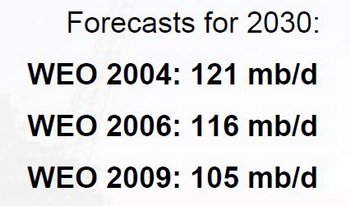
Here at The Oil Drum we see peak oil occuring well before 2030, with production at that point significantly lower than it is now. However, even the IEA’s forecast of 105 mb/d allows for only anaemic growth for total supply of 1% per year. Since they still see strong demand growth from China and other developing nations, OECD takes the hit:
Oil demand is projected to grow by 1% per year on average, from 85 million barrels per day in 2008 to 105 mb/d in 2030. All the growth comes from non-OECD countries; OECD demand falls.
Unfortunately the IEA does not present this oil situation in a figure, however the one below for total primary energy demand gives us a good impression. China, India and the rest of the non-OECD world keep growing their consumption (IEA forecast, not mine!), while OECD is all but flatlining.
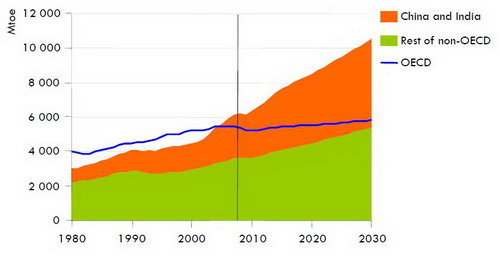
For oil, the situation is worse. OECD share of available oil is constrained so much that it declines. The details for primary oil demand alone are in Table 1.3. The peak for OECD demand was in the period 2000-2008 and declines by 0.3% per year to 2030.
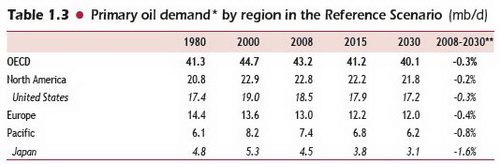
Let me repeat that.. *THE IEA* says that OECD oil consumption is in decline, permanently.
It’s also significant that in their report they say Non-OPEC oil supply declines from 2010. So all those arguments about technology, increasing recovery, a new Middle East in the Arctic.. all amount to nothing at least in the entire Non-OPEC part of the world where all those clever western oil companies do their business.
All the peak oil analysis that you’ve read here still suggests that the IEA’s forecast is too optimistic, for both OPEC and Non-OPEC parts of the world. And the IEA whistleblower also claims that their forecasts are inflated. But a peak is still a peak, and the IEA now says that OECD oil demand is in decline and will not recover the levels prior to the financial crisis.
This seems to me like a dramatic statement for the IEA to make. This official forecast from the agency representing OECD nations, now conflicts with just about every one of its individual member’s own forecasts (and that of just about every private enterprise). To convince decision makers of the inevitable oil decline facing us, we no longer need to refer to the online analysis by peak oil bloggers. You can simply tell your president, chief, boss and your neighbour: The IEA says our oil consumption is going down, what are you going to do about it?
As a footnote, it appears that the IEA is in good company with their updated forecast. Stuart Staniford, now writing at Early Warning, has been exploring recent trends in oil consumption. He also finds that the strong developing economies and the oil exporting nations have a firm balance of trade basis on which to continue increasing their own oil consumption, albeit it at perhaps lower than recent rates, even as high prices and/or hard times hurt elsewhere. Even without a peak in oil supply, Stuart shows that OECD nations will start taking a big hit in oil consumption over the next few years. Any ‘real’ economic recovery (yet to be sighted) is going to hit a brick wall very quickly if we stick to the old ways of using and abusing oil.





Drumbeat: November 30, 2022
A debate rages as to the precise date of peak oil production, but in general it is undeniable that the Second Half of the Oil Age now dawns. The high oil prices, combined with the extreme distortion of the financial system, has led to what may prove to be the World’s Greatest Depression with far reaching consequences for society. Governments have been forced to rescue failing banks, building levels of debt lacking any realistic collateral. Following outdated economic principles, developed during the First Half of the Oil Age, they assumed that the provision of this largely imaginary liquidity would stimulate new consumerism and a return to past prosperity. The policies may indeed meet with a brief success, but if they do so, the demand for oil and gas will rise to again breach the supply limits, giving rise to another price shock followed by a deeper recession. It will be remembered that for every gallon used, one less remains, so it becomes progressively more difficult to raise production.
Oil Rises as Iran Seizes U.K. Yacht, Business Activity Gains
(Bloomberg) — Crude oil rose after a British yacht crew was seized by Iran and a report showed that U.S. business activity gained for a second month.
Oil advanced as much as 2.6 percent after the U.K. government said that the boat was stopped by Iranian naval vessels and that the crew members are being held in Iran. The Institute for Supply Management-Chicago Inc. said today its business barometer increased to 56.1, the highest level since August 2008. Readings above 50 signal expansion.
Big rise in oil demand after 2010 may hit growth: IEA
WARSAW: Demand for oil after 2010 could increase significantly and this may pose a risk to global recovery, International Energy Agency (IEA) chief economist Fatih Birol said on Monday.
“In 2010, there are signs there will be a small green sign (improvement). After 2010, with the improvement in the global economy, we may see a very strong increase in oil demand, which may pose a risk for the global recovery,” Birol said in Warsaw.
Venezuela softens Carabobo oil bid terms - source
CARACAS (Reuters) - Venezuela has slightly softened conditions for the auction of its Carabobo oil project and is due to deliver the finalized terms to interested companies later on Monday, a government source said.
Worried by lukewarm private sector interest in its first oil auction in more than a decade, Venezuela last month said it was lowering taxes and extending the production timeline for the project.
The Difference Between Oil Shale and Shale Oil
There’s a huge difference between oil shale and oil produced from shale reservoirs, often called shale oil. The former remains a promising, yet expensive-to-produce resource that may eventually see more development. The latter generates significant, real production growth for a host of independent North American E&P firms; with crude around $70 to $80 a barrel, many shale oil projects are generating an after-tax return on investment of as much as 100%.
Constellation buys Maryland wind project
BALTIMORE (AP) — Power company Constellation Energy said Monday that it will buy and develop a $140 million wind project in Maryland from Clipper Windpower, one of several clean energy initiatives that Constellation is planning for the state.
The 70-megawatt Criterion wind project in Garrett County will generate enough electricity to power 23,000 households a year. Commercial operation at the plant is expected next fall.
US Sept oil demand off 2.7 pct vs prev estimate - EIA
WASHINGTON (Reuters) - U.S. oil demand in September
was 518,000 barrels per day less than previously estimated, but
still up 523,000 bpd from a year earlier, the Energy
Information Administration said on Monday.
U.S. oil demand in September was revised down by 2.74
percent to 18.362 million bpd from EIA’s earlier estimate of
18.880 million bpd, and was up 2.93 percent from demand of
17.839 million bpd a year ago.
Russia ups Dec seaborne oil exports 3.2 pct vs Nov
MOSCOW (Reuters) - Seaborne crude supplies via
Russian oil pipeline monopoly Transneft’s export terminals in
December will rise 3.2 percent, or by 86,400 barrels per day,
from November, a final export schedule showed on Monday.
Urals supplies to the Mediterranean market URL-E will fall
by 4.1 percent on lower supplies from the Black Sea port of
Novorossiisk, the final plan obtained by Reuters showed.
Natural Gas: Powering the Dubai Overshoot
You’ve seen the before-and-after pictures, like a Vegas slug of glass rising in the desert. And, you’ve read the stories about indebted foreign workers leaving their Range Rovers behind, as they flee. Perhaps you’ve seen video of the indoor ski arcade? Or, caught the gaze of the photographer’s eye on the poor, underpaid migrant workers constructing the Burj Dubai. Welcome to today’s obligatory Dubai blog post. Brought to you courtesy of some very hot, sovereign default action as the UAE’s most glittery city announced overnight a request for a stay on debt payments from Dubai World. How could a country so rich in energy resources have gotten itself into such a mess?
Vast supply alters gas industry
CHARLESTON, W.Va. — West Virginia’s natural gas industry is being transformed by an increase in supply as spectacular as the oil discoveries made at the turn of the last century by the late Michael Benedum.
But instead of new discoveries like those made by Benedum, Bridgeport’s favorite son who was known as “The Great Wildcatter,” the increase in natural gas supplies is coming from shale formations that have been known for years to contain natural gas.
Iran Atomic Sites Plan Decried by U.S., U.K., France
(Bloomberg) — Iran’s plans to expand its nuclear program in defiance of United Nations demands were condemned by the Obama administration, while France called the move by the government in Tehran “infantile.”
“It’s dangerous, but above all it’s dangerous for Iran,” French Foreign Minister Bernard Kouchner said in an interview with RTL radio today. U.K. Foreign Secretary David Miliband said the government in Tehran had chosen to “provoke” the international community.
China and Oil: Future Indicators
At any rate, there is nothing strange about this new relation with the Arab oil producing countries. China is a huge and promising market, and is the second largest energy consumer in the world after the United States. For this reason, Arab petroleum companies are seeking to have an active presence there. At the same time, China is trying to develop its relations with oil producing countries, in order to secure oil supplies by means of its own companies, and not through foreign companies. Furthermore, the expansion of Chinese petroleum companies covers most oil producing countries around the world, and not just the Arab countries; also, the Chinese companies are implementing new means and methods that have been hitherto unknown in the circles of the oil industry. One of these methods, for instance, is becoming partners in national oil companies, and securing massive loans for the countries concerned. In Kazakhstan, for example, the China National Petroleum Corporation (CNPC) bought a 49 percent stake in a local oil company, in addition to providing a five billion dollar loan to Kazakhstan in return for this deal. The Chinese oil companies have also followed similar approaches to obtain shares in Russian, Venezuelan, and Brazilian oil companies.
Russia’s Medvedev inks bill transferring gas pipe tax to regions
MOSCOW (Itar-Tass) - Russian President Dmitry Medvedev has signed a bill into law transferring revenues from the tax on movable property of natural gas giant Gazprom’s gas pipeline system to regional governments, the president’s press service reported Monday.
Venezuela May Advance Long-Delayed Oil Auction
Venezuela’s economy is tumbling just as the rest of the world begins to recover, which may create the perfect combination needed for the country’s long-delayed oil drilling auction to finally get under way.
Industry sources say a contracting local economy alongside stronger global growth, which has pushed up worldwide oil prices, is providing incentive for both sides — the Hugo Chavez-led government and foreign oil firms — to make concessions and find common ground on the terms of the so-called Carabobo oil tender.
BP, Eni to Pump World’s First Coal-Bed Gas for LNG
(Bloomberg) — BP Plc, Europe’s second-largest oil company, and Italy’s Eni SpA plan to produce the world’s first coal-bed methane for liquefaction as global demand expands.
Their VICO joint venture signed a production-sharing contract with the Indonesian government to extract coal-bed methane, or CBM, from the Sanga-Sanga block in East Kalimantan, London-based BP said today in a statement. The fuel may be sent through pipelines to the Bontang liquefied natural gas plant.
“We expect production to begin rapidly — in a very few years,” William Lin, president of BP Indonesia, said in the statement. “Its supply to Bontang will enable Indonesia to become the world’s first CBM-to-LNG producer.”
Inflation fuels Pakistan dissatisfaction with govt
RAWALPINDI, Pakistan — Pakistan’s middle classes are increasingly being squeezed by price hikes, fuelling dissatisfaction with an unstable government that is struggling to contain Taliban attacks.
In a country with huge disparity in wealth, life has always been a struggle for the third of the population that lives below the poverty line but now lower-middle class and professional families find it increasingly difficult to make ends meet.
The rupee has depreciated by 35 percent in the last year while electricity, gas and petrol prices have doubled in the last two.
The country faces a crippling energy crisis, producing only 80 percent of its power needs, causing debilitating blackouts and suffocating industry.
Nigeria: Commuters stranded in Abuja as fuel queues return
Stranded commuters lined many routes in the Federal Capital Territory over the weekend after fresh fuel shortage hit the city in the middle of the Sallah celebration. Between Saturday and Sunday, many passengers stayed at bus stops for hours waiting to be lifted to destinations at increased fares because motorists either bought petrol from the black-market or spent too long at filling stations to buy petrol at the official N65 a litre rate.
‘Extreme green’ house
The home has geothermal heating and cooling, radiant floors, Icynene insulation (spray-on foam) in the attic and vaulted ceilings, low-VOC (volatile organic compound) paints and stains, sky tubes for natural light and a heat recovery ventilation system that moves stale air out and fresh air in. There are numerous Energy Star products. The placement of the home on the lot ensures the maximum use of solar resources, and native plants conserve water.
Rush is on for stimulus’s high-speed rail dollars
The prospect of bullet trains whisking travelers from city to city at more than 200 miles an hour, stalled for years in America’s car-loving culture, should finally get a boost this winter.
That’s when the Federal Railroad Administration will start handing out $8 billion in stimulus money, according to spokesman Rob Kulat.
A Jewish Response to the Energy Challenge?
Israel is an example of a country driven to energy innovation borne by necessity. Israel does not have the vast oil reserves of its neighbors, does have abundant sunshine, and also has water shortage problems. These conditions make it an ideal country for solar energy, energy efficiency, recycling, and water desalinization measures. Israel has been experiencing a solar revolution-Arava Power at Kibbutz Ketura is an example of this. Because Israel is a small country, its clean tech companies need to expand their markets to achieve economies of scale. Israel could become a beta site for clean energy and clean fuel.
Green technology emerges as serious business in Gulf
Green technology is no more a marketing jargon in the Gulf as it has gained relevance in 2009 helping cut down operating and capital expenditure.
With enterprises facing the brunt of cuts in expenses this year, investments in green technologies took the spotlight. Two years ago, it was more of a marketing tool for technology companies and not top priority for Gulf-based enterprises.
Review: Energy Crisis
Interest in space-based solar power (SBSP) has been cyclical over the last 40 years. The first wave of interest came in the late 1960s through the ’70s, from Peter Glaser’s initial promulgation of the concept through the design studies funded by NASA and the Department of Energy. The second wave came in the late 1990s with NASA’s “Fresh Look” studies. Today we appear to be in the midst of a third wave that started a couple of years ago, primarily because of the interest in the concept by the Pentagon’s National Security Space Office (NSSO), which supported a new study of SBSP (see “A renaissance for space solar power?”, The Space Review, August 13, 2022). Earlier this year a major California utility, Pacific Gas and Electric, agreed to purchase electricity from Solaren, a startup that plans to develop SBSP systems that would be operational as early as 2016; that deal won approval from state utility regulators earlier this month.
SBSP is not without its detractors, though. Some argue that the technology needed for a large-scale SBSP system doesn’t exist and would take decades to develop—if it’s even feasible at all. Others argue that even if the technology exists, SBSP would be uneconomical: it couldn’t generate electricity that would be cost-competitive with terrestrial sources, thanks in large part to the high costs of space access. SBSP advocates have argued, in turn, that not only can these problems be overcome, they must be, in order to tap the environmentally clean and plentiful energy people across the world need. In Energy Crisis, Ralph Nansen takes on primarily the latter portion of that argument.
Sustainable Living: A real game-changer in home heating
“Douglas County is the Saudi Arabia of biomass” — Joe Laurance, Douglas County Commissioner
We native Oregonians have another word for it: firewood. Our family has used firewood for heat and hot water most of our lives; it is part of our rituals of the seasons.
We cut or buy the wood in the winter, let it dry the next summer, and burn it the following winter. Then repeat. Relying on the land for energy is as natural as growing our own food. It is a part of being connected to this place.
I remember driving through the Medford area one winter in the 1980s when many people were burning wood in response to the last energy crisis.
The air pollution was thicker than anything I had ever seen in Los Angeles. Wood stoves then were simple steel boxes with an adjustable air draft.
CO2 In The Cuckoo’s Nest
Climategate has come and gone, like Dubai World, with only ripples in the agonizing V-shaped, W-shaped or X-shaped recession and recovery sequence. Recession and recovery of hopes and fears that COP15 will be a success or failure have also rippled.
For the global economy there is a new, X-shape recovery outlook. Global Warming finance, like Keynesian recovery finance might cross out the risks of double dip, with a big new raft of funny money channelled to the right hands. Like the cash needed to cancel out “troubled assets” and bankrupt banks, it can be printed, borrowed and guaranteed in extreme high amounts but in full media view with full media support. Public opinion, as for the Keynesian recovery trillions, will matter little “because this is a complex and urgent affair”. The media can be counted on to give all sides of the story, plus additional sides they invented to amuse the crowd.
A Growing Disaster
THE ethanol industry, once the darling of corn growers, environmentalists and the auto industry, has fallen on hard times. Producers spent this year caught between falling ethanol prices and rising corn costs, causing many to go bankrupt. In response, they are pushing the Environmental Protection Agency to increase the amount of ethanol they can blend into gasoline to 15 percent, up from the current 10 percent. Allowing this, however, would only double down on a discredited environmental policy without solving the industry’s fundamental economic problem.
That problem is simple: Ethanol prices trend higher and lower along with the price of gasoline, yet the cost of producing ethanol tends to rise with demand, since higher ethanol production exerts upward pressure on the price of corn. In a free market, corn prices might be expected to eventually fall as the market adjusts to increased demand. But because the government heavily promotes ethanol use through subsidies and regulation, the market is continually strained.
The problem is magnified because corn is a water- and fertilizer-intensive crop that requires considerable investment. Worse, since fertilizer is often an oil-based product, the cost of growing corn tends to rise at the very moment ethanol prices, which rise with oil prices, might bring a good return.
Somali pirates hijack U.S.-bound oil tanker
NAIROBI, Kenya - Somali pirates seized a tanker carrying crude oil from Saudi Arabia to the United States in the increasingly dangerous waters off East Africa, an official said Monday, an attack that could pose a huge environmental or security threat to the region.
Dubai woes give China chance to buy oil, gold: report
BEIJING (Reuters) - Dubai’s debt crisis could be China’s opportunity to snap up gold and oil assets, a senior Chinese official said in remarks published on Monday.
No Chinese banks have yet reported exposure to debt from Dubai World, a flagship firm that last week said it was seeking to delay debt payments by six months. Some Chinese real estate and construction firms have limited exposure to projects in the emirate, state television reported this weekend.
China’s $2.27 trillion in foreign exchange reserves are mostly parked in U.S. treasuries, despite calls from some in China to invest the reserves in oil and other natural resources that the fast-growing Chinese economy will need in future.
The Vicious Competition For Peak Oil
The more relevant concern, at least in the short-term, about oil should not be how much there is but who will own it. The fight for crude ownership has picked up recently. Two decades from now there may be as much annual supply as there is this year, but the Chinese may have doubled or tripled their share of that market. The obstacle to that happening is that Western oil firms such as Exxon Mobil and BP will get into bidding wars with China-based oil operations for new deposits but that bidding could become extraordinarily expensive.
OPEC unlikely to cut output - Iran national oil co
NEW DELHI (Reuters) - The Organisation of the Petroleum Exporting Countries (OPEC) is unlikely to cut output at its meeting on Dec. 22, Seifollah Jashnsaz, managing director of the National Iranian Oil Co. told reporters on Monday.
“We don’t think there would be such a reaction,” he said in New Delhi, when asked if OPEC was likely to cut output to support prices.
Correa Says Ecuador Oil Output to Rise in 2010, Ending Declines
(Bloomberg) — Ecuador, the smallest member of the Organization of Petroleum Exporting Countries, will increase crude output next year, ending three years of declines, President Rafael Correa said.
“Production will increase a little,” Correa said in an interview in the outskirts of Lisbon, where he’s attending an Ibero-American summit. “In natural gas, we are exploring and we hope that in the next few months we may have some more concrete data on what the potential reserves could be.”
Poland, Russia may not agree gas contract in 2009
KRAKOW, Poland (Reuters) - Russia and Poland may not agree a gas contract by the end of this year, Poland’s Deputy Prime Minister Waldemar Pawlak said on Monday, contradicting earlier comments by Warsaw and Kremlin officials.
Natural Gas Glut Overwhelms Speculators, Defies Rally
(Bloomberg) — When Qatar’s biggest natural gas shipment to the U.S. arrived this month, it signaled to Barclays Capital Inc. and PFC Energy that this year’s worst performing commodity investment won’t recover in 2010.
Murwab, a Qatari liquefied natural gas tanker, carried the first shipment to the U.S. from the Persian Gulf nation since June 2008. Its cargo, enough to heat about 9 million homes for a day, added to the largest gas inventories for this time of year since at least 1994, Energy Department data show.
Algeria gas project delayed - Sonatrach
ALGIERS, Nov 30 (Reuters) - Completion of Algeria’s Gassi Touil gas production and LNG project has been delayed until 2012 or 2013, the Algerian official news agency quoted the head of state energy firm Sonatrach as saying.
Oil May Drop to $70 on Channel, SocGen Says: Technical Analysis
(Bloomberg) — Crude oil prices may slide toward $70 a barrel in New York after breaching the bottom of a monthlong price channel, according to technical analysis by Societe Generale SA.
Oil for January delivery fell as low as $72.39 a barrel on the New York Mercantile Exchange on Nov. 27, breaking through a “descending channel” that formed after the commodity reached a year-to-date high on Oct. 21. This may trigger a decline to the next supportive layer in a Fibonacci sequence of price thresholds, Societe Generale said.
Iran restructuring its naval forces
Iran has reorganized its naval forces to give operational control of the strategic Persian Gulf and Strait of Hormuz to the naval component of the Islamic Revolutionary Guard Corps, the paramilitary organization that is playing an increasingly central role not only in Iran’s military but also its political and economic life.
BP Pipeline Spills Crude Oil, Natural Gas in Alaska
(Bloomberg) — A crude oil and natural gas pipeline spilled an unknown amount of fuel at BP Plc’s Prudhoe Bay field in Alaska, the state regulator said.
The spill has affected 8,400 square feet (780 square meters) of tundra, the Alaska Department of Environmental Conservation said. The leak on a closed 18-inch pipeline carrying crude oil, gas and water was discovered at 3:05 a.m. local time on Nov. 29 about 1.5 miles (2.4 kilometers) from the Lisburne Production Center along Drill Site Line 3, according to the filing.
Tata says plans Nano hybrid cars - paper
SEOUL (Reuters) – Tata Group is planning to produce hybrid versions of its Nano, billed as the world’s cheapest car, to join in the environment-friendly trend, its chairman said in an interview with a South Korean newspaper.
The Maeil Business Newspaper on Monday quoted Ratan Tata, chairman of the Tata Group, as saying in Mumbai that low-priced goods would create stronger demand than high-end products in India, and the so-called low-price revolution would continue across the world.
Energy projects limit role of foreign firms’ U.S. units
The Energy Department is preventing U.S. subsidiaries of foreign corporations from full participation in a $400 million program designed to develop “transformational” technologies.
Affected companies including giants such as Siemens and Philips complain that the policy exceeds the requirements of the “Buy America” provision of this year’s stimulus legislation. They say it will deprive the effort to achieve energy and environmental breakthroughs of unique scientific expertise and will discourage the creation of jobs at the foreign-owned U.S. facilities.
The new politics of the global energy crisis
The events currently tearing the Liberal Party apart are indications of the new politics emerging out of the global energy crisis. Australia, with the highest per capita carbon emissions and heavy reliance on cheap fossil fuels, is ahead of the pack as the “business as usual” politics of the last few decades comes to an end.
Global warming and peak oil are but two of the aspects of the global energy crisis. Measures to cut carbon emissions, such as an ETS, along with peaking oil and gas resources will see all energy costs become increasingly volatile with a general and continuing upwards movement. The world economy will have to shift out of its heavy reliance on cheap fossil fuels and drastically cut energy usage as it attempts a transition to new energy sources.
As such, the ETS is just the beginning of the great changes on the way, and those political parties that fail to adjust to this hard fact will disappear.
Climate Change You Can Believe In
The consensus among the global warming deniers is that the war is over. Thanks to a handful of e-mails we now know that global warming is a gigantic hoax foisted upon an unsuspecting public by a cabal of climate scientists bent on garnering grant money to further their own careers.
Okay. Suppose that is true. What now? Do we just go on with business as usual? Do we keep using fossil fuels at a fast and furious rate until … Until what? Until they run out?
Oops. That would seem to be a bit of a problem, one that the e-mail hoax theory doesn’t even begin to address. This has nothing to do with global warming. Rather, this is about the theory of peak oil, the idea that at some point we begin taking less oil out of the ground than before and that this marks the beginning of the end, so to speak, of the fossil fuel era. It even comes complete with its own whistle-blower scandal.
Well guess what? There is a whole community of self-styled peak oil debunkers who will assure you that peak oil is not a problem. Why? Because when all else fails we can switch to alternative energy sources like solar or wind or nuclear power.
An Upbeat Perspective on Peak Oil: Bart Anderson on Coming Challenges
With last year’s high gas prices fading in our memories, and with the Copenhagen climate talks grabbing the headlines, the peak oil meme seemed, until recently, to have been taking a bit of a breather. Then along came an (admittedly anonymous) whistleblower from the International Energy Agency claiming that statistics on global oil reserves have been massively inflated under political pressure. So what are we to do about peak oil?
There’s no shortage of folks out there telling you you need to grab a gun and run to the hills. Luckily Bart Anderson, former editor of EnergyBulletin.net, is a little more optimistic. In this interview with Peak Moment TV—the folks who have brought us videos on everything from backyard permaculture and safe, legal graywater—Bart expounds on everything from the importance of building resilience, to not painting ourselves into a corner with any one solution or philosophy.
Thanks for the blessings of oil
Thanksgiving Day is a special day for those following the peak oil news. Geologist Kenneth Deffeyes, author of Hubbert’s Peak, predicted that Thanksgiving Day 2005 would mark the peak in world oil production. After that, oil production would decline, irreversibly. And he may have been right. Crude oil production figures have been removed from the most widely influential official statistics, so it’s not easy to check. Even if crude production numbers were easily available, the numbers are so uncertain that it’s hard to see anything other than the biggest trends.
When Deffeyes made the prediction, almost two years before Thanksgiving 2005, his tongue was only slightly in his cheek. Oil production data are not nearly precise enough to establish a peak day.
Was Deffeyes at least right about the year of peak oil?
Incredible Edible: How To Make Your Town Self-sufficient
While citizens of the world turn their eyes to Copenhagen, awaiting leadership with dwindling hope, one town has taken matters into the hands of the people. An idea that started around a kitchen table has grown into a reality demonstrating wisdom not seen since Gandhi. Starting from just a few herb gardens, the “Incredible Edible” project grew organically, out of the energy of local people who sought no public funds because they wanted to do it their way. Now “their way” shows the way. Prepare to be inspired.
Brothels-R-Us
It is important not to try rebuilding the Aspen economy on the rotten pillars of conspicuous consumption and conspicuous waste. Anyone who still thinks these are appropriate values for sustainable economic vitality is either ignorant of climate change and peak oil, or has made a few too many trips to the local pot dispensaries.
In light of today’s downturn, Aspen is faced with converting liabilities into assets. The most obvious liabilities are the vacant pleasure palaces whose resident mice and packrats are now visited only by property management drones making sure the gas is turned on all snowmelt surfaces and that the teak and mahogany doors are secured against vagrants.
Europe’s post-Soviet greening — gains and failures
DNIPRODZERZHYNSK, Ukraine – Twenty years ago, when the Iron Curtain came down, the world gagged in horror as it witnessed firsthand the ravages inflicted on nature by the Soviet industrial machine.
Throughout the crumbling communist empire, sewage and chemicals clogged rivers; industrial smog choked cities; radiation seeped through the soil; open pit mines scarred green valleys. It was hard to measure how bad it was and still is: The focus was more on production quotas than environmental data.
Today, Europe has two easts — one that has been largely cleaned up with the help of a massive infusion of Western funds and the prospect of membership in the prosperous European Union; another that still looks as though the commissars never left.
Russia vows quick completion of Iran atom plant
TEHRAN - Russia’s energy minister pledged on Sunday a quick completion of Iran’s first nuclear power station, Iran’s state broadcaster IRIB reported, weeks after Moscow announced the latest delay to the Bushehr plant.
The reported statement, which did not give a specific time for the launch of Bushehr, came as Iran’s government announced plans to build 10 new uranium enrichment plants, in a major expansion of its disputed nuclear programme. Russia said in mid-November that technical issues would prevent its engineers from starting up the reactor at Bushehr by the end of the year as previously planned.
The great green fraud
All responsible people want to assist the disadvantaged parts of the world and do what we reasonably can for our own descendants, but not to the point of self-impoverishment now for the sake of a marginal gain against a wildly unproved prognosis a century from now. This is the flimsiest justification imaginable for the mad slogan parroted endlessly by the eco-Zouaves, from Hollywood to the UN to Ducks Unlimited: “Save the Planet!,” as they try to force-march the world into biodegradable pastoralism.
What Happens When Your Country Drowns?
IT’S A BRIGHT, BALMY SUNDAY afternoon and I’m driving through the western outskirts of Auckland, New Zealand, the kind of place you never see on a postcard. No majestic mountains, no improbably green pastures—just a bland tangle of shopping malls and suburbia. I follow a dead-end street, past a rubber plant, a roofing company, a drainage service, and a plastics manufacturer, until I reach a white building behind a chain-link fence. Inside is a kernel of a nation within a nation—a sneak preview of what a climate change exodus looks like.
Monbiot: Please, Canada, clean up your act
The excuses made by the Canadian government for its filibustering and obstruction become more feeble by the day. As I understand his current position, your Environment Minister, Jim Prentice, will not contribute to an international treaty until his government knows what its domestic policies will be, and he will not formulate its domestic policies until there’s an international treaty. He appears to be seeking to delay and weaken any international agreement, while claiming that there is no point in setting strong national targets if the rest of the world isn’t pulling its weight.
Canada’s tactics have caused shock and revulsion everywhere. They are dragging your good name through the mud. Stephen Harper and Jim Prentice threaten to do as much damage to your international standing as George W. Bush and Dick Cheney did to that of the United States.
China must show leadership on climate change, EU says
NANJING, China — The European Union said Monday that cataclysmic climate change cannot be averted without Chinese leadership but Beijing stood firm in pushing for the rich world to take the lead.
“We cannot solve the climate challenge to mankind without China taking on leadership and responsibility,” Swedish Prime Minister Fredrik Reinfeldt said in his capacity as EU president at a summit in the eastern city of Nanjing.
India Says Emission Cut Offers by Rich Nations Not Good Enough
(Bloomberg) — India, the world’s fourth-biggest polluter, said emission reduction offers by rich nations before next week’s climate change talks in Copenhagen are insufficient.
“If we take all the offers that are on the table at the moment, it will add up to, at the most, about 15 percent to 20 percent reduction by 2020 as compared to 1990,” Shyam Saran, special envoy of Prime Minister Manmohan Singh, said in New Delhi today. The offers are “far below even the conservative 25 percent” projected by the Nobel Prize-winning Intergovernmental Panel on Climate Change, he said.
Rudd Carbon Bill Faces Senate Test Before Obama Talks
The political twists and turns — Senators from the Liberal and Nationals coalition will meet today to decide whether to defer a vote until next year — threaten to leave Rudd empty- handed when he travels to the United Nations summit on climate change. The political debate also sows confusion at electricity providers and mining companies as they prepare to deal with the proposed cap-and-trade carbon emissions trading plan.
Australian PM to meet Obama for talks
WASHINGTON — Australian Prime Minister Kevin Rudd visits the White House Monday for talks with US President Barack Obama set to be dominated by climate change and the conflict in Afghanistan.
Rudd will arrive fresh from a Commonwealth summit in Trinidad where he helped steer a landmark declaration backing moves to draw up a legally binding pact to fight global warming at climate talks beginning next week in Copenhagen.
The two men will also discuss Afghanistan on the eve of a nationwide address by Obama to lay out a new strategy for the conflict including deploying more than 30,000 extra troops.
Dalai Lama urges world to act on climate change
SYDNEY — The world’s leaders must prioritize the issue of global warming above all else, the Dalai Lama said Monday, adding that he feels encouraged by next month’s climate change summit in Copenhagen.
The revered Buddhist figure and Nobel Peace Prize winner, in Australia for a series of lectures on universal responsibility and the environment, said politicians must focus their energy on finding a solution to climate change.
“Sometimes their number one importance is national interest, national economic interest, then global (warming) issue is sometimes second,” he said during a news conference. “That I think should change. The global issue, it should be number one.”
Ski Resorts Fight Global Warming
Ski resorts across the country used the Thanksgiving weekend to jump start their winter seasons, but with every passing year comes a frightening realization: If global temperatures continue to rise, fewer and fewer resorts will be able to open for the traditional beginning of ski season.
McCartney calls for meat-free day to cut CO2
BRUSSELS — Paul McCartney is urging consumers to fight global warming by going vegetarian at least once a week, ahead of an address he will deliver on Thursday to the European Parliament.
“By making a simple change in the way you eat, you are taking part in a world changing campaign where what’s good for you is also good for the planet,” the former Beatle told the Parliament Magazine.
Climate research e-mail controversy simmers
The case for global warming rests on “all kinds of evidence,” says climate scientist Don Wuebbles of the University of Illinois in Urbana-Champaign. “Look at what’s happening to ice in the Arctic. Explain that as ‘no global warming.’ It doesn’t take a genius to see, obviously, warming is happening, e-mails or not.”
Further, notes IPCC chief Rajendra Pachauri, the evidence for warming in the 2007 IPCC report comes from multiple lines of evidence besides surface temperatures, such as ocean heat, atmospheric water vapor and sea ice. The 2007 report found man-made gases have raised average atmospheric temperatures about 1.3 degrees Fahrenheit since 1905 and probably will raise them 3 to 7 degrees by 2100, depending on future emission cuts.
“The East Anglia temperature records aren’t the core problem,” says climatologist Patrick Michaels of the Cato Institute in Washington, D.C., which advocates for limited regulation.
Expert: Climate change affecting Midwest
Warmer winters, wetter springs and more flooding along riverfront communities in Illinois may become the norm, according to Wes Jarrell.
“The time for debate about global warming is over,” he said. “It’s not a matter of opinion. It’s a matter of fact. Climate changes are already occurring in the Midwest.”
Jarrell, interim director of the University of Illinois’ Environmental Change Institute, said temperatures are generally rising, especially in the winter, and noted that the spring rains that delayed planting in Illinois may become typical.
What Is the Right Number to Combat Climate Change?
Despite all these variables, scientists from Svante Arrhenius to those on the United Nations Intergovernmental Panel on Climate Change have noted that doubling preindustrial concentrations of CO2 in the atmosphere from 280 parts per million (ppm) would likely result in a world with average temperatures roughly 3 degrees C warmer.
But how much heating and added CO2 is safe for human civilization remains a judgment call. European politicians have agreed that global average temperatures should not rise more than 2 degrees C above preindustrial levels by 2100, which equals a greenhouse gas concentration of roughly 450 ppm. “We’re at 387 now and we’re going up at two ppm per year,” says geochemist Wallace Broecker of Columbia University’s Earth Institute. “That means 450 is only 30 years away. We’d be lucky if we could stop at 550.”
How Can Humanity Avoid or Reverse the Dangers Posed by a Warming Climate?
So how do we keep global average temperatures from warming more than two degrees Celsius? Scientists have begun to turn their attention to answering this critical question now that the potential impacts of climate change have become clear. The solutions offered range from a tax on emissions of carbon dioxide to an end to forest-clearing for agriculture.
Climate Change Is Inevitable — It’s Time to Adapt
The really inconvenient truth: We’re toast. Fried. Steamed. Poached. More so than even many hand-wringing carbonistas admit. According to the National Oceanic and Atmospheric Administration, C02 that’s already in the air or in the pipeline will stoke “irreversible” warming for the next 1,000 years. Any scheme cobbled together in Copenhagen for slowing—forget reversing—the growth of greenhouse gases will be way too little, way too late. In the apt jargon of industry, a hotter planet is already “baked in.” James Lovelock, the British chemist who redubbed Mother Earth as “Gaia,” tells the ungilded truth: Can we hit a carbon Undo button? “Not a hope in hell.”
Now here’s some good news: We can still come out OK. Because by one of those strokes of luck that seem to follow the most charmed species on earth, climate change arrives just at the moment when we have—or have in sight—an array of tools for adapting and extending human civilization to any and every environment. Homo sapiens now splash golf courses across deserts, joyride in outer space, update their Facebook profiles from the South Pole. And technological change is accelerating. By 2050—zero hour for many warming scenarios—the 2010s will look as primitive as the buggy-whipped 1890s do today.
Climate Change: Survival Kit
Are there low-cost ways to adjust to a warming world? The United Nations’ Local Coping Strategies Database tracks techniques already being used as communities feel the heat.




Lloyds leads FTSE lower on Dubai debt concerns

Banks led the market lower on continuing concerns about their exposure to debt-laden Dubai, as the government said it would not be responsible for the liabilities of the Dubai World conglomerate.
Lloyds Banking Group lost 3.45p to 55.15p, not helped by news that S&P Equity Research had cut its price target from 90p to 60p. Royal Bank of Scotland fell 1.545p to 33.180p while Standard Chartered slipped 36p to £14.84. HSBC bucked the trend - just - rising 0.7p to 707p as Bank of America/Merrill Lynch analysts played down the Dubai effect and upgraded their rating from neutral to buy. They said:
While market estimates have risen steadily since the second quarter, we believe HSBC is likely to experience a further sustained period of earnings upgrades as the market gains confidence in the outlook and plays catch up with improvements in credit costs and revenues. Defensive qualities should rise to the fore – HSBC has used 2009 to strengthen its balance sheet, capital and liquidity, which are now among the most robust for big, international banks. With less than 2% of loans in UAE, HSBC is well placed to deal with the potential fallout from recent developments in Dubai. While not the cheapest stock in the world, we believe HSBC’s risk/reward profile should appeal to investors looking for a big, liquid, diversified way of gaining exposure to the global banking sector. The bank’s 3%-4% dividend is also quite attractive in our view.
Overall the FTSE 100 finished at its lowest level of the day, down 55.05 points at 5190.68, in the wake of the Abu Dhabi stock market suffering its biggest ever one day fall and the Dubai exchange losing 7.3%. An early rise on Wall Street after a fairly positive start to the Christmas shopping season gave some brief hope to the optimists but this had fizzled out by the time London closed.
However, November still proved to be a reasonable month for the leading UK index, which added nearly 150 points since the end of October.
Miners gave the market some support, as metal prices held firm. Eurasian Natural Resources Corporation added 16p to 861.5p, with Credit Suisse raising its rating from neutral to outperform and its target price from 960p to £11. The bank said:
ENRC has been a major laggard of late versus equities selling into the ferrous sector, namely Rio Tinto and Xstrata. We believe the market has neglected the upside risk to ENRC earnings from recent upgrades to iron ore and the longer term positive Ferrochrome outlook, as well as ENRC’s superior growth potential.
Credit Suisse was also upbeat on Anglo American, up 15p to £26.03. It said:
We think there is around $22bn of upside to the market capitalisation (or around 40%) from pure self help. Anglo could be debt free by end 2010 through planned asset sales, a possible Minas Rio [Brazil] stake sale and internal cash generation on the backdrop of relatively stronger commodity price environment. The major growth projects now in progress will significantly enhance the earnings potential of Anglo from 2011-12 onwards. We should see an early resumption of dividend if asset sales progress well. What is more, we expect more positive developments at Anglo over the next few months as the management will attempt to pull out all possible stops to avoid another bid from Xstrata in around five months time.
Among the mid-caps, directories group Yell added 1.75p to 38.76 as it announced it had successfully completed its refinancing. At the same time Deutsche Bank issued a buy note with an 80p target, saying:
We believe there are few remaining recovery plays in European media trading on valuations as low as this. Yell trades at a discount to TV and newspaper stocks (both structurally challenged subsectors), yet derives a higher proportion of revenues online (20%) than its UK media owner peers. With the capital restructuring now complete, the balance sheet is no longer an overhang. We anticipate a material recovery in earnings per share (20% growth per annum from next fiscal year) over the next three years driven solely by reducing interest costs.
Lower down the market Immunodiagnostic Systems, a maker of diagnostic kits, jumped 82.5p to 600p.The company reported a 188% rise in first half profits - reflecting a huge increase in demand for its core Vitamin D tests - and made positive noises about the rest of the year. Panmure Gordon increased its price target to 574p from 523p, while KBC Peel Hunt was even more optimistic, saying:
With strong market tailwinds, international exposure, and consensus upgrades sure to come, our 700p target price is not demanding.
DCD Media, best known for television programmes such as Stephen Fry in America, rose 2p to 9.25p after it refinanced a chunk of its debt. Coutts bank has loaned the company £3m allowing DCD to pay off £6.98m worth of loan notes with £2.48m in cash and 7.6m in shares (worth £550,000 at Friday’s closing price).
The balance of the Coutts cash will be used for working capital - the group is making a big push into the US television market and more details are expected in mid-December.
Prosperity Minerals added 32p to 97.5p as it announced an agreement in principle to sell its Upper Value Investments subsidiary for £312m - more than double its market value even after today’s rise.
But Amerisur Resources slipped 0.125p to 9.875p despite talk of an imminent update.
Finally Watford Leisure, the owner of the Championship football club, fell 3.25p to 6.75p as it said it could run out of cash by Christmas without a fundraising.
- Lloyds Banking Group
- Royal Bank of Scotland
- Standard Chartered
- Eurasian Natural Resources Corporation
- Anglo American
- Yell
- HSBC
Wall Street shakes off Dubai woes in early trading

Despite the debacle in Dubai, US investors seem more concerned with domestic issues than debt defaults in the Gulf.
With a better than expected performance from the Chicago purchasing managers index and news of a 0.5% rise in US consumer spending over the weekend, the Dow Jones Industrial Average has moved around 30 points into positive territory in early trading. The weekend includes Thanksgiving and the so-called Black Friday and traditionally marks the beginning of the traditional Christmas shopping season.
All this has helped pull the FTSE 100 off its lowest levels, and the UK index is now down 12.40 points at 5233.33. Investors are still nervous about the problems in Dubai, however, especially since there is as yet little clarity about how much could potentially be lost. Banking groups with exposure to the region are therefore among the biggest fallers, with Lloyds Banking Group 1.89p lower at 56.71p and Royal Bank of Scotland down 0.57p at 34.155p. David Buik at BGC Partners commented:
I would be very surprised if British, European or US banks had not made provisions for bad debt on their exposure to property in Dubai, in the wake of what they have experienced across the world in the last two years. I think what has transpired is a severe backlash from disinformation, poor public relations and discourtesy to world financial markets. They vented their spleen on Thursday to some considerable effect, but to date, the follow through has been rather muted. There bound to be gyrations. Market sentiment has been screaming for a correction but I suspect that this is only a catalyst and there will be other nuggets of news which will drive markets down.
- Market turmoil
- Lloyds Banking Group
- Royal Bank of Scotland
Morgan Stanley predicts a Grim 2010
Goodbye the Nice economy, hello the Grim one. That’s the view of the strategists at Morgan Stanley as they look ahead to 2010.
The Nice acronym was coined by the Bank of England a couple of years ago to describe the economic situation since its independence in 1997, and it stood for ‘Non-Inflationary Constant Expansion.’ Of course a lot has happened since then, including one severe financial crisis after another, the latest to unsettle investors’ nerves being, of course, Dubai.
So - although he never mentions the D word - Morgan Stanley’s Graham Secker has come up with a new moniker for the UK economy over the next few years:
As we look out at prospects for the domestic economy over the next five to ten years, we think Grim is a much better acronym, meaning ‘Growth Really Is Mediocre’. In addition, we think grim is likely to be a fairly apt description of consumer sentiment as living standards are likely to fall, reflecting factors such as a weak jobs market; low real wage growth; higher taxes; higher inflation (weak pound means higher import prices); and less credit availability (which means lower spending power on the demand side and less consumer choice on the supply side).
And the ending of the Bank of England’s stimulus programme, including quantitative easing, will also have an impact on sentiment, he said:
We think stocks can go higher in the near term and forecast 34% earnings growth in 2010. However, valuation is not compelling and we think sentiment around stimulus withdrawal is likely to weigh on stocks through the year. We set a December 2010 FTSE 100 target of 5000.
The key indicators that investors should follow next year, in our view, include: inflation expectations, interest rate expectations and bond yields, credit availability, earnings revisions, emerging market indicators and UK political opinion polls.
The combination of a weak domestic economy and volatile markets suggests to us that the stocks that should do well in 2010 will be those that have high overseas exposure and/or a reliable growth profile and/or a reasonably good dividend yield that is secure and growing. Investors also need to think about the impact of a forthcoming tightening cycle, inflation and M&A.
On that basis the Morgan Stanley team like the look of the following stocks: BAE Systems, BAT, BP, Carnival, Cobham, Diageo, Legal & General, National Grid, PartyGaming and Vedanta.
- Market turmoil
Watford football club could run out of cash by Christmas

More bad news for supporters of Watford football club following Saturday’s 3-0 loss to Crystal Palace in the Championship, with the announcement that the team’s holding company could run out of cash by Christmas without further funding.
Watford Leisure said it had borrowed another £1m last week from Valley Grown Salads - controlled by Watford directors Vincenzo and Giacomo Russo - taking the total loan to £4.88m, secured against the Vicarage Road ground.
But today it said it needed another £5.5m to cover cash flow requirements to the end of June 2010, and it has so far been unsuccessful in getting shareholders to agree to an equity fundraising.
Last week’s loan will only be enough to cover its cash requirements until 22 December, and if it gets no further funding, the company said it would ask for its shares on Aim to be suspended “pending clarification of its financial position.” Which is never a comforting phrase to hear from a company.
In the football world of course, points are docked for severe financial difficulties although the company did point out that the fundraising options it had proposed were still being actively considered.
In the market Watford Leisure’s shares have slumped 3.25p to 6.75p - a 32.5% decline.
- Watford
Mitchells & Butlers calls in takeover panel over boardroom row

Just a few days after a relatively upbeat trading statement, Mitchells & Butlers has revealed it has called in the takeover panel over the actions of billionaire investor Joe Lewis, who owns 23% of the pub company.
The company said today that it wanted to draw to shareholders’ attention two actions by a representative of Piedmont (Lewis’ investment vehicle) which “could potentially undermine the independence and effectiveness of the board.”
According to M&B, Piedmont frustrated the appointment of an independent chairman to replace Drummond Hall, who is stepping down. The board put forward three possibilities - reportedly including Archie Norman who has now joined ITV - but these were rejected at the last minute by Piedmont despite its representative being involved in the process from the beginning.
Piedmont also asked for the resignation of senior independent director Simon Laffin, saying if he did not go, a number of large shareholders would vote against his re-election in January.
M&B said it had approached the panel and would make a submission imminently
regarding the cumulative evidence that a number of shareholders have been seeking to gain control of the board and of the company to advance the interests of a small group of shareholders at the expense of others.
Analyst Hugh-Guy Lorriman at Seymour Pierce repeated his sell stance on the shares with a target price of 210p. He said:
Today’s statement is very strongly worded and shows significant turmoil within the company, most of which has been kept under wraps until now. Our assumption is that a PE of around 10 times is the appropriate rating for M&B considering the high risk nature of the stock.
Meanwhile Simon French of Panmure Gordon commented:
This could be another long and drawn out power struggle at M&B which will once again divert attention away from the group’s operational excellence. We retain our hold recommendation and 295p price target.
In the market M&B shares have edged up 1p to 254p despite the row.
- Mitchells & Butlers