

it’s the end of the world as we know it (…and I feel fine) (1)
it’s the end of the world as we know it (…and I feel fine) (1)
Probably few saw this meltdown coming. We have come to view human progress as a given, and an ever growing economy and living standard as an entitlement.
read more
Peak oil notes - July 30
 A weekly round-up including:
- Prices and production
- Curbing Speculation
- EEStor’s New Battery
read more
Peak oil, prices, and supplies - July 30
-’$20 Per Gallon’ by Christopher Steiner
-Oil is Peaking But Not Because of Speculation
-Are We Headed for Another Oil Shock?
read more
Is Canada becoming a petrostate?
 Canada’s increasing reliance on energy exports, especially oil from the Alberta tar sands, risks unsettling its politics and economy and turning the country into a petrostate-an authoritarian society in which dissent is stifled and enterprises beyond the energy sector are de-emphasized or even discouraged.
read more
Clean Energy Act Is Not Going Anywhere
If you have read my book “Detensive Nation”, you know I am concerned about the damage we humans are doing to our environment. Our intensive consumption of energy, arable land, fresh water, and minerals is not sustainable. That means we humans will be forced to adopt a detensive Cultural EcoSystem. In order to ease the pain of this transition, we need a positive, proactive, and intellectually honest political system.
read more
How Much Natural Gas Do We Have to Replace Gasoline?

I Took This Picture of a CNG Bus on a Recent Trip to D.C.
You may have seen the recent news that a report by the Potential Gas Committee says natural gas reserves in 2008 rose to 2,074 trillion cubic feet. The New York Times and the Wall Street Journal (via Rigzone) both had stories on it, and T. Boone Pickens issued a press release. In this post, I will look at how long these reserves might last, if used to replace US gasoline usage.
First, from the New York Times:
Estimate Places Natural Gas Reserves 35% Higher
Thanks to new drilling technologies that are unlocking substantial amounts of natural gas from shale rocks, the nation’s estimated gas reserves have surged by 35 percent, according to a study due for release on Thursday.
Estimated natural gas reserves rose to 2,074 trillion cubic feet in 2008, from 1,532 trillion cubic feet in 2006, when the last report was issued. This includes the proven reserves compiled by the Energy Department of 237 trillion cubic feet, as well as the sum of the nation’s probable, possible and speculative reserves.
The new estimates show “an exceptionally strong and optimistic gas supply picture for the nation,” according to a summary of the report, which is issued every two years by a group of academics and industry experts that is supported by the Colorado School of Mines.
The Wall Street Journal wrote:
US Has Almost 100-Year Supply of Natural Gas
The amount of natural gas available for production in the United States has soared 58% in the past four years, driven by a drilling boom and the discovery of huge new gas fields in Texas, Louisiana and Pennsylvania, a new study says.
…the Potential Gas Committee’s study was prepared by industry geologists who analyzed individual gas fields using seismic imagery and production data provided by gas producers. The surge in gas resources is the result of a five-year-long drilling boom spurred by high natural-gas prices, easy credit and new technologies that allowed companies to produce gas from a dense kind of rock known as shale. The first big shale formation to be discovered, the Barnett Shale near Fort Worth, Texas, is now the country’s top-producing gas field, and companies have made other huge discoveries in Arkansas, Louisiana and Pennsylvania. Together, the shale fields account for roughly a third of U.S. gas resources, according to the Potential Gas Committee.
Pickens had this to say:
T. Boone Pickens Statement on Surge in Estimated Natural Gas Reserves
Today’s report substantiates what I’ve been saying for years: there’s plenty of natural gas in the U.S. I launched the Pickens Plan a year ago to help reduce our dangerous dependence on foreign oil, and using our abundant supply of natural gas as a transition fuel for fleet vehicles and heavy-duty trucks is a key element of that plan. On the same day this report is going out, diesel prices are again on the rise, squeezing the trucking industry. Now more than ever we need to take action to enact energy reform that will immediately reduce oil imports.
The 2,074 trillion cubic feet of domestic natural gas reserves cited in the study is the equivalent of nearly 350 billion barrels of oil, about the same as Saudi Arabia’s oil reserves.
A number of people have rightly pointed out that a 100-year supply implies usage at current rates. But it got me to thinking about how much natural gas it would take to displace all U.S. gasoline consumption. So in the spirit of my year-ago essay Replacing Gasoline with Solar Power, I will do the same calculation for replacing gasoline with natural gas. The big difference between this calculation and the earlier one is that solar power still has some technical issues to resolve (e.g., storage) and electric vehicles are not yet ready for prime time. On the other hand we are perfectly capable, today, of displacing large numbers of gasoline-fueled vehicles with natural gas.
How Much Do We Need?
The U.S. currently consumes 390 million gallons of gasoline per day. (Source: EIA). A gallon of gasoline contains about 115,000 BTUs. (Source: EPA). The energy content of this much gasoline is equivalent to 45 trillion BTUs per day. The energy content of natural gas is about 1,000 BTUs per standard cubic foot (scf). Therefore, to replace all gasoline consumption would require 45 billion scf per day, or 16.4 trillion scf per year. Current U.S. natural gas consumption is 23 trillion scf per year (Source: EIA). Therefore, replacing all gasoline consumption with natural gas would require a total usage of 39.4 trillion scf per year, an increase in natural gas consumption of 71% over present usage.
Assuming for the sake of argument that the 2,074 trillion standard cubic feet cited in the study is accurate, that the “probable, possible and speculative reserves” eventually equate to actual reserves, and that the gas is economically recoverable, that is enough gas for 53 years of combined current natural gas consumption and gasoline consumption. If you assume that only the proven plus probable reserves are eventually recovered, the amount drops to about 1/3rd of the 2,074 trillion scf estimate, still enough to satisfy current natural gas consumption and replace all gasoline consumption for almost 20 years.
We can also calculate in terms of oil imports. Right now the U.S. imports about 13 million barrels per day of all petroleum products. A barrel of oil contains around 5.8 million BTUs, but oil only makes up 10 million of the 13 million barrel per day figure. Other imports include things like gasoline (4.8 million BTUs/bbl) and ethanol (3.2 million BTUs/bbl). Scanning the list of imports, I probably won’t be too far off the mark to presume that the average BTU value of those 13 million bpd of imports is about 5.4 million BTUs/bbl. On an annual basis, this equates to 25.6 trillion scf of natural gas, which would be an increase over current natural gas usage of 111%. Going back to the 2,074 trillion scf from the study, this would be enough to displace imports of all petroleum products (again, at current usage rates and not factoring in declining U.S. oil production) for 43 years.
What’s the Cost?
Natural gas is presently trading at about $4 per million (MM) BTU (although December 2009 is trading at almost $6). Oil is presently trading at $71/bbl, which equates to $12.24/MMBTU. Gasoline is presently trading at over $17/MMBTU. Thus, natural gas is a bargain relative to oil or gasoline. Incidentally, I just checked on seasoned wood and wood pellets, and they range from $8-$12/MMBTUs. So it is cheaper to heat your house with gas than with wood. I am not sure I would have guessed that.
While natural gas is a bargain relative to gasoline, converting a gasoline-powered vehicle to natural gas isn’t cheap. According to this source, it can cost $12,500 to $22,500 to convert a gasoline-powered car to natural gas. Honda makes a compressed natural gas (CNG) vehicle, but according to this review in Car and Driver the premium over the gasoline version is $8,780. A person would need to drive an awful lot to justify that premium. However, that’s what fleets do. They drive a lot. The large price differential explains why fleets would be interested in running their vehicles on natural gas.
Conclusions
So, the good news is that the United States could be energy independent if the newly released natural gas reserve numbers are remotely accurate. It also appears that we have enough natural gas available that civilization isn’t going to end any time soon due to lack of energy supplies. There are three caveats. First, energy independence via natural gas could require us to spend significantly more for personal automotive transportation. Second, “possible” reserves may never materialize. Finally, a large chunk of the calculated reserves are based on shale gas, and that requires gas to be in the $6-$8/million BTU range to be economical. Still, it is a bargain compared to gasoline, and it explains why fleets are more receptive to conversion to natural gas than the general public is likely to be for their personal vehicles.
Afterword
After posting this post on my personal blog (R Squared Energy Blog), I received the following e-mail from Marc J. Rauch, Exec. Vice President/Co-Publisher of The Auto Channel, explaining why converting a gasoline powered vehicle is so expensive.
Hi Robert -
Thanks for the work you did on figuring out how much natural gas we actually seem to have (according to current knowledge) and for the related cost comparisons. It’s a great and value tool for those of us that believe in CNG (and propane) as a viable engine fuel alternative.
One thing that I would like to add (assuming that you didn’t already know this or learn it since posting your piece), is that the cost of CNG conversions for existing vehicles is as high as it is because of EPA licensing requirements. For an individual (or shop) to be licensed to do a conversion, the person must pay $10,000 per year, per engine type, per year of manufacture. So that if a conversion shop wanted to do conversions in 2009 for Camrys for the years 1995 to 2005, the shop owner would have to pay the government $100,000 in licensing fees. Then, if he wanted to do conversions on the same models in 2010, he would have to pay the $100,000 again, even though they are the exact same models and engines that he has been licensed on already. And if there is more than one engine involved, i.e., a 6-cylinder and 8-cylinder, the cost would double.
Therefore, if a shop owner wanted to do 10 model years of Camrys and Corollas and Celicas, and well as Honda Accords and Civics, unless there were common engines being used in these five models the licensing cost (for just one engine per) would be a half million dollars, which would have to be paid again in 2010. These fees are, needless to say, ridiculous and are only there to ensure that many don’t get done (thanks to the gasoline lobby). The cost of the conversion kits are actually relatively inexpensive. If there was a sensible licensing fee (or no fee) the cost for the work could be just a few hundred dollars.
To be fair, there is a second part of the cost equation that has to be addressed: trained CNG conversion mechanics. An argument is typically made by those that want to make argument against CNG that there aren’t enough trained mechanics. This is somewhat true, but of course there really is no shortage of new and old mechanics that would be willing to learn. So the issue is where can they be trained? The University of West Virginia has a great automotive program that they’ve “syndicated” to other colleges around the country. In California, two schools (Rio Hondo in So. CA and Yuba College in No. CA) teach the UWV curriculum. They can and do teach CNG conversions.
I hope the above wasn’t too redundant for you. If you have other information or newer information I would love to hear of it.
Regards.
Marc J. Rauch
Exec. Vice President/Co-Publisher
THE AUTO CHANNEL
www.theautochannel.com





Drumbeat: July 30, 2023
Drillers bid adios to Canada, hola to Mexico
CALGARY - Calgary-based drillers are ripping out heaters and installing air conditioning units on their rigs as the crews trade winter gloves for sunblock to get in on a growing Mexican oil boom.
As low natural gas prices continue to idle drilling equipment in Canada, the national oil company of Mexico is implementing plans to invest $240 billion US over the next 14 years to stoke its declining domestic industry.
No peak in sight for oil production or demand
There’s much talk these days that a peak in global oil production looms in our immediate future. It’s certainly not here yet, and based on human behavior and recent evidence, that elusive peak moment when oil production begins to irreversibly decline remains decades away. I know this is true because we pay attention to these things out here in the energy-conscious countryside, where the weekly trip into town can burn three or four gallons of gasoline.
Mexico police raid Pemex in fuel theft probe
MEXICO CITY (Reuters) - Mexican federal police raided the headquarters of state oil monopoly Pemex on Wednesday in an investigation into rampant fuel theft that costs the company more than $2 billion a year, Pemex said.
“At this time the Internal Audit office, with the help of federal police, is seizing computer equipment and documents belonging to the company’s Security Directorate,” Pemex said in a press release.
John Michael Greer: The Economics of Entropy
To call this law unpopular is not to say that it suffers from any lack of recognition by scientists. The comment of Sir Arthur Eddington, one of the twentieth century’s greatest physicists, is typical: “If your theory is found to be against the second law of thermodynamics, there is nothing for it but to collapse in deepest humiliation” – a summing-up so useful that it probably deserves to be called Eddington’s Law. Entropy is the gold standard of physics, the one thing you can count on even when the rest of the cosmos seems to be going haywire. What makes it unpopular, rather, is that it stands in stark conflict with some of the most deeply and passionately held convictions of modern industrial humanity.
For all that, it’s a simple concept to grasp. Pour a cup of hot coffee on a cold morning and you can watch entropy in action. The coffee will gradually get colder and the air around it will get very slightly warmer. All energy everywhere, left to itself, always moves from higher to lower concentrations: that’s the second law of thermodynamics. On the way from higher to lower, the energy can be made to do useful work, and you can even force some energy to a higher concentration by allowing a larger amount of energy to go to a lower one, but one way or another entropy’s price must be paid.
We don’t like thinking in these terms, and for the last three hundred years, most of us in the industrial world haven’t had to. The 18th-century breakthroughs that allowed coal to be turned into steam power, and gave human beings command over amounts of highly concentrated energy never before wielded by our species, convinced most people in the western world that energy was basically free for the taking. In the halcyon days of industrialism, it was all too easy to forget that this vast abundance of energy was a cosmic rarity, a minor and finite backwash in the flow of energies on a scale almost too great for human beings to comprehend.
Blackout: Heinberg on dwindling coal reserves and the siren song of “clean coal”
There isn’t nearly as much coal left as most people think. “Clean coal” will run down limited reserves even faster. If humanity doesn’t begin massive, sustained investment in renewable power sources immediately, civilization could be at risk before the end of the century. And that’s without considering the impacts of climate change.
Such is the stark conclusion of Richard Heinberg’s Blackout: Coal, Climate and the Last Energy Crisis, which despite its dry tone and technical complexity is one of the scariest f*cking books I’ve ever read.
Oil rises after biggest plunge in 3 months
Oil prices rose above $64 a barrel Thursday as upbeat corporate earnings suggested the global economy is slowly recovering, though inventories data showed U.S. crude demand remains weak.
Benchmark crude for September delivery was up 92 cents to $64.27 a barrel by early afternoon European time in electronic trading on the New York Mercantile Exchange. On Wednesday, the contract fell $3.88 to settle at $63.35.
On Wednesday, oil prices sank nearly 6 percent, the largest drop in more than three months, with more signs emerging that consumers are cutting back on energy costs.
Petro-Canada Profit Drops 95% as Energy Prices Fall
(Bloomberg) — Petro-Canada, the formerly state- owned oil company that’s being acquired by Suncor Energy Inc., said second-quarter profit fell 95 percent as petroleum prices tumbled amid the global recession.
Net income dropped to C$77 million ($71 million), or 16 cents a share, from C$1.5 billion, or C$3.10, a year earlier, the Calgary-based company said today in a statement. Excluding such items as a drop in the value of U.S. natural-gas assets, per-share profit was 20 cents, 31 cents below the average of 11 analyst estimates compiled by Bloomberg.
Exxon Mobil profits plunge 66%
NEW YORK (CNNMoney.com) — Exxon Mobil reported a 66% decline in second quarter earnings Thursday due to weak energy demand and volatile oil prices.
The world’s largest publicly traded oil company said it earned $3.95 billion in the second quarter, down from $11.68 billion a year earlier. On a per-share basis, Exxon said it earned 81 cents, off 64% from $2.22 in the second quarter of 2008.
Energy giant Shell profits slump on weak oil prices
LONDON (AFP) – British energy giant Royal Dutch Shell said on Thursday that its second-quarter net profit plunged 67 percent to 3.82 billion dollars (2.71 billion euros) on tumbling crude oil prices.
“Our second quarter results were affected by the weak global economy,” said Chief Executive Peter Voser in the group’s results statement.
“This weakness is creating a difficult environment both in upstream and downstream” operations.
Shell Examines Refinery, Retail Outlets as Fuel Demand Declines
(Bloomberg) — Royal Dutch Shell Plc, Europe’s biggest oil company, will examine the sale of refineries in New Zealand, Germany and Canada and may exit a retail network in Greece as oil demand dropped the most since 1980.
The company is reviewing plans to sell assets able to process a total of about 330,000 barrels-a-day in 2009 and 2010, reducing company-wide capacity by 8 percent, Chief Executive Officer Peter Voser said today.
New Technology Aimed at Increasing Oil Production
HOUSTON (AP) — Imagine having a nice ripe orange, ready for squeezing, but being able to get out only a small amount of juice. There’s got to be more, you just can’t get at it.
That’s the frustration of the global oil business.
The industry is spending billions on technology to increase the amount of oil it can extract from the ground. Oil companies typically recover only about one in three barrels of oil from their fields, but they can’t afford to leave so much crude untapped at a time when it’s difficult to access new reserves. Recovering more oil has enormous implications, not only for the companies’ balance sheets but also for the world’s diminishing supply.
It’s all about Saudi Arabia and IEA stats: Contrarian oil watcher Henry Groppe
Canada’s Globe and Mail has an interview with iconoclastic oil analyst Henry Groppe, who argues most oil statistics - including those from the IEA - are wrong because they are based on incorrect data. This is because, he says, they look at exports rather than imports.
Imports are more reliable because they are taxed, Groppe says, and looking at these figures shows that oil exports are overstated by between 1.25m and 2m barrels per day:
Ignoring unreliable weekly inventory numbers and dismissing claims of oil-filled tankers sitting idle in the Caribbean as largely fanciful, he has concluded that much of what has transpired in the past two-and-a-half years “can be traced to specific changes to the supply-demand balance.”
Russia seals Cuba deal over Gulf of Mexico oil
HAVANA - Russia and Cuba signed agreements to search for oil in the Gulf of Mexico, and Moscow extended the island $150 million in credit for construction materials and farm machinery, state media said Wednesday.
Offshore drilling ruling doesn’t apply to Gulf
WASHINGTON – A federal appeals court ruling won’t stand in the way of new oil and gas drilling in the Gulf of Mexico.
The U.S. Court of Appeals in Washington clarified late Tuesday that its decision earlier this year to block some Bush-era drilling plans was meant to apply only to activity in Alaska, not the Gulf.
If you build it, they will (not necessarily) come
There was always something vaporous about Irving Oil’s ambition to erect a second refinery in Saint John. So many intangibles “” the price of oil, market demand, available labour, government support, private partnerships “” conspired to derail the project before the first spade even hit the ground. And so, it wasn’t particularly surprising when the company announced, last week, that it has experienced a change of heart.
In a press conference that resembled a funereal address, Irving spokesman Kevin Scott declared: “Over the last 30 years, gasoline demand kept growing about one or two per cent a year, and that was forecast to continue basically forever, despite changing demographics. [But], since 2007, we’ve actually seen gasoline demand fall each year. And it may well fall again in 2010. It was going down and we now expect that to continue. Things are much worse than in 2006.”
Surplus of LNG Ships May Reduce Vessel Orders, Clarksons Says
(Bloomberg) — Shipyards including Samsung Heavy Industries Co. and Hyundai Heavy Industries Co. may see orders drying up for liquefied natural gas tankers because of a surplus of ships and low demand, a shipbroker said.
There may be no new orders for LNG vessels in the next couple of years, said Keith Bainbridge, managing director of the LNG division at London-based Clarksons Plc, the world’s largest ship broker. LNG tanker rentals in the spot market are still at about half of what charterers paid in winter 2007, according to Bainbridge & Drewry Maritime Services Ltd.
Britain Entices Power Trading as Brown Bemoans Oil
(Bloomberg) — Britain, the only European power market to shrink in the past six years, wants hedge funds, banks and commodity firms to trade more electricity at a time when Prime Minister Gordon Brown seeks to quash oil speculation.
The U.K. energy market regulator, called Ofgem, is considering asking companies to post electricity prices to attract more participants such as Rampart Capital, a London- based hedge fund that plans to start trading U.K. power. Nasdaq OMX Group Inc. will start an electricity auction on Sept. 28 in an attempt to make the market more transparent.
Chevron, Environmental Groups Halt Talks on California Refinery
(Bloomberg) — Chevron Corp., the largest refiner in California, and environmental groups halted talks on reviving a project to upgrade a plant near San Francisco that still uses steam boilers installed in the 1930s.
Beijing closing coal plants in environmental move
BEIJING – China has taken advantage of a drop in electricity demand due to the global financial crisis to speed up a campaign to close small coal-fired power plants and improve its battered environment, an official said Thursday.
Authorities have closed power plants with a total of 7,467 generating units, meeting a previously announced goal 18 months ahead of schedule, said Sun Qin, deputy administrator of the Cabinet’s National Energy Administration.
Australian PM vows to create 50,000 ‘green’ jobs
SYDNEY – Australia’s prime minister promised Thursday to create 50,000 “green” jobs and apprenticeships to combat climate change and unemployment simultaneously.
Prime Minister Kevin Rudd has prioritized environmental legislation this year even as his government forecast that Australian unemployment would rise to 8.5 percent next year from the current 5.8 percent because of the global downturn.
Pakistan island sees light, puts wind-power to work
KHAROCHHAN, Pakistan (AFP) – A tiny island of fishermen is light years ahead of the rest of Pakistan, powering homes and businesses with wind turbines — protecting the environment and improving the quality of life.
The government may lack the cash to harness hydro, wind and solar resources on a large scale in the electricity-starved country but charities are lighting the way forward by putting wind power to work in remote villages.
NJ to more than double solar power generation
NEWARK, N.J. – Regulators approved more than $515 million in projects Wednesday that will more than double the amount of solar power generated in New Jersey and will solidify the state’s No. 2 spot behind California in power produced from the sun.
The state Board of Public Utilities gave the green light to proposals from four utilities that together will yield 145 megawatts of solar energy, enough to power about 130,000 homes, and will boost the state total to 232 megawatts.
EEStor Founder Dick Weir Confirms ESUs Presently Being Built, and Once Delivered to ZENN by the Fourth Quarter
EEStor Inc is a Texas based startup that has been working in stealth mode for years to develop a disruptive breakthrough battery technology which would be extremely useful in electric cars. The material they use is called Barium Titanate (composition modified) and has already been demonstrated to have extremely high permittivity, which means is can hold tremendous amounts of energy. Batteries made from this material would be several times lighter and less expensive than lithium-ion batteries, will not degrade over charge-discharge cycles, and could be recharged in minutes.
We recently heard from the CEO of ZENN Motors (ZNN.V) who is seeking to commercialize the ESU batteries for automotive use that the batteries were about to be publicly demonstrated for the first time, with proof they can hold energy at high voltage by September. ZENN is a 10 percent owner of EEStor, Inc.
White Roofs Catch on as Energy Cost Cutters
Relying on the centuries-old principle that white objects absorb less heat than dark ones, homeowners like the Waldreps are in the vanguard of a movement embracing “cool roofs” as one of the most affordable weapons against climate change.
Studies show that white roofs reduce air-conditioning costs by 20 percent or more in hot, sunny weather. Lower energy consumption also means fewer of the carbon dioxide emissions that contribute to global warming.
What is more, a white roof can cost as little as 15 percent more than its dark counterpart, depending on the materials used, while slashing electricity bills.
Health care, peak oil and climate change are linked
Municipalities are increasingly implicated in the health of their residents. Recently, the mayor of Bas-Caraquet even gave up her office so that a clinic could expand and offer space to a new doctor. While this is an example that speaks directly to the needs of rural communities, municipalities will also be involved in health care at more intricate and complex levels.
There are a number of inter-related factors leading to this involvement. The first is health care reform. A recently released document in the United States suggests health care reform is really about transportation reform. As Canadian provinces begin to face the mounting sustainability challenge, the effect of transportation on our health will become ever more apparent as well.
Does Population Growth Impact Climate Change?
No doubt human population growth is a major contributor to global warming, given that humans use fossil fuels to power their increasingly mechanized lifestyles. More people means more demand for oil, gas, coal and other fuels mined or drilled from below the Earth’s surface that, when burned, spew enough carbon dioxide (CO2) into the atmosphere to trap warm air inside like a greenhouse.
Sub-Arctic timebomb: warming speeds CO2 release from soil
PARIS (AFP) – Climate change is speeding up the release of carbon dioxide from frigid peatlands in the sub-Arctic, fuelling a vicious circle of global warming, according to a study to be published Thursday.
An increase of just 1.0 degree Celsius (1.8 degrees Fahrenheit) over current average temperatures would more than double the CO2 escaping from the peatlands.
Northern peatlands contain one-third of the planet’s soil-bound organic carbon, the equivalent of half of all the CO2 in the atmosphere.




Eight Principles for Successful Rainwater Harvesting
The following is a guest post by Brad Lancaster on rainwater harvesting, that I posted about a year ago. Energy scarcity and water scarcity are closely related phenomena, especially in certain parts of the world. While rainwater harvesting is no panacea for our water or energy problems, it may be a critical component in many regions for dealing with issues of scarcity. It is also an excellent example of a scale-free tool: it can be implemented by individuals, communities, or nations.

Food produced from rainwater on Brad Lancaster’s Tucson residence
Brad Lancasteris a permaculture expert and consultant based in Tucson. His award-winning book Rainwater Harvesting for Drylands and Beyond, Volume I: Guiding Principles to Welcome Rain into your Life and Landscape (2006, Rainsource Press) and Rainwater Harvesting for Drylands and Beyond, Volume 2: Water-Harvesting Earthworks are available on the web at www.HarvestingRainwater.com and at amazon.com. This website also contains a bounty of free information, image, video, and audio resources.
[break]
My interest in water -harvesting arose from a desire both to reduce my cost of living and to be part of the solution rather than the problem in my desert city of Tucson, Arizona. One of Tucson’s biggest problems is its mismanagement of water resources, pulling more each year from the water table than nature can replace. This is a practice that has dried out the Santa Cruz river, killed countless springs and wells, and severely depleted available groundwater resources.
Living in the desert has put a special emphasis on water -harvesting for me, but it’s a valuable strategy for non-desert environments, too. Rainwater harvesting is effective for reducing or preventing erosion and downstream flooding while improving stormwater quality. Thus, Portland and Seattle have embraced water-harvesting to protect salmon populations, and Maryland is doing the same to protect the Chesapeake Bay. And anywhere in the world, water -harvesting is a smart strategy for helping to recharge groundwater tables, springs, wells, and rivers.
Back in 1994, my brother Rodd was also interested in water-harvesting, but as long as we were both renting, all we could do was read up on the subject. At the time, we were both self-employed, making what the government considers poverty wages. No bank would touch us. On our own, neither of us could afford to purchase a home, but together, it was feasible. (It helped that the house we wound up purchasing was about to be condemned.) We did 95% of the renovation work ourselves and used mainly salvaged materials.
Twelve years later, our property value has shot through the roof. The integrated water-harvesting techniques Rodd and I learned and implemented on this once-barren urban lot have transformed it into an oasis in the desert, with temperatures ranging an average ten degrees lower than our neighbors’. Our land produces 15-25% of our food, which includes organic, homegrown fruits, nuts, vegetables, eggs, honey, and mesquite flour grown solely with rainwater and greywater (reclaimed household wash-water.) Our utility bills have been dropping steadily since we moved in and now run an average $20 per month.
The Lancaster residence before renovation in 1994

2006, after renovation: rainwater and greywater utilized for food production, climate control, privacy.
In the course of creating our sustainable oasis here in Tucson, Rodd and I arrived at eight basic principles that anyone can use to implement a successful rainwater-harvesting strategy of their own.
Principle #1: Begin with long and thoughtful observation.
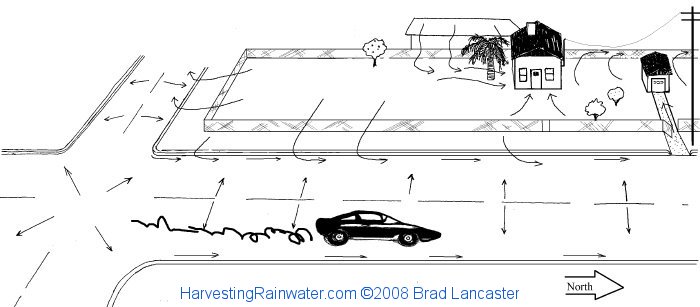
Right after we bought the house, monsoon rains poured from the sky. Rodd and I got acquainted with where where runoff pooled against the house and how the bulk of the rain ran off our site into the street. We mapped these observations, and others, including noise, head¬lights, and pollution from the street; where we wanted privacy; where we needed shade; and where we needed to enhance winter solar exposure. Wherever you direct rainwater in your landscape, you will be nurturing plant life, so take the time to make ensure this vegetation is part of your overall plan.
Next, calculate the rainwater resources available within your site’s “watershed.” For us, that area included not only the 12 inches of annual rainfall on our roof and 1/8th of an acre property, but the 20 foot wide public right-of-way adjoining our property, the section of street draining past the right-of-way, and the runoff from our neighbor’s roof. (See Table, below) This totaled about 104,600 gallons (397,000 liters) of rainwater in an average year!
Principle #2: Start harvesting rain at the top of your watershed, then work your way down.
In most cases, the top of your watershed means the roof of your house.
Our leaky asphalt roof was a mess, so we removed it and installed 26-gauge galvanized steel metal roofing instead, which harvests rainwater in a potable form. However, as long as you’re only harvesting rainwater for use in landscape irrigation, this isn’t a necessary step. (Rainwater harvested off a conventional asphalt roof can also be made safe for consumption with the installation of an appropriate water filtration system.)
Take a look at your roof. Where do the gutters drain? Where is rainfall currently being directed? This is where you should begin with mulched water-harvesting basins and plantings (at least 10 feet from the building’s foundation.) On our property, just under half of the roof runoff is directed to earthworks and fruit trees north of the house. The rest is directed to an above-ground cistern west of the garden along our property boundary on top of a 2-foot (60 cm) high earthen platform.
Our cistern is a custom-modified new ferro-cement septic tank, but a number of good alternatives exist. (See, Choosing a Tank.) We selected the location of our cistern to provide multiple functions. By placing it on the western boundary of our yard to shadeing out the hot afternoon sun, it creates a beneficial microclimate for our garden. By acting as part of the property line, it provides a privacy screen from a peering neighbor. And by placing the cistern on an elevated platform, the system utilizes gravity in circulating water from the roof’s gutter to the tank, and from the tank to the garden.
Whatever type of cistern you choose, having your garden located nearby will keep hose length to a minimum (25 ft. ideal) This will reduce water-pressure loss to surface-friction inside the hose and make watering with rainwater a convenience. (Your plants will love it too!)
Principle #3: Always plan an overflow route, and manage overflow as a resource.
Eventually, all water-harvesting systems will meet a storm that exceeds their capacity, so don’t get taken by surprise. All rainwater harvesting structures should be managed in such a way that the system can overflow in a beneficial, rather than destructive way.
In that spirit, overflow from our backyard cistern is directed via a 4-inch diameter overflow pipe gutters to a series of adjoining mulched basins that passively irrigate a citrus tree and our garden. In addition, all of our sunken earthworks have an overflow “spillway.” Typically, one earthwork overflows to another and another, until all are full and then, if needed, the lowest earthwork can overflow to a natural drainage–-or, in a typical urban context, the street.
Your goal should be to harvest the rain, but never get flooded by it. This is key.
4. Start with small and simple strategies that harvest the rain as close as possible to where it falls.
When people think of rainwater harvesting, usually it’s cisterns and tanks that spring to mind. But the water collected off your roof is typically much less than what’s actually falling on your property. Simple water-harvesting earthworks, such as basins, terraces, contour berms, and check dams will harvest the rain where it falls, on the land.
The water-harvesting earthworks Rodd and I created collect the vast majority of our rain. We dug level-bottomed basins and deeply mulched them (about 4 inches) in order to infiltrate rainfall and runoff throughout our watershed—once again starting at the highest points of the yard and working down. Overflow water was directed from the upper basins to the lower basins, which brings us to principle number five.
5. Spread, slow and infiltrate the flow of water into the soil.
Cisterns along with mulched and vegetated earthworks basins with overflow routes will effectively transform your erosive runoff during heavy rainfall into a calm, productive resource while reducing water loss to evaporation and downstream flooding.
Raised pathways and gathering areas are also a great strategy for spreading water through the landscape. This pattern of “high and dry” regions that drain to adjoining basins kept “sunken and moist” will help to define those areas through vegetation while spreading and sinking the flow of water. (This also helps keep ice off walkways and driveways in colder regions.) At our place, we also used earthworks to redirect the runoff that used to pool against our house to planting areas 10 feet or more away from the building’s foundation.
6. Maximize living and organic groundcover.
All your basins and other water-harvesting earthworks should be well mulched and planted. This creates a “living sponge” effect that will utilize the harvested water to create food and beauty in your surrounding landscape while steadily improving the soil’s ability to infiltrate and hold water due to the vast network of growing roots and beneficial micro-organisms.
Groundcover is equally important in helping to ensure that, in your enthusiasm for harvesting rainwater, you don’t wind up creating a haven for mosquitoes. Mosquitoes need three days of standing water to transform from eggs to adults. Water-harvesting earthworks allowing water to infiltrate below the surface of the soil (typically within one hour) where it won’t be lost to evaporation.
Take a hike in the natural unmanaged areas near your home to determine what native vegetation would be best to plant within or beside your earthworks. Out in the wild, you’ll notice which plants grow naturally in depressions – they can be planted within your basins. Wild plants preferring better drainage can be planted beside, but not within earthworks.
Blue palo verdes, velvet mesquite, chuparosa, oreganillo, and desert lavender are a few of the native plants found along the ephemeral washes in our area of Tucson that we plant within our earthworks.
7. Maximize beneficial relationships and efficiency by “stacking functions.”
As mentioned previously, water-harvesting strategies offer maximum benefits when they’re integrated into a comprehensive overall siteplan. We focused on locating the earthworks where we wanted to stack functions with multi-use vegetation.
Through rainwater harvesting earthworks, we’ve nurtured a solar arc of deciduous trees on the east, north, and west sides of our home that cool us in the summer, but let in the free light and warmth of the sun in winter. A living fence of native plants along the property line (along with an existing citrus tree) form part of a sun trap. This suntrap shades our garden from the afternoon sun, creates on-site stormwater control, and enhances habitat for native songbirds and butterflies.
The Big Picture
Within our generative landscape, rainwater has become our primary water source, greywater our secondary water source, and municipal groundwater a strictly and infrequently used supplemental source (meeting no more than 5% of our exterior water needs). Most of our established landscape has even become regenerative by thriving on rainwater alone.
Our household consumes less than 20,000 gallons of municipal water annually, with over 90% of that being recycled in the landscape as greywater. Additionally, we harvest and infiltrate over 100,000 gallons of rain and runoff into the soil of our site (and, by extension, the community’s watershed) over the course of our annual average rainfall.
As a household, we’re shifting more and more to living within our rainwater “budget”: the natural limits of our local environment. As a result, we’re enriching the land, growing up to 25% of our food on site, creating a beautiful home and neighborhood environment – and giving back more than we take!
The further we go, the easier and more fun it gets, which brings us to the eighth and last principle:
8. Continually reassess your system and improve it.
Three years ago, Rodd and I set up an outdoor shower so the bather could either use pressurized municipal water at the showerhead or cistern water distributed from a shower bucket on a hook. Other strategies have included a solar-powered greywater “laundromat” in our backyard (utilized by seven neighboring households) along with a reduction in impermeable hardscape by replacing our asphalt driveway with lush plantings and earthworks.
One of our most rewarding recent improvements has been the process of working with our neighbors and the city to replace 26% of the pavement from the corner intersection with a water-harvesting traffic circle planted with native vegetation. We also succeeded in implementing a system that harvests street runoff within curbside mulched basins to grow a greenbelt of trees along the street and sidewalk, so the street now passively irrigates the trees.
As a result, our neighborhood—once the victim of urban blight—is now one of the greenest and most livable areas of the city.
My advice to anyone who wants to get started living more sustainably is to start with rainwater-harvesting. Start at the top. Start small. But above all—start!

Enjoying a shady right-of-way produced by rainwater-irrigated, food-producing trees at the Lancaster residence
Sidebar: Choosing a Rainwater Cistern
Our cistern has a 1,200-gallon (4,560 liter) capacity. We selected this size after calculating the average annual roof runoff, assessing our water needs, and determining the resources we wanted to commit to the system. We opted for a precast concrete septic tank for a number of reasons, but primarily because it was affordable as well as a workable size and shape for our space (5 foot wide, 6 feet tall, 10 feet long).
Our septic tank was custom-made for use as a cistern, and further reinforced for above-ground installation. The cost back in 1996 was $600, which included delivery and placement. It’s been working great ever since.
Other options for pre-manufactured cisterns include light-free dark green or black polyurethane plastic, corrugated metal, and fiberglass. See www.watertanks.com for options and look in the yellow pages under tanks for local suppliers.
Calculating Your Rainwater Resources
To calculate the volume of rain falling in an average year on a specific surface such as your roof, yard, or neighborhood, use the following calculation: CATCHMENT AREA (in square feet) multiplied by the AVERAGE ANNUAL RAINFALL (in feet) multiplied by 7.48 (to convert cubic feet to gallons) equals the TOTAL RAINWATER FALLING ON THAT CATCHMENT IN AN AVERAGE YEAR: CATCHMENT AREA (ft2) x RAINFALL (ft) x 7.48 gal/ft3 = TOTAL AVAILABLE RAINWATER (gal/year)




FTSE at seven-month high in cheery trading
Their outlooks are grim, cautious at best. But the slew of companies reporting on Thursday still managed to surprise markets on the upside and big swings for big names such as BT and Rolls-Royce pushed the FTSE 100 to within a whisker of its highest close this year.
The index of leading London-listed shares ended up 84.1 points, or 1.9%, at 4,631.61 - the highest since this year’s peak close of 4,638.92 on January 6.
BT was the biggest riser, up more than 12% to a six-month high of 126.9p following its forecast-beating results.
Engine maker Rolls-Royce was not far behind, up 8.7% at 408p as predictions of a slow recovery in trading conditions was outweighed by rising profits.
Early gains for the FTSE 100 after the morning rush of company news were extended in afternoon trading when Wall St opened in a bright mood on the back of positive results from mobile phone maker Motorola.
Economic data also highlighted an upbeat mood in equity markets, with traders on both sides of the Atlantic apparently determined to put a positive spin on almost any news out on Thursday.
US government data showed the number of Americans filing new claims for unemployment benefits rose slightly more than expected last week. But the markets focussed on the four-week moving average for new claims, considered to be a better gauge of underlying trends, which fell to the lowest level since late January.
That helped lift the Dow Jones industrial average more than 1.5% to over 9,221 by the time London closed. Amid the generally confident mood, market players see more rises for the FTSE 100 ahead.
David Jones, chief market strategist at IG Index comments:
“The next big test for the London market will be the 4,700 level – the one that successfully stopped rallies in the last quarter of 2008.”
“But the way momentum is at the moment, and with the ease that US markets have shrugged off the downbeat jobs news this afternoon, traders and investors alike seem happy to take the view that there are even more gains to come for share prices. Increasingly it feels like the time is not right to worry about this strength running out of steam just yet.”
Building supplies group Wolseley was one of the FTSE’s top risers, up more than 10% to £13.11, benefiting from the upbeat mood around mid-cap rival Travis Perkins - up 13.6% to 795p.
The miners also helped lift the overall index as they benefited from firmer metals prices.
Further down the market, mid-cap company United Business Media was under pressure, falling almost 4% to 371.25p ahead of its results today and weighed down by rival Reed Elsevier‘s woes.
Reed was the biggest FTSE 100 faller, down 12.6% at 420p. BAE Systems was next, down 4.9% at 312p as news of a sharp rise in its pension deficit overshadowed in-line earnings and an upbeat outlook.
- BT
- Wolseley
- Rolls-Royce
- Reed Elsevier
- BAE Systems
- Travis Perkins
- United Business Media
Bright start on Wall St pushes FTSE higher
Upbeat US company news has helped shares on Wall St open sharply higher, pushing the FTSE 100 up further in afternoon trading.
With the Dow currently up 1.5% to 9,209, the FTSE 100 has extended earlier gains and is now 85 points, or 1.9%, higher at 4,634.4.
There were strong results in the US from Motorola and insurance broker AON while economic data also improved the mood.
Government data showed the number of Americans filing new claims for unemployment benefits rose slightly more than expected last week. But the four-week moving average for new claims, considered to be a better gauge of underlying trends, fell to the lowest level since late January.
Back in the UK, BT remains the FTSE 100′s top riser following this morning’s better-than expected results. The shares are still up more than 12% at 126.3p.
Engine maker Rolls-Royce is also one of the top risers up more than 11% at 417.25p after its news of a 9% rise in underlying pre-tax profits for the first half to £445m.
Wolseley remains in demand, up more than 11% to £13.30, benefiting from the upbeat mood around mid-cap rival Travis Perkins - up 11.7% to 782p.
The miners are also helping lift the overall index as they regain some of Wednesday’s lost ground and benefit from firmer metals prices.
Moving to the fallers, Reed Elsevier is still the worst performer on the FTSE 100, sinking 13% to 418p. The publishing group unveiled a fund-raising, abandoned the sale of its trade mags business, and warned that advertising remains under pressure.
Its cautious outlook has put mid-cap rival United Business Media on the backfoot. UBM, which reports first-half results on Friday, is down 16p, or 4.2%, at 370p.
BAE Systems remains under pressure following the news of its ballooning pensions deficit. The shares are down 5.2% at 310.75p.
- BT
- Wolseley
- Travis Perkins
- Rolls-Royce
- Reed Elsevier
- BAE Systems
- United Business Media