This is a guest post by Stuart Staniford, former Oil Drum staff member. It was originally posted in Stuart’s blog Early Warning.
The Chinese National Bureau of Statistics has a lot of interesting data. The web site is hard to use, at least in my browser, but after poking around in the html source of the pages, I’ve managed to figure out how to get to all the annual data, which let me make some graphs. I don’t know how accurate these numbers are, but here, at any rate, is the official story.

As usual, when reviewing Chinese economic statistics, I strongly recommend that you first arrange for ample clearance below your lower jaw to avoid any risk of accidental injury…
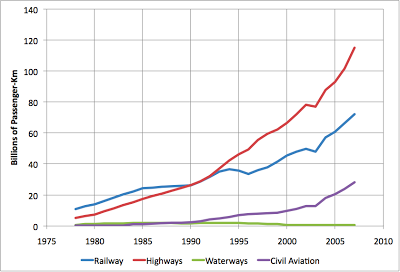
First up, we have the data on total passenger-kilometers by major mode. (One caveat to bear in mind. These are annual data from 1990 to 2007. Prior to 1990, there are data points for 1978, 1980, and 1985. I have made annual plots from 1978-2007, and just used linear interpolation for the data gaps before 1990.)
To get a better sense of the growth rates in that data, here’s the five year compound annual growth rate (CAGR) for the three major modes:
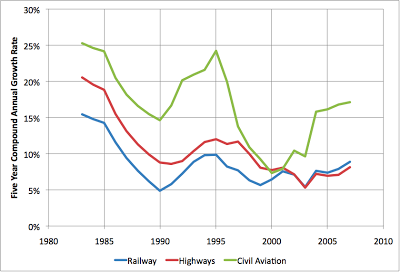
As you can see, growth rates of railway and highway usage are both very high (the 7% growth corresponds to about a ten year doubling time). However, it’s the airline usage that’s really electrifying with over 15% growth over the last decade. Note also that highway passenger travel will include both buses and personal vehicles, and this combined data likely conceals a significant transition from the one to the other.
Next, there are some data on total length of transportation routes. (Here the only missing data point is 1979 which I interpolated). In this next graph, I show the length of railways versus expressways (not all highways, which is a much larger number, just the freeway-equivalent roads):
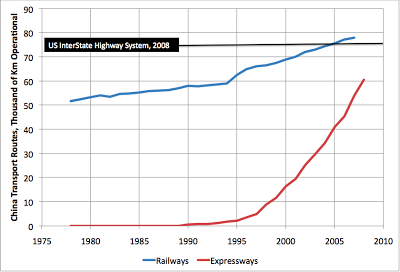
Clearly, China is becoming increasingly car-centric, versus rail-centric. For kicks, I also put in the level of the US Interstate Highway System in 2008. As you can see, the Chinese Expressway system is reaching the size of that system and will likely far surpass it soon. According to the wiki entry:
Design standards for China’s National Trunk Highway System are derived from the standards used on the American Interstate Highway System, with Chinese expressway cross-sections, interchange profiles, and bridge designs closely reflecting their counterparts in the United States
The Wikipedia even has a nice map, with blue being expressways in existence, and red under construction or planned.
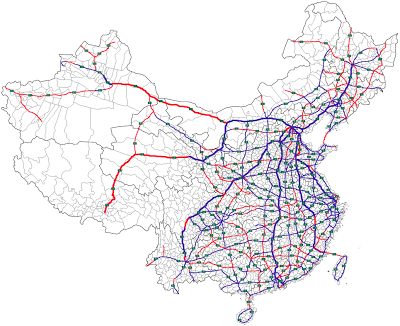
Looks like they can keep stimulating their economy with shovel-ready projects for quite a while to come…
Also, from the same dataset, here is the breakdown of electrified and non-electrified railroad:
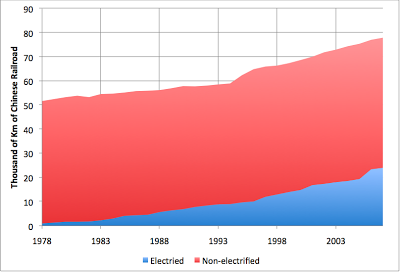
The electrified railroad is increasing very rapidly, but right now, between the rapid growth of private passenger transportation, and the remaining diesel powered railroads, Chinese transportation is probably almost as oil dependent as US transportation (they have pretty much phased out the steam trains now).
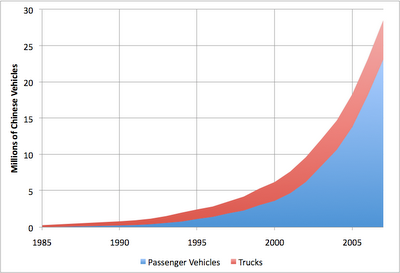
Next up, ownership of private vehicles:
Holy Batmobile! That’s quite a growth curve!
Still a ways to go to reach US levels of 250m or so. But with growth rates like these:
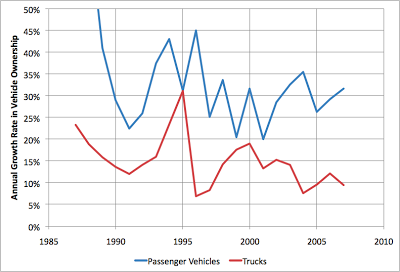
it won’t take long! Over the twenty years 1987 to 2007, the compound annual growth rate was 30.8% in the private passenger vehicle ownership rate. That’s the average growth rate. And it’s not like there’s a sharp slowdown - 2006-2007 was over that twenty year average. In fact, if you take the decade 1997 to 2007 CAGR of 28.3% (!!), and project it forward then the Chinese vehicle fleet will surpass the US fleet by 2017 or so.
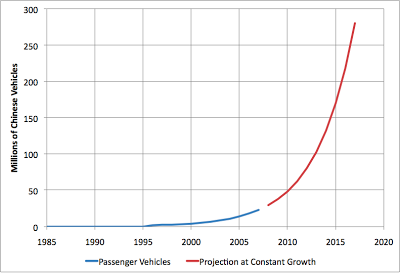
Admittedly it’s hard to see such astronomical growth rates continuing for long. Maybe they won’t. But then, it’s hard to imagine them having continued for the last 25 years, and apparently they did. If you’d said in 2000 that growth was slowing down and certain to slow down more, you’d have been wrong. And they’d still be a long way from US per capita car ownership at that level, since the population is four times larger.
The world has never seen anything like this Chinese industrial machine.
In summary, if present trends continue, the Chinese expressway system will likely grow larger than the US interstate highway system within the next couple of years, and Chinese car ownership will exceed US car ownership by somewhere in the neighborhood of 2017. So while the al-Shahristani plan for Iraqi oil production seems like it aims for an extraordinary increase in oil production in a hurry, it’s not at all hard to see where all that oil can go. Oversimplifying greatly, it’s as though the US borrowed a pile of money from China in order to fight a war to free up oil supply in Iraq in order that China could become the greatest industrial power the world has ever seen.
Oh, and you can see why China wasn’t too keen to strike a deal in Copenhagen.


