
Costs and environmental impacts of electric cars
This is a guest post by Joost van den Bulk in which the costs and benefits of electric cars available by 2010 are compared with internal combustion cars powered by gasoline for the Netherlands. It is a summary of his Master thesis in environmental science at Wageningen University in the Netherlands (PDF, 3 Mb, 72 pages).
Developments in battery technology have made cars driven by electric propulsion cost competitive with internal combustion based cars. Based on a scenario in which a car owner drives 15,000 kilometers annually, the car is owned for a period of 6 years, and the oil price on average remains above 100 dollars per barrel in the next two decades, it was found that an electric car for the consumer is already cheaper than a gasoline powered vehicle in the Netherlands, and that this will only improve in the future. This is the case because higher initial investments in the purchase of an electric car are more than compensated by lower fuel costs, reduced maintenance and tax benefits. Furthermore, greenhouse gas emissions of an electric car are at least half that of the gasoline powered car based on the current Dutch electricity mix.
In recent years attention for electric cars has increased significantly. There are many countries and regions pursuing electric car technology, including Israel, Denmark, Portugal, Germany, Ireland, and California. Most of these countries have a goal of 500,000 to 1 million electric cars on the road by 2020. The necessary battery technology for all these cars is developing rapidly which stimulates large and small car manufacturers to develop a production line. Considering the current developments, it is interesting to analyze the costs, benefits and environmental consequences of electric cars compared to cars with a combustion engine.
What is the electric car?
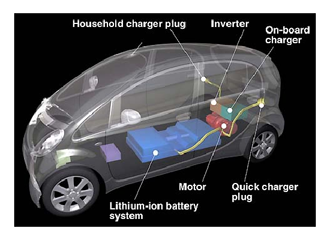 The biggest difference between a car with a combustion engine and the electric car lies in the drive-train (see Figure 1 to the left). The electric car is powered by an electro motor which receives its electricity from an on board battery. In the majority of electric cars currently under development lithium-ion polymer batteries are used which combine a high energy density with durability and safety. An inverter placed in between the battery and electro motor converts direct electric current from the battery, to alternating electric current supplied to the electro motor and car electronics. An electric car can be charged in four to eight hours by plugging it in the standard electricity grid or in fifteen minutes by connecting it to a high voltage charging station.
Cost comparison
The costs of a car can be divided in depreciation costs, fuel costs, maintenance costs and fixed costs shown in table 1. These costs are based on specific parameters such as the efficiency of a car. The fixed costs of the car consist of road tax, insurance and membership of the Automobile Association patrol. Current costs of the electric car and a car with an internal combustion engine can be compared by developing a car usage scenario. In the scenario included here I assume an annual driving distance of 15,000 km, a car ownership of 6 years, and two oil price and related electricity price scenarios. The first scenario is based on IEA assumptions in the World Energy Outlook 2008 which assume an average global oil price of over $100 per barrel between 2010 and 2030 (see figure below). In this scenario the Dutch gasoline price increases from the 2007 average of 1.40 euro per liter to 1.50 euro per liter in 2020 and 1.60 euro per liter in 2030. The energy content of gasoline is 34.3 mega joule per liter which results in a base electricity price of 0.15 eurocent per kilowatt hour in 2008, 0.16 in 2020 and 0.17 in 2030.
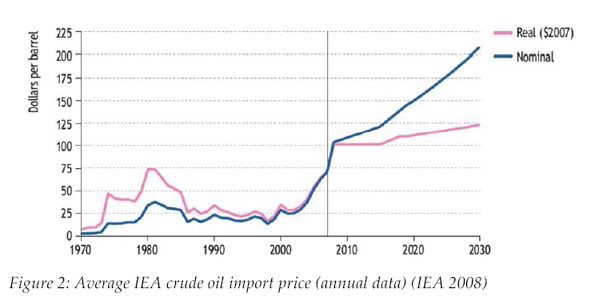 Figure 2 - oil price scenario from the World Energy Outlook 2008 reference case by the International Energy Agency.
In the second gasoline price scenario it is assumed that the Dutch petrol price increases gradually to 2.00 euro per liter by 2030, which is equal to an annual inflation corrected gasoline price increase of 1.56%. Resulting in a gasoline price of 1.7 euro per liter by 2020 and an electricity price of 0.18 eurocent per kilowatthour in 2020 and 0.21 euro cent in 2030.
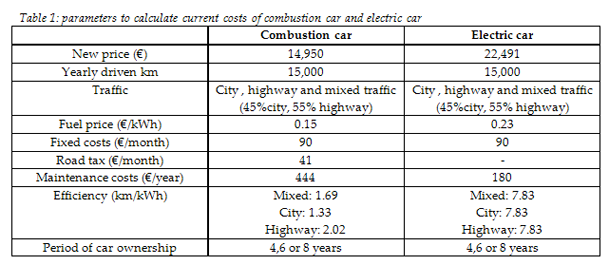
Depreciation costs - A Detroit Electric Subcompact electric car which will be available around 2009/2010 on the Dutch market is expected to cost 22,491 euro. It is estimated that the car will have an expected rest value of 7,000 euro after 6 years with an assumed battery life of 10 years. The rest value of a comparable gasoline/diesel car with a new price of 15,000 euro is expected to depreciate to 4500 euro after 6 years. In this scenario the depreciation costs of the electric car are 17 eurocent per driven kilometer. The depreciation costs of the combustion car are 12 cents per driven kilometer.
Fuel costs - Fuel costs per kilometer of an electric car are based on the consumer electricity price per kWh and the overall energy efficiency of the car. With 23 eurocent/kWh the electricity price of Dutch households is one of the highest in Europe. The energy efficiency of the electric car is almost 8 kilometer/kWh which results in an electricity cost of 3 eurocent per kilometer. Fuel costs of a car with an internal combustion engine are calculated by multiplying the costs of gasoline (Euro 95) with the fuel use of the car. The average Dutch gasoline price in 2008 was €1.40 for a liter of Euro 95. Fuel use of a compact combustion car under mixed traffic conditions (combination of city and highway traffic) is 6.2 liter per 100 kilometer which results in fuel costs of almost 9 eurocent per driven kilometer.
Maintenance costs - The electric car contains few moving components which are vulnerable to wearing out. The electro motor for example contains one moving component while the combustion engine contains dozens. Regular combustion car maintenance such as the replacement of oil and filters is not necessary with electric vehicles. The yearly maintenance costs of electric cars are estimated to be €180 which results in maintenance costs of 1 cent per kilometer. The drive-train of a car with an internal combustion engine contains a considerable number of moving components which are vulnerable to wear out such as the internal combustion engine, transmission system, and gearbox. Cars with a combustion engine need regular maintenance including the replacement of oil, oil filters and spark plugs. The annual maintenance costs of a compact car with a combustion engine are €440 which results in 3 eurocent per driven kilometer.
Fixed costs - The fixed costs of a car consist of road tax, insurance, membership of the Automobile Association patrol and cleaning costs. At this moment the fixed costs for electric car owners are lower than the fixed costs for combustion cars because the owners of electric cars do not have to pay road taxes. On a monthly base fixed costs for electric car owners amount to 90 euro which results in 7 cent per driven kilometer. Combustion car owners have to pay an additional amount of €40 on road taxes monthly which results in fixed costs of 10 cent per kilometer.
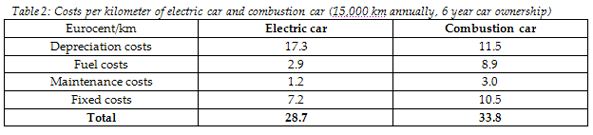
Total costs - The total costs per kilometer of a compact electric car are at 2008 oil prices 5.5 cent lower than total costs of a compact combustion car as shown in table 2. The new price of an electric car is higher but the fuel costs, maintenance costs and fixed costs result in cost benefits over a time period of 6 years.
Future development
The future development of the kilometer price of electric cars and combustion cars can be estimated by developing scenarios for the parameters on which the costs of a car are based. By 2020 it is expected that the large scale production of electric cars and improvements in battery technology will result in reduced electric car costs. The amount of yearly driven kilometers is expected to increase to 16,500 by 2020 and a kilometer tax which is coupled to CO2 emissions of a car is expected to be implemented, included in table 3.
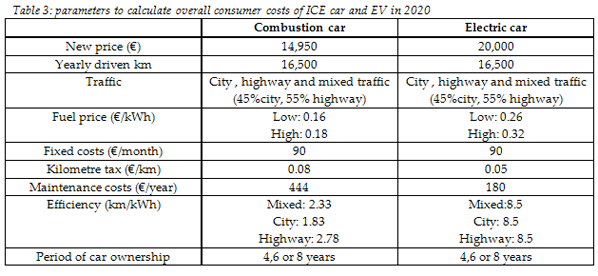
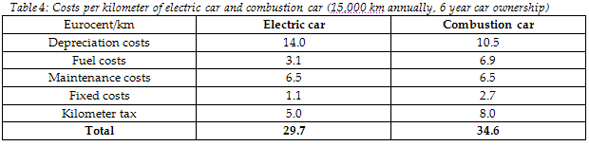
According to the scenario the total costs per kilometer of a compact electric car are estimated to be 4.9 cent lower than total costs of a compact combustion car by 2020 as shown in table 4. The new price of an electric car remain higher due to its more costly components, but the lower fuel costs, maintenance costs and tax costs result in cost benefits over a time period of 6 years.
Environmental impacts
Electric cars drive on electricity which is stored in the on board battery. An electric car is not directly dependent on oil because electricity is generated by a variety of sources. The compact electric cars which are developed at the moment have a range of 200 to 300 kilometer on a full battery. It can be charged on the standard electricity grid or by charging poles situated at parking lots. Use of electricity instead of gasoline has consequences on the environmental impact of the electric car. Measured by the CO2 and particulate matter (PM2,5 and PM10) production per driven kilometer. Besides environmental impacts due to the energy use the battery of the electric car is an important aspect from an environmental and resource perspective.
Environmental impacts of a combustion engine - The European Union has decided that CO2 emissions of a car driven by a combustion engine should be reduced to 130 gram per kilometer by 2012. At the moment, CO2 emission of an average Dutch car are 150 gram per kilometer. The efficiency of the production process of oil is estimated to be 83% which results in a well-to-wheel CO2 emission of 180 gram per kilometer. Current PM10 production of combustion cars with a soot filter is 5 mg per kilometer. Road traffic is the main cause of particulate matter- and air pollution such as SOX, NOX and ozone in the Netherlands. Furthermore, combustion cars emit their exhaust gas directly in the urban environment which results in air pollution of the urban environment.
Environmental impacts of Dutch electricity production - 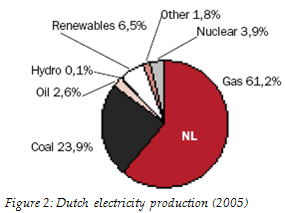 The majority of Dutch electricity is produced in power plants which are powered by natural gas. Other electricity sources are successively electricity from coal powered plants, hydro, wind and solar powered energy, nuclear energy, oil and other sources, shown in figure 2. According to Dutch electricity companies average CO2 emission per kWh of produced electricity in the Netherlands is 450 gram. An electricity grid efficiency of 92% and an electric car efficiency of 8 kilometer per kWh results in well-to-wheel CO2 emissions of 60 gram per kilometer. CO2 emissions of the electric car can be further reduced by increasing efficiency of the electricity production process and increasing electricity from sustainable sources such as wind and solar power. Per kilometer, electric cars have a lower PM10 production compared to cars with a combustion engine. Power plants cause no air pollution in the urban environment which reduces health risks.
Environmental impact of the battery - Electric car producers already guarantee a battery lifetime of 160,000 kilometer for models currently on the market. Sufficient to drive 11 years when one drives 15,000 kilometers annually, a distance covered by the average Dutch car driver. Improvements in battery technology and battery management systems are expected to increase the lifetime of the batteries further. The Lithium-ion polymer batteries which are used in electric cars nowadays are relatively environmental friendly because they contain no heavy metals or other toxic compounds, opposite to Zinc acid batteries. Lithium-ion battery are claimed to be completely recyclable by companies such as Tesla motors. Costs involved in recycling need to be included in the new price of the car as to ensure proper handling of the material. When electric cars are implemented on a large scale the recycling process of the Lithium-ion batteries provides economic opportunities due to the value of the material remaining after the battery life time is spent. Another possibility lies in using a former electric car battery as a stationary electricity storage station. Because when a car battery is not suited for use in a car anymore it still has 80% of its charging capacity .




Comments
Feel free to leave a comment...
and oh, if you want a pic to show with your comment, go get a gravatar!