

Advice To Pres. Obama (#2): Yes We Can, But Will We?
The below post/letter is very important to me, and brings together much of what I have worked on the past few years. We are at a major crossroads in the history of our nation and our world. There are dozens if not hundreds of salient aspects of our supply and demand situation, each with its own cheerleaders, opponents and unaware. Myopic focus on any particular issue runs the risk of creating more long term harm than good. In this letter, I attempt to highlight our situation’s most critical components, not claiming other issues are unimportant, but that the following principles likely trump/supercede the others:
1)It is energy, not money, that powers our economies
2) All energy is not equal- each energy investment entails different input costs, and has different output quality, often not recognized by the market system, nor environmentalists
3)By far the highest odds for arriving at a better energy future lie in exploration of, understanding of, and ultimate jettisoning of our cultural addiction/habituation to conspicuous consumption.
Note to reader: This is longer than I anticipated (plus ca change….)
Dear President Obama,
Let me start by explaining where I am coming from. Until a few years ago, I worked as a Wall Street trader and hedge fund manager. I am now working on a Ph. D. in Natural Resources from the University of Vermont. I am neither capitalist nor communist nor Republican nor Democrat, but just an awfully concerned citizen of this great country and planet. I have recently come to see that there is a great deal hidden from view both about our energy resources and our energy consumption. In this letter, I would like to explain what some of these things are.
INTRODUCTION
Let me start with a thought experiment. Imagine two scenarios - 1)the US Treasury ‘prints’ $100 trillion of new ‘capital’ to be spent on infrastructure, reviving the economy, etc. - far in excess of the $1.2 trillion budget deficit you expect to incur in 2009 (and even in excess of the $24 trillion the IEA has suggested needs to be spent to assure future oil flows) - and 2)instead of issuing this new debt, all the world’s billionaires and nations in monetary surplus donate this $100 trillion to the US Treasury – effectively for you/Congress to spend and allocate.
In the second scenario, we are not only out of hock but rich again! All problems solved right? DJIA 30,000? Not so fast - there is another important fact connected to this thought experiment. The energy surplus (gross energy less energy costs) we derive from world fossil fuels is declining, possibly approaching energy break-even for new fields. It requires about 750 joules to lift 15kg of oil 5 meters out of the ground - a physical fact that will vary little when the number of digits in the worlds banks increases or shrinks. As such, the above two scenarios would both be equally ineffective at reviving the economy for any period of time- even with plenty of ‘money’ -the first would likely just add an extra digit or two to the nominal lack of affordability. Energy is what we have to spend - in the long run a transfer of money from rich to poor (or vice versa) is just a transfer of an abstraction to another abstraction - those altruistic billionaires will feel poorer and the government dole recipients will feel successfully bailed out, but the real assets constraining future trajectories didn’t change. In the (very) short run however, whoever holds the money, does control the energy.
Oil Supply Costs Based on CERA Analysis - From Horizon Energy November Investor Presentation (slide 17)ENERGY QUANTITY
The easy fossil energy pickings have largely been picked. Though costs have been coming down in past few months, the above graph gives a flavor of the problem that until recently the IEA/CERA/Bodmans of the world would not voice - the horizon of overall affordability is receding, and its origins are in energy. The average replacement cost of oil is far in excess of the current commodity price, especially in non-OPEC countries. To increase reserves and maintain flow rates, we must drill in the oceans, off continental shelves, use expensive horizontal laterals, drill deeper and in more environmentally sensitive areas and define more things as oil. Technology is always in a race with depletion, and in the late innings loses at an accelerated rate. Because of this, energy costs have been rising faster than revenues -the heavy economic lifting so long undertaken by the energy sector now needs help from the rest of ‘productive’ society. With new investments being unaffordable and/or unfinanceable, the global oil production rate will fall increasingly in sync with the natural decline rate - close to double digits and rising as small/offshore fields replace giant/onshore ones. This suggests even with current deflationary forces due to credit unwind, at best (or worst) we have about a year or two before depletion once again overtakes the recent demand drop, and this time, there will be no new peak in supply when prices rise. Essentially Mr President, though there is undoubtedly a great deal of oil and gas remaining, a lower aggregate energy surplus means it may cost more to procure than society has the ability to pay, at least in the currencies that matter: energy and other limited natural resources. (An example of a hypothetical society encountering lower energy surplus can be read here).
High quality, low cost energy has enabled our economic engine. There is a high correlation between energy consumption per person and GDP over the past 50 years. If energy costs continue to increase in energy terms, even with trillions of dollars, it will eventually require more in energy inputs to procure a new barrel of oil from domestic territory than the amount of joules contained in that barrel. Of course, most energy ‘analysts’, trained in economic concepts will say ‘all we need is $30,40,50 trillion and we will have enough energy for decades’. Don’t fall for it Mr. President. At some point between $1.2 trillion and the $100 trillion thought experiment, even Rush Limbaugh and Larry Kudlow will recognize that ‘money’ can’t procure ‘resources’. Marginal costs of growth now likely exceed marginal benefits, so that real physical growth makes us poorer, not richerThe sooner we educate policymakers about this constraint the better choices we will make - Energy and scarce resources are what we have to spend – money is just who has the energy (for now).
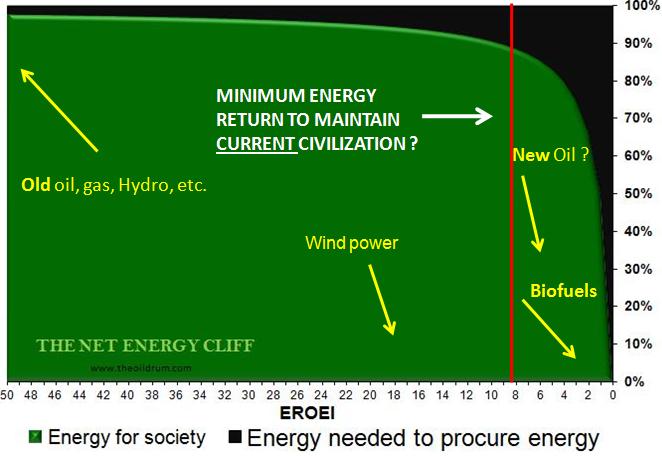
The fundamental principles of net energy are ignored by most in Washington (and the energy industry) where costs in terms of dollars and market signal via current price have been the lone decision criteria that have brought us to this energy precipice. The energy return on the energy we are spending is declining, possibly rapidly (we can’t know because data is no longer kept in non-$ terms). As we replace ‘old, high energy surplus’ sources with ‘new, lower energy surplus’ alternatives, our energy cash flow decreases. At some minimum aggregate threshold, the entire surplus is spent on maintenance, there can no longer be growth - I believe we are past this point. (We do know we’ve gone from over 100:1 in the 1930’s to 30:1 in the 1970s to a range of 10-17:1 in 2000 - Cleveland, Hall) and something anecdotally much less today (note: this is total energy return, which is fixed plus marginal - marginal costs for oil are very low -basic lifting and some labor-, raising the possibility we are in the midst of a stealth energy cliff -since most energy infrastructure was built and paid for when oil/natural gas prices were low, we are still ’spending’ the cheap marginal flow rates from earlier days, even though we can’t afford their replacements! It is logical that financial analysts, or even Presidents, don’t start to notice our decline in physical return until the lack of continued energy surplus eats into the economy, forcing the ‘profit’ to be made up different ways (no-doc loans, leverage for banks, easy credit, etc.). The situation is even more dire on the natural gas treadmill, as it is largely a domestic market, overall decline is north of 40% per year, and the commodity price is far below both average and marginal cost.
(*Note In the Journal - Energy, there is an upcoming paper by Hall, Murphy et al. titled “What is the Minimum EROI that a Sustainable Society Must Have” that looks at the above concepts in greater detail.
ENERGY QUALITY
Modern society has been built and developed not only on a large annual energy surplus, but also become dependent on specific energy properties. Light sweet crude oil is incredibly energy dense, transportable at room temperature, and can be procured from a very small land footprint -drilling under the earths surface. Energy quality, such as differences in power density, gravimetric and volumetric density, conversion efficiencies, intermittency, storability, environmental externalities, spatial distribution, transportability, etc. is not equal - even (and especially) because an energy alternative is labeled as ‘green’. A successful energy transition will match up the energy asset/liability balance sheet of our built infrastructure. The new post-fossil fuel era will require huge changes, as the mismatch currently is so large as to be virtually impossible once depletion catches up with the fall in demand.
Finally, Energy Return on Energy Invested gives us a rough idea of our energy budget, but we can (and should) calculate similar ratios for other limiting resources – Energy Return on Water Invested, Energy Return on Land invested, etc. As net energy declines, it stands to reason that the Energy return on NON-ENERGY inputs will decline faster. (examples are going from concentrated light sweet oil fields to tar sands, needing both more land, and water inputs – ditto with biofuels.) Once we approach and sink into a single digit average EROEI era, a higher % of energy AND non-energy resources (water, labor, land, etc.) will have to be devoted to energy production. This is the as yet unseen tragedy of biofuels and similar low energy gain technologies. On the surface, they seem better (renewable), but a) the inputs allocated to their procurement once generated far more energy - (returns that are no longer available yet continue to be spent), b)they require far more land, water, NPK, and generate negative externalities (large scale windpower a notable exception). Each attempt to buttress the energy supply side of our situation should be measured in a multi-criteria framework.
Supply side summary ===> Maximize the quality adjusted, non-energy input equalized, ‘energy cash flow’. This is your real ‘budget’. (A stricter, ‘greener’ budget would also internalize the externalities.)

THE BIG KAHUNA (DEMAND)
Our species in general and Americans in particular have the wiring and drive to be consumptive machines. No matter how many goods we acquire over time, our pecuniary desires seem to increase faster than our acquisitions. Combine this with our mirror neurons(video), between-and-within-nation aspiration gaps (based on biologic underpinnings of relative fitness), an evolutionary penchant for waste, a built in drive to outcompete, a culture that fosters keeping up with the Joneses with a high % of Veblen goods, and you get a frenetic feedback loop that has a vast plurality of Americans now Jonesing, many nearly broke, obese, and a fair number realizing, without knowing the details, that something is amiss. Alternative measures of ‘keeping score’ other than GDP concur that we are losing ground. Fortunately, subjective well being studies show we are equally happy as the average Phillipino, yet use 39 times the primary energy. This I view (as should you) as a great opportunity. In the end, humans are ‘adaptation-executors’, not utility maximizers. (This is really an ace in the hole - because the economic ‘utility’ machine is not needed to make us happy).
Facing our bigger problems requires that we individually and collectively become better able to consider and more heavily weight the future vis-a-vis the present. However, recent research suggests that addicts, and many other social groups (including men), have steeper discount rates - less able to access longer term thinking and action. Furthermore, there are numerous cognitive biases, ideological immunity (the Planck Problem), and belief systems that stand in the way of change.
Demand Side Summary===> We are hard-wired to compete, and our brains are easily hijacked and confused by modern stimuli. Both these aspects lead to incredible wastes of energy and resources. It is the most politically difficult area, but also the one with lots of low hanging fruit.
CONCLUSION AND (PARTIAL) PRESCRIPTION
If energy is what we have to spend, we are even running more of a deficit that commonly known. We import 70% of our oil and pay for it with dollars. Someday soon someone will recognize this trick. “Replacing” this quantity and quality of energy is not possible, nor affordable by a long shot. Admit this, devote resources to accurately determining what our energy and natural resource principal and cash flows are and then make difficult choices on how to allocate these. A great many marginal industries are going to have to be stopped.
A birds-eye view will see our system as little more than satisfying short term cravings, turning resources rapidly into garbage, and concentrating wealth. Repeat every day. Wealth itself is not bad, but a social democracy will stretch only so far in its GINI coefficient before snapping - (look to some European peers for (more) successful models). From a prescriptive standpoint, looking beyond putting out the Presidential short term fires du jour, the long term strategy should be some sort of Ecological Keynesianism, that is, spending of financial capital to best maximize future real capital. If we can’t get enough current flow rate from surplus energy we will borrow from poor countries, from environments, and increasingly, from the future.
The demand side is where the real opportunities lie: the main points are that we need to understand why humans behave the way they do, otherwise we are not going anywhere. Missing on your staff are neuroscientists, behavioral economists, and evolutionary psychologists – three disciplines that will eventually, given time and energy, converge on a unified theme of human nature. One driver that is already clear is that we cannot change our neural drive to want ‘more’ – but we can, via cultural transmission, via example and via strong visionary leadership, change how we ‘define’ more.
Here is a brief list of ideas that may help. As radical as some may seem, these are the types of steps needed to turn in the right direction. Almost by definition they are all politically untenable, but that is the point we have reached:
1)Put a floor on energy prices. The marginal barrel is killing future production. However, wait 6 months or so in doing this. Then the market will show you how many of these ‘alternative energies’ are actually viable, given that we don’t have accurate energy input output data. However, if oil (and particularly natural gas) prices remain below average cost for long, depletion is going to roar its head beyond what we can judiciously manage.
2) Scale wind turbines everywhere that they can be scaled as soon as possible. On a long term basis they are a far better investment than new money towards oil or natural gas. But that means moving away from liquid fuels.
3a) Focusing energy policy and social change on anthropogenic global warming is at best a half-measure and at worst could have negative repercussions, for two reasons: First, if there is a cold winter or three for whatever reason, and in a period of severe economic hardships high quality energy is being used to mitigate GHGs that might be spent on other needs then the populace may quickly lose their buy-in to carbon taxes etc. and behavioral change that were enacted DUE to global warming. But more importantly: it removes focus and responsibility from the larger problems we face: as long as we compete for conspicuous consumption, the non-GHG externalities from more consumption will increase to offset GHG reduction policies (kind of like quitting drinking and taking up sugar – ’serotonin deficiency’ is root cause not alcoholism). In sum, we should definitely be concerned about our impact on planetary ecosystems (our nest) and what toxins we emit, but this should be part of a larger science based roadmap not the entire roadmap. This will have the positive externality of mitigating climate change as well!
3b) On the spectrum of carbon taxes, cap and trade ,etc. consider gradually introducing a consumption tax instead. Subsidize basic needs and severely tax Veblen goods.
4)Gradually move to 100% reserve requirements in the banking system. Creating money (and debt) only partially out of thin air is preferable to completely out of thin air. The definition of ‘gradually’ would need to be explored..
5)On what may seem peripheral and brand me as a moonbat, I would seriously consider taxing or eliminating altogether refined sugar products, and refined carbohydrate foods in our grocery stores and convenience stores and changing to more local food production/availability. In addition to having an obesity epidemic that is accelerating, sugar has now been shown to be a gateway drug (Hoebel, Princeton) and chronic use results in low serotonin levels which in turn increases discount rates which has been shown to choose what they want/need today at cost to the future. Exactly the opposite of what we need. (So a meaningful chunk of both basic needs procurement and behavioural change can be accomplished by moving away from industrial ag and towards more locally intensive food production). If you can’t or won’t go this far, instituting national exercise programs (like in Naperville IL), would also pay neural dividends
6)In the same vein, tax or eliminate the gambling industry, indian casinos, Vegas, online poker rooms etc. The easy access millions of young people worldwide have to online poker contributes (as do many things) to hijacking our neural dopamine highways, which we then habituate to and consume more in other areas. People will continue to gamble anyways but at least the revenues will filter locally. Most neuroscientists and evolutionary biologists would agree we are not ‘intelligent’ enough to overcome the smorgasbord of impulses offered. I recommend reading “American Mania” by Dr Peter Whybrow at UCLA or contacting him directly.
7 Eliminate leverage on Wall street. Yes this will remove ‘income’ opportunities, but it will deter future volatility, and inherently transfer human talent into more productive sectors.
Please take seriously the task of matching our real assets with our real liabilities as soon as possible. You are a very smart man and well understand the implications of acting later as opposed to sooner on these tough choices, when our liabilities have increased and our assets have shrunk. Just ahead of us is a waterfall that few can clearly see. Even our scientists are focused on measuring the water speed, distance to the waterfall, building bigger canoes and larger life preservers, etc. But one path that hasn’t been duly considered, is just paddling towards shore, and walking the rest of the way.
Yes we can, but we need to use lateral thinking, be realistic, and be bold.
Sincerely,
Nate Hagens
Gund Institute for Ecological Economics
Rubenstein School of Environment and Natural Resources
Editor - www.theoildrum.comp.s. If ever in doubt, Herman Daly is just a cab ride away.
_0.gif)





Comments
Feel free to leave a comment...
and oh, if you want a pic to show with your comment, go get a gravatar!