Looking east: The Saudis are hedging their bets
CHINA, the world’s second-largest consumer of oil, is poised to buy more Saudi oil than the United States does. Last year it actually did so, though this year’s figures suggest that the Americans may again be level-pegging as the biggest buyer. In the next two years, however, China looks set to become consistently the Saudis’ key customer. Moreover, the Saudis are also now buying more Chinese goods—mostly food, textiles, hardware and heavy industrial stuff—than American ones.
Since he came to the throne in 2005, King Abdullah has adopted a pro-Asian, “look east” trade policy. More than half of Saudi oil now goes to Asia, against around 14%, at the latest count, to the United States. Saudi Aramco, the world’s largest oil company, owns a refinery in Qingdao province and has another, in Fujian, as a joint venture with Sinopec, a Chinese petroleum giant, and ExxonMobil, an American one. Meanwhile, Chinese firms have begun to invest in infrastructure and industry in Saudi Arabia, including in an aluminium smelter in the southern province of Jizan, at a cost of $3 billion. Saudi Arabia now sends students on scholarships to Chinese universities, and some rich Saudis, more used to shopping for Gucci in New York or London, are heading to once-obscure Chinese cities to buy furniture.
Japan, Russia set to tie up on gas plant
Japan and Russia are close to signing an agreement on building a joint liquefied natural gas plant in Vladivostok on the Japan Sea, The Yomiuri Shimbun has learned.
The plant would begin operation in 2017, and produce more than 5 million tons of liquefied natural gas (LNG) a year, informed sources said Friday. The Vladivostok project will allow Japan to procure a significant amount of LNG from Russia’s eastern Siberia region, thereby helping stabilize Japan’s energy supply, the sources said.
Saudi Oil Minister Al-Naimi Says $70-$80 a Barrel Is a `Good’ Oil Price
Saudi Arabian Oil Minister Ali al- Naimi told reporters that $70 to $80 a barrel is a good price for oil. He spoke before ministers from the Organization of Petroleum Exporting Countries began a closed-door meeting in Quito, Ecuador, to decide on OPEC policy and production quotas.
Venezuela Oil Min: OPEC Unlikely To Change Output In ’11
QUITO -(Dow Jones)- OPEC is unlikely to change its production ceiling in 2011 even though the price of oil could rise, Venezuela Oil Minister Rafael Ramirez said Saturday.
Angola Oil Min: Oil Markets To Dictate OPEC Output In 2011
QUITO -(Dow Jones)- Any future decision to change OPEC’s crude output quotas will depend on global oil market behavior, Angola’s oil minister said.
“We cannot change our decision” unless oil markets demand it, said Jose Maria Botelho de Vasconcelos. The Organization of Petroleum Exporting Countries on Saturday kept its oil output ceiling at 24.85 million barrels a day, a level that hasn’t changed since late 2008.
Libya Oil Head: Preferred Oil Price $100 A Barrel
QUITO -(Dow Jones)- Libya’s top oil official said Saturday that $100 a barrel is a “good price” for oil.
Shokri Ghanem also joined the chorus of ministers going into Saturday’s OPEC meeting, saying the group won’t change its current self-imposed limits on crude-oil output.
Iran Oil Minister Complains Of Gas Glut, Low LNG Price
QUITO -(Dow Jones)- Iran’s oil minister said Saturday he was concerned about oversupply in the global natural gas market, after producers last week warned it could hurt project investments.
Earlier this year, Iran froze the development of several liquefied-natural-gas export schemes in a move seen as result of international sanctions and depressed gas markets.
Another fuel price hike looms
MANILA, Philippines - The public will have to brace for higher fuel prices next week, according to the Department of Energy (DOE).
DOE Undersecretary Jay Layug said oil prices are expected to go up given the higher demand for petroleum in the international market.
Slow Pace Of Coalition Talks Sparks Kyrgyz Crisis Fears
As some in Kyrgyzstan are pointing out, there are important issues that require the attention of a government. The annual winter energy crisis is starting, the food situation this year is tenuous since fires caused Kyrgyzstan’s main grain suppliers — Kazakhstan and Russia — to cut back on exports this year, and the country has no budget for 2011.
End of consumerism
A change is about to be forced on society because energy consumption pretty much is the economy. And we are about to run short of the cheap energy which has been driving the past century of unchecked economic expansion.
There is this myth going round, says Krumdieck, that with every decade we have grown wealthier because we have collectively become smarter and more productive. If everything is bigger, better, brighter, well, it has been earned.
Yet actually we have just been digging up and burning more fossil fuel. Graph the world’s energy consumption against its gross domestic product (GDP) and the two lines track. So get down to the nitty gritty and this is what it has all been about. Converting oil or coal into shoes, hamburgers, cellphones and SUVs.
However, a reckoning is coming. The ecological limits on growth have come into view. Climate change and over- population. But peak oil most immediately.
Gauging how much oil there is (review of When Oil Peaked)
In 2001, building on the geologist M. King Hubbert’s prediction that U.S. oil production would peak between 1965 and 1970, Kenneth S. Deffeyes, emeritus professor of geology at Princeton University, predicted in his book “Hubbert’s Peak” that world oil production would peak in 2005.
“I’ve been a Hubbertian since the late 1950s,” Mr. Deffeyes writes. “I’m a geologist, with no professional expertise in economics or politics.” As a Hubbertian, or “peak oil” person, he numbers himself among “those who think that we have already found most of the world’s oil.”
Oil rises to near $89 ahead of OPEC meeting
SINGAPORE – Oil prices rose to near $89 a barrel Friday in Asia as traders looked to this weekend’s OPEC meeting for any changes to the cartel’s crude production policy.
OPEC set for no change despite $90 oil
QUITO - OPEC will not raise oil supplies at a meeting on Saturday, Saudi Oil Minister Ali al-Naimi said, leaving traders to ask what price the group requires to open the taps and prevent fuel inflation hurting global economic recovery.
“Absolutely not,” Naimi told reporters when asked if the Organization of the Petroleum Exporting Countries needed to raise production.
Oil prices are just short of the top end of the $70-$90 a barrel range flagged recently by Naimi as the level consumer nations can cope with, but concern about the potential damage of rising fuel costs on a convalescent world economy is mounting.
Iran sees no increase in OPEC quotas
(Reuters) - The Organisation of the Petroleum Exporting Countries will not increase quotas at a meeting on Saturday in Quito, Iran’s oil minister said, a view that chimed with other ministers gathering in the Ecuadorian capital.
“According to the market situation and the economic recession … and according to the amount of reserves, despite the beginning of the cold season, the prediction is that there will be no change in the quotas and there will be no increase in production,” Massoud Mirkazemi told Iranian state TV.
OPEC has No Reason to Change Crude Oil Quotas, Angola’s Oil Minister Says
There is no reason for the Organization of Petroleum Exporting Countries to change quotas at a meeting in Ecuador tomorrow, Angola’s oil minister said.
“There is no reason to change production,” Angolan Oil Minister Jose Maria Botelho de Vasconcelos said in Quito, where OPEC ministers will gather. “The situation is stable right now,” and oil at $90 a barrel makes up for a weak dollar.
Berman’s Call (video)
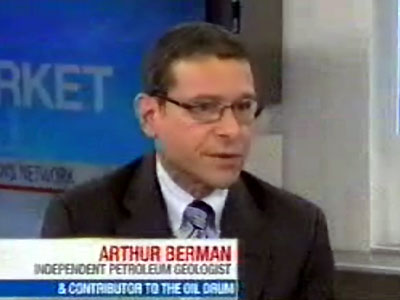
BNN speaks to Arthur Berman, Independent Petroleum Geologist and Contributor to The Oil Drum.
Power Output in China Gains at Slowest in 16 Months on Curbs to Industry
China’s electricity output grew at the slowest pace in 16 months in November as the government made last-minute efforts to meet energy saving targets slated to be completed this year.
E.P.A. May Enforce Rules as Suit Proceeds, Court Rules
The United States Circuit Court of Appeals for the District of Columbia on Friday denied an appeal by industry groups to block the Environmental Protection Agency from imposing greenhouse gas regulations early next year.
Inquiry Into Former Interior Secretary Ends
The Justice Department has closed an ethics inquiry into former Interior Secretary Gale Norton, who was accused of using her position to steer lucrative oil leases to Royal Dutch Shell, where she now works.
A power shift for consumers
The reputation of the California Public Utilities Commission badly needs repair. Many residents worry it’s too lax when it comes to safety, energy company policies and consumer issues. Just ask the burned-out residents of San Bruno, where a Pacific Gas and Electric pipeline explosion killed nine and destroyed 36 homes in September.
Calif. panel approves 30-year Chevron lease for marine tanker terminal off Los Angeles County
SAN DIEGO (AP) — A state panel on Friday approved Chevron Corp.’s request for a 30-year renewal of its lease for a marine terminal off the Los Angeles County coast where tankers deliver oil by undersea pipes to a refinery on shore.
The 2-1 vote by the California State Lands Commission came despite the objections of environmentalists worried about oil spills and the threat of whales being struck by tankers entering Santa Monica Bay to reach the terminal off the city of El Segundo. Some urged a shorter lease of 10 years.
30 accused of oil spill damage fraud
NEW ORLEANS — Federal authorities say 30 people have now been indicted for allegedly filing fraudulent damage claims for money following the BP oil spill in the Gulf of Mexico.
BP claims fund to offer additional payment
OCEAN SPRINGS, Miss. — The administrator of the $20 billion BP PLC fund doling out money to Gulf oil spill victims says the program will be offering claimants an additional payment.
U of M’s Smil a top global thinker
A Winnipeg author has made the list of Top 100 Global Thinkers in a U.S. highbrow public affairs journal.
Foreign Policy places University of Manitoba scientist Vaclav Smil at No. 49 among those who shape world opinion.
Smil “has led a 30-year career of interdisciplinary contrarianism, writing hundreds of scientific articles and dozens of books attacking sacred cows of Western environmental and geopolitical thought,” the magazine said.
“This year alone, he published four books and took on carbon sequestration and peak oil.”
Architecture students’ term project a first for Vancouver
If you want to know how your neighbourhood can change as your lifestyle needs change, you can find it in this plan. If you want to know how Vancouver can accommodate a growing aging population with an adequate and diverse supply of affordable housing, you’ll find it in this plan. If you want to now how we can move about a more heavily populated city when peak oil pushes energy prices to new highs, you’ll find it in this plan.
Why Do We Live Where We Do?
I started off my first post explaining how I decided I wanted to live in the city, and several of the comments make points about why urban living might or might not be such a good idea. (Short answer: it depends how soon you expect Peak Oil to completely upend the current reality.) We’re all working from the assumption that we can choose where we want to live. But it hasn’t always been so easy to choose where to live, and for millions of people the idea of moving to a better place is a dream they might never achieve.
In the developing world, many rural residents migrate to the city because they figure it’s their only shot at rising above poverty. It might take years to save up for the move, but it’s an investment millions of people are willing to make. China actually has a system, known as hukou, that requires permits for urban residency, so many of the rural migrants who arrive in cities without official permission have a status not unlike that of undocumented immigrants.
Player One: What Is to Become of Us
Where will you be when the apocalypse drops? For the anguished strangers in this novel by the author of “Generation X,” the answer is the cocktail lounge of an airport hotel in Toronto. Karen, a lovelorn divorced mother, is here to meet a man from her online discussion group about peak oil. Rick, the bartender, is a recovering alcoholic who intends to give his life savings to a self-help guru. Luke, a pastor experiencing a crisis of faith, is on the run after stealing from his church.
Petrobras bids for stake in ethanol firm: report
(Reuters) - Brazilian state oil company Petrobras has made an offer of about 3 billion reais ($1.76 billion) to buy 40 percent of ethanol producer ETH in an effort to become the leading player in the biofuels sector, a newspaper reported on Saturday.
Using Waste, Swedish City Cuts Its Fossil Fuel Use
KRISTIANSTAD, Sweden — When this city vowed a decade ago to wean itself from fossil fuels, it was a lofty aspiration, like zero deaths from traffic accidents or the elimination of childhood obesity.
But Kristianstad has already crossed a crucial threshold: the city and surrounding county, with a population of 80,000, essentially use no oil, natural gas or coal to heat homes and businesses, even during the long frigid winters. It is a complete reversal from 20 years ago, when all of their heat came from fossil fuels.
In Cancún, a Roar of Indignation From Bolivia
As the United Nations conference on climate change in Cancún, Mexico, entered its last official day on Friday, one thing was clear: whatever the final outcome, real progress on reining in the emissions responsible for global warming would have to wait for another time.
But even as some diplomats expressed cautious optimism that modest action on small-bore issues like deforestation and emissions verification could be wrung from the negotiations, a bellow of indignation came from the developing world, in the form of remarks at the proceedings by Evo Morales, president of Bolivia.
U.N. climate talks agree on modest package
CANCUN, Mexico (Reuters) – Almost 200 nations agreed on Saturday to modest steps to combat climate change, including a new fund to help poor countries, and put off major disputes until 2011 and beyond.
“This is a new era of international cooperation on climate change,” Mexican Foreign Minister Patricia Espinosa told delegates at the end of two weeks of talks after breaking the deadlock between rich and poor countries.